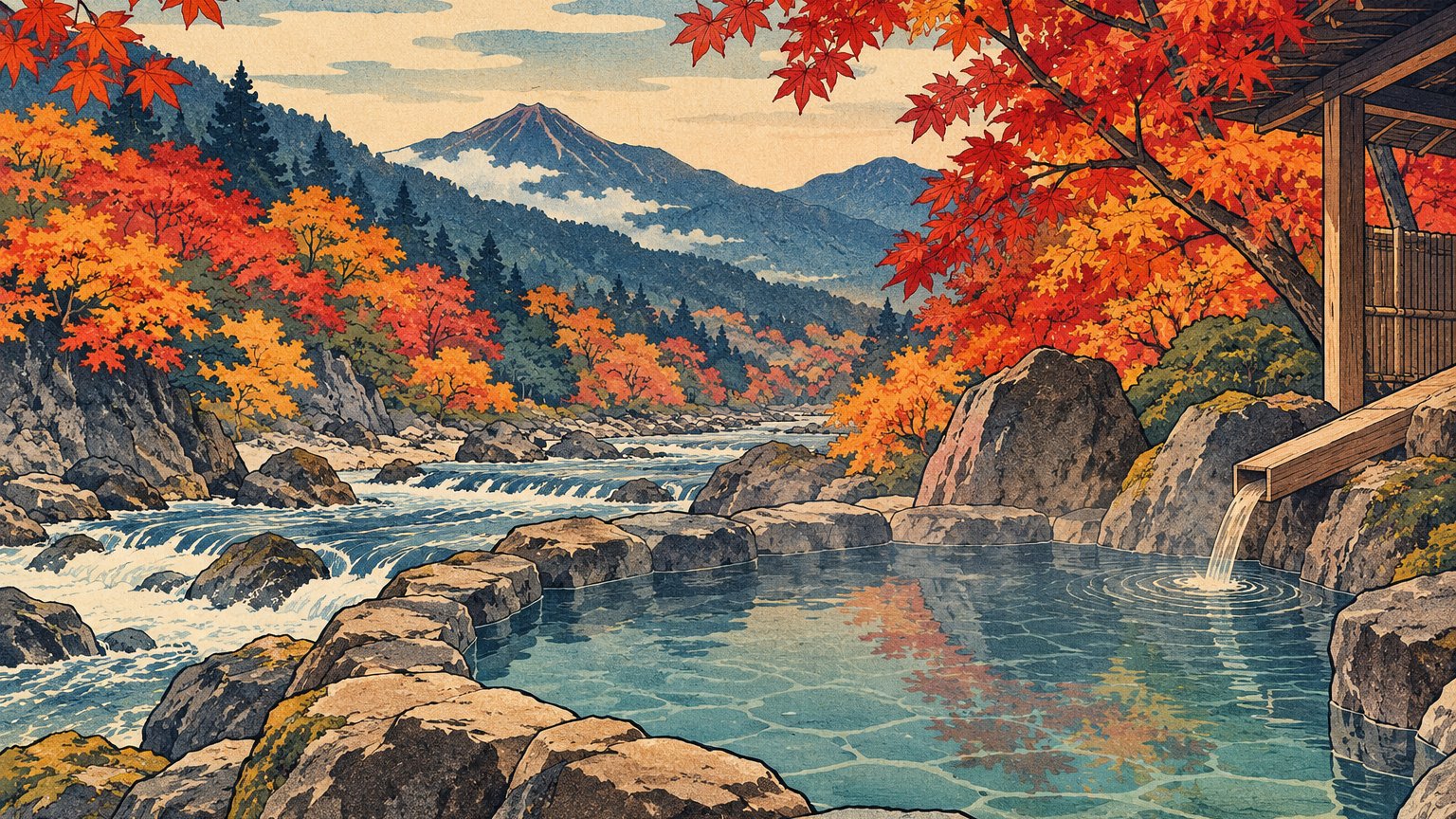
For Japanese learners, that matters because this isn't just a pretty scene. You get a compact set of everyday words, a very Japanese lodging format, and a clear cultural frame: ryokan, onsen, 浴衣 (yukata, light cotton robe), and the seasonal language that runs through so much of Japan’s design sense.
A VRChat ryokan that changes with the year
The world at the centre of this guide is a VRChat ryokan built around an onsen and a seasonal cycle, with the mood shifting between spring, summer, autumn, and winter. That four-part structure is the hook, and it gives the space more than decoration, it gives it rhythm.

According to the Nico Nico source, the creator presents the world as a setting that's meant to be experienced through changing scenery rather than a single static screenshot. That's a smart choice. A ryokan already depends on atmosphere, and the four seasons are one of the cleanest ways to make that atmosphere feel Japanese without overloading it with props.
The thing is, VRChat worlds can sometimes lean too hard on spectacle. Here, the appeal seems quieter. A ryokan works because it is orderly, warm, and slightly formal, and the seasonal changes let the space breathe without breaking that structure.
Why the ryokan setting works so well in VR
A ryokan isn't just a hotel in Japanese clothing. It usually means 畳 (tatami, tatami mat flooring) flooring, 布団 (futon, bedding; Japanese floor mattress) bedding, sliding doors, yukata, and meals or bath culture that feel tied to the building itself. In a virtual world, that becomes a useful design template because every object has a job.

For Japanese learners, the vocabulary is worth noticing. Ryokan means traditional inn, onsen means hot spring bath, tatami is the woven mat flooring, and yukata is the light cotton robe often worn inside the inn. Those are simple words on paper, but together they tell you a lot about how Japanese hospitality is staged.
My tip: pay attention to the nouns, not just the scenery. This is one of those cases where a handful of everyday words carries most of the cultural weight, which is very Japanese and, frankly, very efficient.
What to look for in the world
In a good ryokan world, the layout usually matters more than the furniture count. You want a clear entrance, a calm hallway, bath access that feels separated from the main room, and lighting that changes the tone without making everything look like a theme park.

In practice, that's what makes the seasonal shift interesting. Spring can soften the space, summer can brighten it, autumn can deepen the colour palette, and winter can make the whole inn feel more enclosed. Same structure. Different feeling. That's the point.
The onsen element, and what it adds to the experience
An onsen in VRChat doesn't just act as background scenery, it changes how you read the room. The bath area suggests rest, privacy, and ritual, which are all central to the Japanese hot-spring image. Even when the water itself is virtual, the social code around it still matters.
One detail from the additional source material is worth keeping in mind: in many communal baths in Japan, tattoos can still be restricted because of their historical association with organised crime. Private baths avoid that issue entirely, and many ryokan now offer them. That context helps explain why a virtual onsen can feel welcoming to a wider group of players, especially when the world is designed as a shared social space rather than a rules-heavy simulation.

And this is where it gets a little interesting. In a real ryokan, the bath is often as important as the room. In a VR world, the bath becomes a mood anchor, a place where the environment slows down and the seasonal changes have something to contrast against.
Four seasons as a design language, not just decoration
Japan’s four-season aesthetic shows up everywhere, from packaging to station ads to menu layouts. VRChat worlds use that same logic when they shift cherry blossoms, green foliage, autumn leaves, and snow across one familiar space. It isn't random variation. It's a visual grammar.
That grammar also helps language learners. Words like 春 (haru, spring), 夏 (natsu, summer), 秋 (aki, autumn; fall), and 冬 (fuyu, winter) are basic, but seeing them embodied in a space makes them easier to remember than a flashcard ever will. The same goes for sakura, momiji, and yuki, which carry seasonal meaning well beyond their dictionary definitions.
What I especially like is that the four-season idea fits the ryokan format without needing explanation. A ryokan already invites slower pacing, and the seasons give it a natural reason to be revisited. One room, four moods, no forced gimmick. That's rare enough to notice.
In pictures
Frequently Asked Questions
Is this a real ryokan in Japan?
No. It is a VRChat world inspired by ryokan design and onsen culture.
Why do the four seasons matter here?
They give the world a changing mood, which fits both Japanese aesthetics and the slower rhythm of a ryokan setting.
What Japanese words are useful to learn from this world?
Ryokan, onsen, tatami, yukata, and the season words haru, natsu, aki, and fuyu are a strong starting set.