
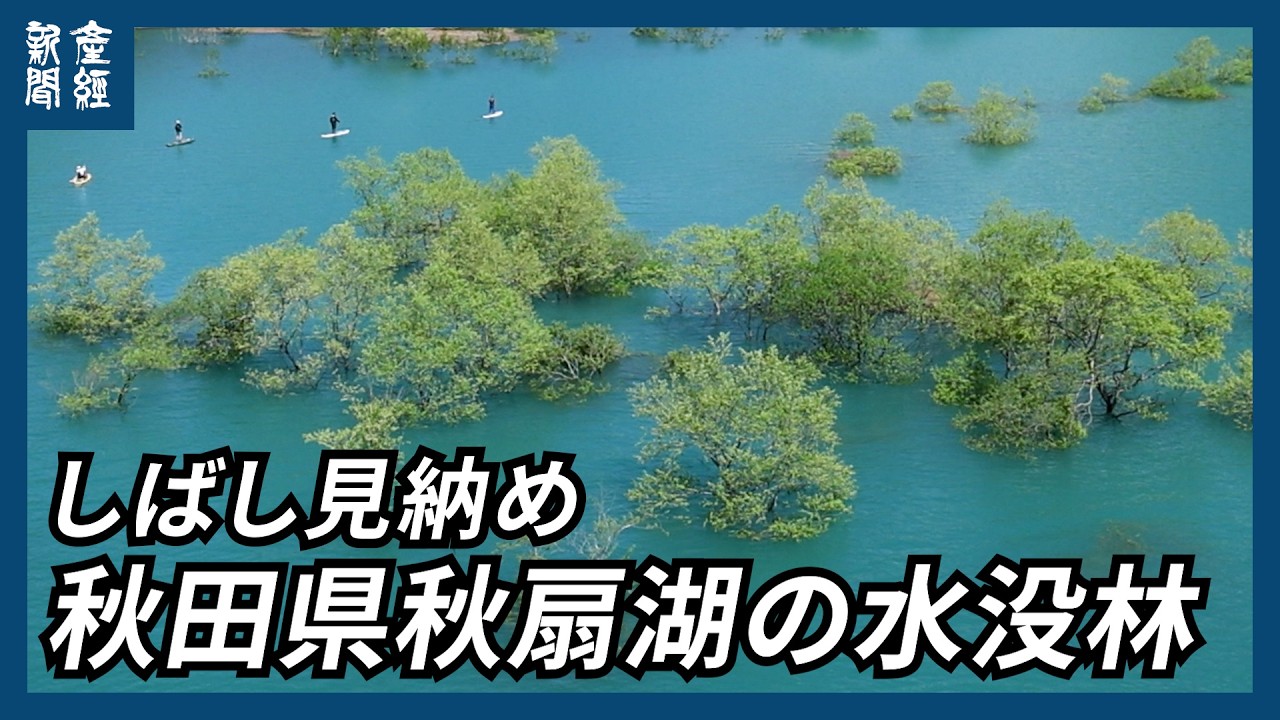
Guess what? That’s exactly why this spot’s become such a talking point among Japan fans, photographers, and anyone who loves nature that refuses to stay still.
Akita’s Hidden Lake Forest and the lake that keeps changing
Did you know that Akita has a place locals sometimes describe as a hidden forest lake, even though it doesn’t always look like a lake at all? That’s the charm here. The water level rises and falls, and the whole landscape flips between flooded forest, shallow lake, and woodland edge.
In Akita Prefecture, where snowy winters and heavy seasonal rain shape the land, this kind of changing water scene feels very Japanese to me. The name sounds quiet, almost secretive, and that’s part of the appeal. Sounds odd, but it’s true.
Compared with back home, this is the kind of place where nature doesn’t sit still for a postcard. It breathes, shifts, and sometimes erases its own outline. For Japanese learners, words like mizumi for lake, 森 (mori) for forest, and mizubari for flood conditions can help you notice how people describe these landscapes in everyday language.
Why the flooded forest appears, then fades
The reason’s simple: water is doing the storytelling. When the water level rises, trees stand in the middle of a flooded forest, their trunks reflected in still water. When it drops, more ground appears, and the “lake” can look much smaller, or even vanish as a clear body of water.
No wonder, because Akita gets strong seasonal changes. Snowmelt, rainfall, and local drainage all affect how much water stays behind. On a related note, this is why the same location can be photographed in totally different moods depending on the month.
Spring and early summer
Let me show you why spring is the season many nature fans hope for. Meltwater can fill the low areas, and the flooded forest effect becomes strongest. Trees rise out of the water like something from a dream, and reflections are often at their sharpest on calm mornings.
That’s also when the light feels soft, which helps photographers. My tip: go early, before the wind picks up, because the surface can turn from glassy to messy very fast. But that’s not all.
Autumn and winter
I still remember exactly how different a water landscape can feel once temperatures drop. In colder months, the scene becomes more restrained, more skeletal, with branches, reeds, and wet ground taking over from open water.
To be fair, this is where Japan’s seasonal culture comes in. Many travellers chase 桜 (sakura, cherry blossom) in spring or 紅葉 (koyo, autumn leaves) in autumn, but places like this remind you that even a forest lake can be part of the same seasonal rhythm. The same spot can be bright, flooded, and reflective one month, then quiet and nearly dry the next. Convinced yet?
Why Akita’s Hidden Lake Forest matters to Japan fans
What I especially like is that this isn’t a theme park version of nature. It’s raw, slightly unpredictable, and tied to the local climate in a way that feels very real. If you’re learning Japanese, that unpredictability’s a nice reminder that many place names and nature words are more flexible in use than they first appear.
For example, Japanese often uses descriptive phrases rather than fixed labels. A place might be called a pond, a marsh, a flooded plain, or a hidden lake depending on the season and who’s speaking. Pro tip: when you hear words like 湿原 (shitsugen, marshland / wetland) for marshland or 湖 (mizuumi) for lake, pay attention to context. The landscape may be changing right in front of you.
There’s also a travel angle here. Akita is already known for hot springs, snowy scenery, きりたんぽ (kiritanpo, Akita rice-stick dish), and the friendly but sturdy local pace of life. Add a vanishing lake forest to that mix, and you get a destination that feels far from the usual Tokyo route. Simply brilliant.
How to read the landscape like a local
Guess what? The best way to enjoy a place like this is not to expect one perfect view. You check the season, the weather, and the water level, then you accept whatever version of the forest shows up. That mindset is very Japanese, and it’s useful far beyond travel.
If you want to practise language while reading about nature in Japan, try pairing scene words with observation. You might say, ki ga mizu kara dete iru for trees rising from water, or mizugata ga kawatta for the water shape changed. Even simple descriptions like that help you think more naturally in Japanese.
Speaking of which, this changing forest is also a nice example of why local nature stories matter. They show how one place can hold several identities at once, and none of them are fake. The lake isn’t gone, exactly. It’s just waiting for the next season to bring it back. My verdict:
Akita’s Hidden Lake Forest is the kind of story I never get tired of. It’s quiet, seasonal, and a little mysterious, and that makes it perfect for anyone who loves Japan beyond the standard sightseeing list. And if the water rises again, the whole scene could be reborn in a completely new way. But that’s not all.
Frequently Asked Questions
Where is Akita’s Hidden Lake Forest?
It is in Akita Prefecture in northern Japan, a region known for strong seasonal changes and snowy winters.
Why does the forest flood?
The water level changes with snowmelt, rainfall, and local drainage, which can turn the area into a flooded forest.
Can visitors see the same view all year?
No. The scenery changes a lot by season, so the lake-like appearance may come and go.


