
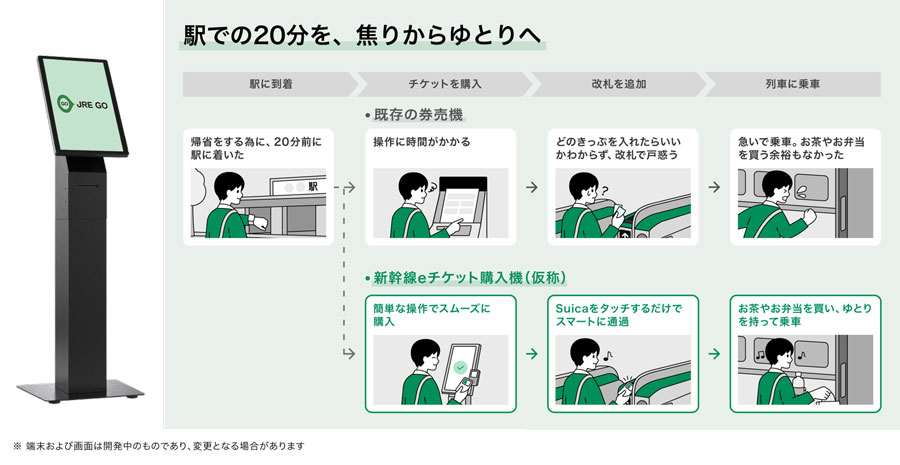
It’s not glamorous. It’s better than that. The texture of a trip is often decided by tiny frictions, the queue, the machine, the reservation flow, the moment you realise your IC card and your ticket aren’t speaking to each other. This is where JR East is working.
JR East and the Shinkansen e-ticket test in Omiya and Utsunomiya
JR East, the operator behind a huge stretch of rail in eastern Japan, has started testing a new 新幹線 (Shinkansen, bullet train) e-ticket system at two key stations: Omiya in Saitama and Utsunomiya in Tochigi. Those aren’t random dots on a map. Omiya is one of the main gateway stations for the Tohoku Shinkansen, and Utsunomiya is a major stop further north, which makes both places sensible test beds for real-world passenger behaviour.
Let me show you why this matters. Shinkansen travel in Japan has already become smoother over the years, but the booking-and-boarding chain still has enough moving parts to trip people up, especially first-time visitors or anyone buying tickets after a long day, with a bag on each shoulder and no desire to perform interface archaeology. JR East is trying to reduce that friction. That’s the whole game.
The test is centred on a system called the Shinkansen e-Ticket Purchase Machine, plus a new reservation technique. In plain terms, JR East wants to make it easier to buy and reserve Shinkansen seats in a digital-first flow, while still giving passengers a physical machine when they need one. For Japan travellers, that could mean fewer lines at busy counters, less confusion over seat reservations, and a cleaner handoff between booking and boarding.
Why Omiya and Utsunomiya make sense for JR East
Take Omiya, for instance. It’s one of those stations that feels bigger every time I pass through it, all platforms and movement and utilitarian bustle, with the Shinkansen level serving as a reminder that Tokyo isn’t the whole story. Omiya handles serious traffic, including commuters and long-distance travellers, so any new ticket workflow gets a proper workout there.
Utsunomiya brings a different but equally useful kind of pressure. It’s a regional hub, not just a stop on the way to somewhere else, and that matters because a system that works only for central Tokyo regulars isn’t really finished. To be fair, a lot of railway innovation in Japan is quietly designed around people who already know the drill. A test in Utsunomiya says JR East wants broader usability. Good sign.
The reason is simple: if you can make a reservation system behave at two stations with different passenger patterns, you’re closer to something that ordinary riders can trust. And trust, on a platform, is everything. You want to know that the machine will read your booking, print or confirm what needs confirming, and get you onto the train without drama. That’s the promise here.
What the Shinkansen e-Ticket Purchase Machine changes
Guess what? The machine itself is the part I find most interesting, because machines are where railway policy meets the body. You stand there, bags at your feet, scanning options, deciding whether you’re a 9:10 person or a 9:40 person, whether you want window seat A or B, whether you’ve got the patience left for another screen. The interface either respects that reality or it doesn’t.
JR East's Shinkansen e-Ticket Purchase Machine is meant to support a more flexible purchase experience for electronic tickets. That should matter to Japan learners too, because rail vocabulary is one of those practical language zones where a few words go a long way: 切符 (kippu) for ticket, 予約 (yoyaku) for reservation, 指定席 (shitei-seki) for reserved seat, and 自由席 (jiyu-seki, non-reserved seat) for non-reserved. If you can read those terms, suddenly the station feels less like a maze and more like a place with rules you can actually use.
Speaking of which, the move toward e-tickets fits the broader rhythm of Japanese travel. Japan loves precision, but it also loves the little analogue remnants that keep a system humane. A ticket machine at a station isn’t just hardware. It’s a public promise that the network is legible to people who aren’t railway insiders. If this test goes well, that promise gets a little stronger.



New reservation technique, old-school reliability
Here’s the catch: digital systems only help if they stay reliable under pressure. That’s probably why JR East is testing rather than rolling this out everywhere at once. A new reservation technique sounds abstract until you imagine the edge cases, the missed connection, the seat change, the family travelling together, the tourist who booked the wrong day because the calendar looked strangely polite. The real value is in making all of that less painful.
My tip: if you ride Shinkansen in Japan more than once, get comfortable with the reservation vocabulary before you arrive. Learn 駅 (eki, station), shinkansen, yoyaku, and shitei-seki. It sounds basic, and it is. But basic is what saves time when you’re standing in front of a machine in Omiya with five minutes to spare and a train waiting like it has somewhere better to be. Classic Japan, isn’t it?
What this means for Japan travellers and Japanese learners
Did you know that station technology can be a language lesson? Not a cute one, a real one. If JR East expands this system, travellers will increasingly interact with screens, confirmation flows, and machine prompts in Japanese and often in simplified multilingual formats. That gives learners a practical edge, because you’re not memorising words in the abstract, you’re matching them to a live journey, with a platform number, a departure time, and a concrete decision to make.
For visitors, the benefit is obvious. Less queueing. Less second-guessing. Fewer moments where you’re trying to ask a station clerk, in careful fragments, whether your booking is valid for the next train or the one after it. For learners, the deeper value is psychological. Once you can move through rail spaces without feeling lost, Japan opens up differently. You notice the texture of place rather than just the logistics.
Seriously though, this is how travel gets better, not through grand speeches, but through tiny operational improvements that remove a layer of stress. JR East knows its network is part infrastructure, part daily ritual. If the test in Omiya and Utsunomiya works, it could make Shinkansen booking feel less like a transaction and more like what it should be, a straightforward start to the ride.
And that’s the point. Not spectacle. Reliability. More soon,
C
Frequently Asked Questions
What is JR East testing?
JR East is testing a new Shinkansen e-ticket system with a purchase machine and a new reservation method.
Where is the test taking place?
The test is being carried out at Omiya and Utsunomiya stations.
Why does this matter for travellers?
It could make buying and reserving Shinkansen tickets simpler, faster, and less confusing.


