
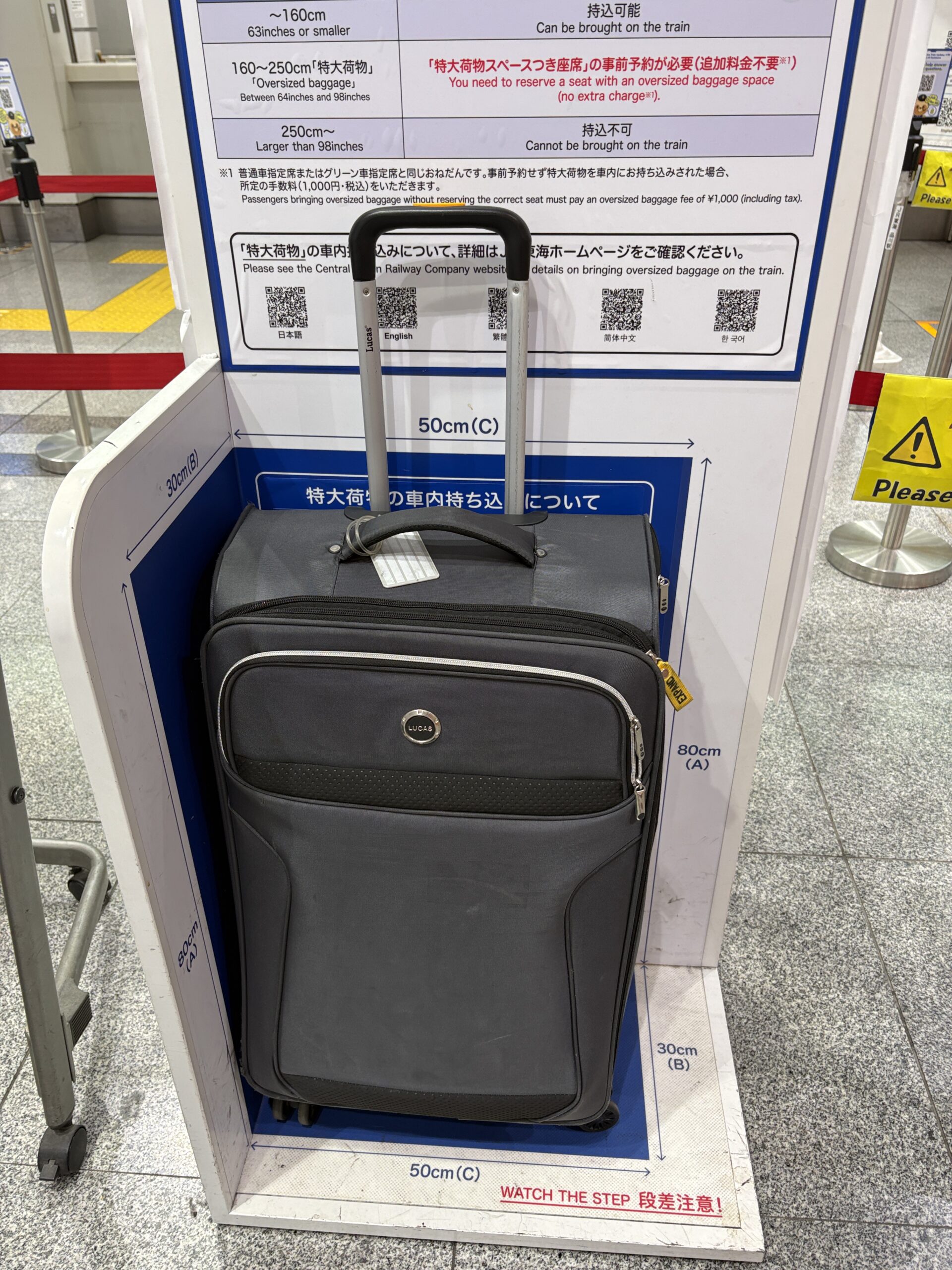
Let’s make it practical, because this isn’t just about a measurement; it’s about avoiding a 1,000 yen surprise and keeping your trip smooth from Tokyo to Kyoto or Osaka.
Did you know...? On Japan’s fastest trains, suitcase size can decide whether your journey feels easy or awkward. The Shinkansen luggage rules in 2026 are actually pretty straightforward once you know the numbers, but there’s one detail many first-time visitors miss: baggage over 160 cm in total size usually means you need a reserved seat with extra luggage space. Get that wrong, and you could end up paying a 1,000 yen fee. Wild, isn’t it?
That number, 160 cm, isn’t the length of one side. It’s the total, meaning height plus width plus depth. So a suitcase that looks normal enough can still fall into the oversized category if it’s a big hard-shell model. Let me show you why this matters, and why I think it’s one of the most useful Japan travel rules to understand before your first bullet train ride. Convinced yet?
Shinkansen luggage rules 2026: the 160 cm line that matters
What many overlook is that Japan’s major rail operators use total dimensions, not just height. For the Tokaido, Sanyo, and Kyushu Shinkansen services, luggage from 160 cm up to 250 cm in total size is treated as oversized baggage. That means it’s still allowed, but not with a casual hop-on-and-go approach.
If your suitcase is 160 cm or smaller, you’re in the easy zone. You can usually take it on board without the special reservation, as long as it fits safely in the luggage rack or at your feet. If it’s bigger than 160 cm, the system changes, and that’s where the reserved seat comes in. The rule is simple, but the stress point is real when you’re standing in a station like Tokyo or Shin-Osaka with a 28-inch suitcase and a coffee in hand.
Here’s the thing: Japan is serious about keeping trains tidy, quiet, and efficient. That’s part of the culture, and it shows on the Shinkansen. The aisles aren’t made for rolling giant bags around, and nobody wants a suitcase blocking exits. My tip: check your bag at home with a tape measure, and don’t guess. From my experience, “it looks fine” is how people get surprised at the platform. My verdict:
Quick size guide
Up to 160 cm total size usually means no special reservation. From 161 cm to 250 cm, you need the oversized baggage seat reservation. Over 250 cm, it isn’t accepted as onboard luggage. That final limit is the hard stop, so if you’re travelling with sports gear, extra-large cases, or gear bags, plan ahead. Pretty straightforward once you know it.
Why you need a reserved seat if your bag is over 160 cm
Let’s be honest: this is the part that changes the whole trip. Unlike what we're used to on some European or North American trains, you can’t just board with a huge suitcase and hope for the best. On the Tokaido Shinkansen, oversized baggage needs a reserved seat in a specific area, usually the last row seat or another designated seat with nearby storage space.
That reservation is there for a reason. It keeps the luggage out of the aisle and gives you a proper place to stash it behind your seat. It also reduces the chance of staff having to intervene at the platform, which saves time for everyone. If you’re travelling during Golden Week, お盆 (Obon, Bon festival / ancestral holiday), or New Year, this matters even more, because seats disappear quickly and people are already dealing with packed stations and tight schedules. That’s why planning your bag is just as important as booking your ticket.
How do you make the reservation? Usually when you buy your Shinkansen ticket, either online, at a ticket counter, or at a reservation machine. On JR Central and JR West routes, the oversized baggage option is built into the booking flow. You select the seat category that allows large luggage, and that’s it. The first time I went to Japan, I didn’t realise how much smoother this process is when you book ahead. No drama at the gate, no awkward lifting, no staff trying to solve a suitcase puzzle. Convinced yet?



What many travellers forget
Your suitcase may fit the size rule, but if the train is fully booked, your seat choice can still matter. On busy routes, those luggage-friendly seats aren’t unlimited. So if you’re carrying a big suitcase from Narita, Kansai, or a ski resort run, reserve early. Insider tip: the last row is often the best choice if you want a bit more breathing room, especially for a long ride to Kyoto, Hiroshima, or Kagoshima. That’s the kind of detail that makes rail travel feel effortless.
Shinkansen oversized baggage fee: the 1,000 yen rule
Here’s the catch: if you bring oversized luggage onto certain Shinkansen services without the required reservation, you can be charged 1,000 yen. This fee isn’t some vague possibility; it’s a real penalty tied to the baggage rule. In practice, staff may direct you to a seat that can handle the bag, but the extra charge can still apply if you skipped the proper booking step.
The 1,000 yen fee is meant to push passengers towards the system that keeps the train flowing cleanly. And honestly, it’s not a huge sum compared with a Japan trip, but it’s annoying, avoidable, and totally unnecessary. On the flip side, if you’ve already paid for a JR Pass or a regular ticket, you still need to follow the baggage reservation rule where it applies. The pass doesn’t cancel the baggage policy. That’s a common misconception.
My opinion? It’s one of the more traveller-friendly systems once you understand it. You’re not banned from bringing a big suitcase; you’re just asked to use the right seat and respect the train layout. Compared with some other countries, that feels fair. And because Shinkansen services are so punctual, a tiny bit of preparation goes a long way. From my experience...
How to travel smarter with large luggage on the Shinkansen
The simplest answer is to avoid oversized luggage if you can. A medium suitcase, a backpack, and a small carry-on often work much better in Japan than one huge bag. If you’re staying in multiple cities, Japan’s delivery services can be a lifesaver. Yamato Transport’s 宅配便 (takuhaibin, parcel delivery service) is famous for moving luggage between hotels, airports, and even convenience stores, and it can save you from hauling a giant case through crowded stations.
That reminds me: many ryokan and hotels will also help with luggage forwarding or at least point you in the right direction. If you’re learning Japanese, this is a good moment to remember a few useful words: 切符 (kippu) for ticket, 呼び込み (yobikomi, announcement call) for announcement, and 受付 (uketsuke, reception / front desk) for reception. You don’t need perfect Japanese to use the train, but these little terms make station life much less intimidating. That’s part of the fun of travelling Japan, really, picking up practical language in real situations.
What I especially like is that the system encourages lighter travel. A smaller suitcase is easier on escalators, more manageable on local trains, and less stressful if you’re changing hotels every two nights. If you’re going from Tokyo to Osaka on the Nozomi, or heading out to Kanazawa or Fukuoka, that comfort adds up quickly. Pretty handy.
My tip: measure your bag at home, reserve the right seat if it’s over 160 cm, and don’t leave it to the station counter on departure day. That one habit can save time, money, and a lot of standing around. And if you’re planning more Japan reading after this, more Japan news on jpnerd.com is a good next stop.
Frequently Asked Questions
What happens if my suitcase is over 160 cm?
You usually need to book a reserved seat that allows oversized luggage. If you don’t, a 1,000 yen fee may apply on the relevant Shinkansen services.
Can I bring a large suitcase without reserving a special seat?
Only if it is 160 cm or smaller in total size. Bigger bags need the proper reservation.
Is the 1,000 yen charge always applied?
It depends on the situation and the train service, but you should treat it as a real fee and plan to avoid it.


