Overview
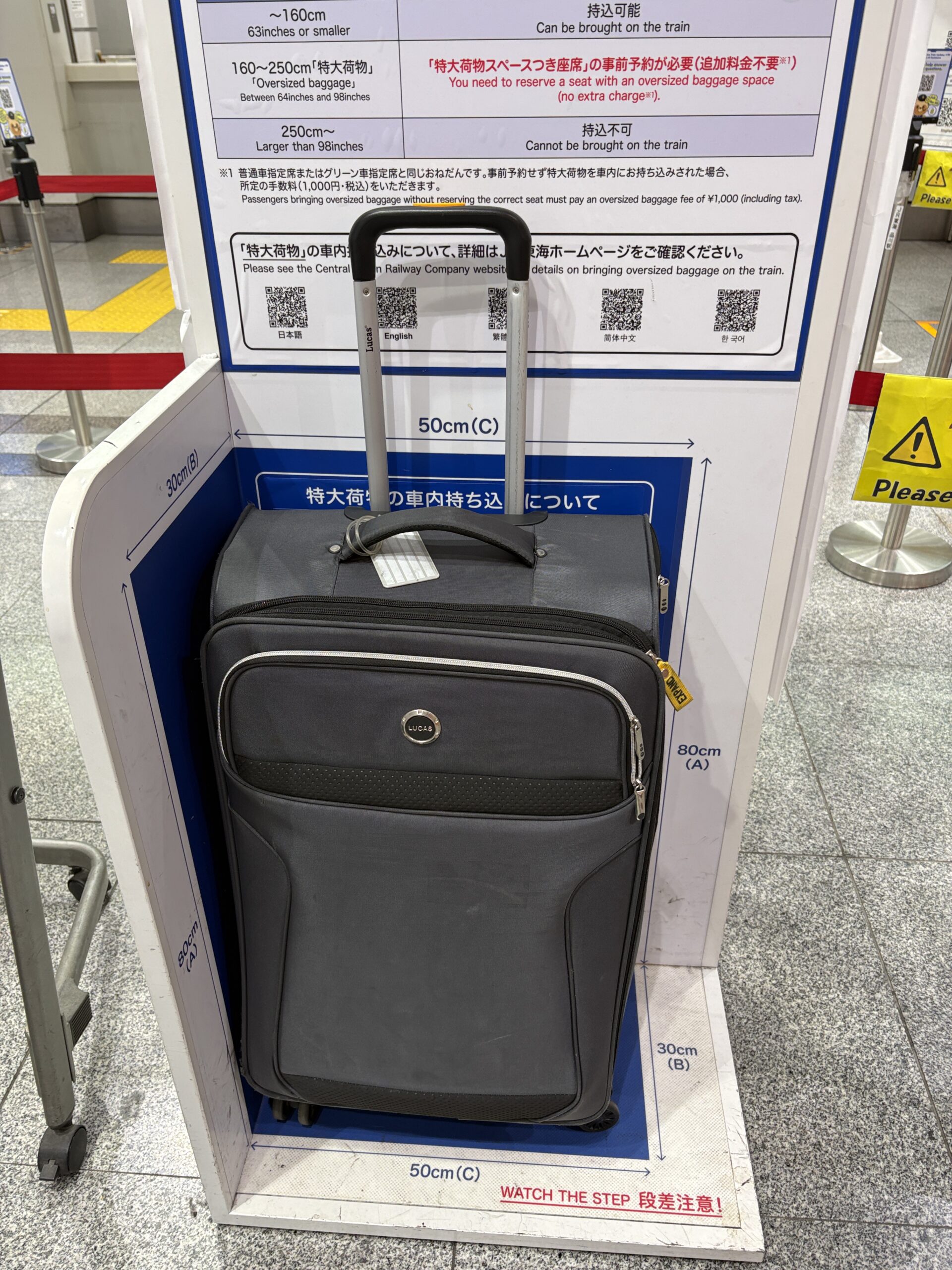
If you are taking the 新幹線 (shinkansen, bullet train; Japan's high-speed rail network) in Japan, the first thing to check is not the weight of your suitcase, but its total external size: length plus width plus height. Up to 160 cm is generally fine without special handling. From 160 cm to 250 cm, the bag is treated as oversized baggage and may require an advance reservation for a seat with an oversized-baggage area or a reserved space near your seat. Anything over 250 cm is generally not accepted. That is the core of the matter. Everything else is detail, and detail is what keeps a station platform calm when the train is full.
For first-time riders, the rule can feel more severe than it is. In practice, it is a system built to keep boarding orderly, keep aisles clear, and avoid overloading luggage racks. On crowded routes, especially the Tokaido, Sanyo, and Kyushu Shinkansen, the policy is applied strictly because free storage space is limited. If you are traveling long-distance, say Tokyo to Kagoshima, the safest move is to plan ahead rather than gamble with a large bag and a tight connection. I recommend treating the reservation as part of the journey, not an annoyance. It is one of those small Japanese logistics problems that rewards attention and punishes improvisation. Fair enough.
How the size rule actually works
The crucial measurement is the combined external dimensions of your luggage. Measure the outer shell, not the neatly folded contents inside. A bag under 160 cm total is generally accepted without special arrangements. Once you move into the 160 cm to 250 cm range, your luggage becomes oversized baggage under Shinkansen rules. That does not mean you cannot travel. It means you need to use the system properly.
A typical 28-inch suitcase may be close to this boundary, and in some models it can cross it. That is why this is not a matter for guesswork. Check the manufacturer’s dimensions, or measure the bag yourself. If you are packing for a longer stay, mind the lumpy reality of souvenirs, winter clothing, and the small extra objects that somehow appear at the bottom of every suitcase. The train does not care about intentions.
The logic behind the 160 cm limit is practical: it keeps the cabin less cluttered, preserves the flow of people moving through the carriage, and reduces the chance that luggage racks become overloaded. It is a system designed around the texture of place inside the train itself. Narrow aisles. Fast boarding. Limited space. Everything has to fit.
What to do with oversized baggage
If your luggage measures between 160 cm and 250 cm, the standard solution is to reserve a seat with an oversized-baggage area. The reservation itself is free; there is no added charge to the seat fare. The important distinction is that the reservation is mandatory on many trains, while the penalty is only for boarding with oversized baggage without making the required booking. In that case, the fee is ¥1,000, tax included. That is not a service charge. It is a penalty.
Reservations can be made at station ticket counters such as Midori no Madoguchi, at station reserved-seat ticket machines, or online through services such as Smart EX, e5489, or JR Kyushu's reservation system. Convenience stores are not a supported channel for this type of reservation. If you prefer to keep things simple, book before you arrive at the station and print or save the confirmation. That is the 予約 (yoyaku, reservation; advance booking), a reservation, in its most useful form: one less thing to think about when the platform is already moving.
For travelers carrying large luggage on long routes, advance planning matters more than elegance. If you are crossing several prefectures, reserve early and keep the bag size within the published limits. You will thank yourself later, usually while walking through a station with your hands free.
Where the rules are enforced most strictly
JR applies the oversized-baggage rules especially strictly on the Tokaido, Sanyo, and Kyushu Shinkansen lines. That is where the pressure is highest, and where space is most precious. These routes carry large volumes of passengers, and the trains have limited free storage. On such services, the difference between a smooth boarding experience and a stressful one is often a single reservation.
If you are connecting between major cities, assume the system will be enforced exactly as written. Do not rely on the hope that a bag will simply fit somewhere. That kind of optimism is how platforms become a mess. If your route is long and your suitcase is large, make the booking early and travel like someone who has already seen the timetable twice.
There is also a practical planning angle for Japan travel more generally. On the day of departure, arriving with a bag that is clearly within the 160 cm limit is the least complicated option. If your luggage is borderline, consider shipping it ahead or repacking into something smaller. Not glamorous. Very effective.
Good travel habits that make the trip easier
A few habits save a great deal of friction. Measure the bag before you leave home. Keep the reservation confirmation handy if you need oversized-baggage seating. Minimize loose items that can turn a medium suitcase into a stubborn one. And if you are traveling with several people, check everyone’s bags, because one oversized case can change the rhythm of the whole group.
- Measure length, width, and height together before departure.
- Assume a 28-inch suitcase may be borderline until proven otherwise.
- Reserve oversized-baggage space in advance when needed.
- Use official JR booking channels, not convenience stores, for these reservations.
- On long routes, plan as if space will be tight, because often it is.
If you want a broader breakdown of the policy, including practical booking details, see Shinkansen mit großem Gepäck: Die Regel, die Touristen überrascht. For the most current size thresholds, reservation flow, and fee structure, Shinkansen-Gepäckregeln 2026: Größen, Reservierung, Gebühr is the cleaner reference point.
Why this matters for Japan travel
Shinkansen luggage rules are not a side note. They shape how you move through Japan, especially if you are crossing distance with more than a day bag. They affect how early you leave for the station, which service you choose, and whether your luggage is a quiet companion or a stubborn object taking up too much mental space. The best version of the Shinkansen experience is orderly, fast, and almost boring in the right way. The baggage rules help keep it that way.
If you are still learning the basics, this is also useful Japanisch lernen material in the practical sense: shinkansen luggage rules kanji may be intimidating on signs, but the underlying idea is straightforward once you know the size brackets and reservation requirement. Read the official terms once, then trust the numbers. That is usually enough.
Frequently Asked Questions
What is the key measurement for Shinkansen luggage rules?
The key measure is the combined external dimensions of the bag: length plus width plus height. Up to 160 cm is generally allowed without special handling.
Do oversized Shinkansen bags need a reservation?
Yes. Bags from 160 cm to 250 cm usually require an advance reservation for a seat with an oversized-baggage area or a reserved luggage space.
Is there an extra fee for reserving oversized baggage space?
No extra charge is added to the seat fare for the reservation itself. The ¥1,000 fee is a penalty only if you board with oversized baggage without the required reservation.
Where can I make an oversized baggage reservation?
You can book at station ticket counters, station reserved-seat ticket machines, or online through supported JR services such as Smart EX, e5489, or JR Kyushu's reservation system.
Are the rules stricter on some Shinkansen lines?
Yes. JR applies them especially strictly on the Tokaido, Sanyo, and Kyushu Shinkansen lines because storage space is limited.