Okay, here’s the thing: this isn’t about saying one console is better overall. It’s about hardware behaviour, Nvidia vs AMD, and why DLSS changes the conversation completely.
![Dragon Ball Z: Kakarot [Master Edition]](https://s.pacn.ws/1/p/1eh/dragon-ball-z-kakarot-master-edition-908785.1.jpg?v=t8ja8t&width=400)
![Startup Company [Console Edition] (Limited Edition)](https://s.pacn.ws/1/p/157/startup-company-console-edition-limited-edition-741799.16.jpg?v=ry4mm8&width=400)
![Startup Company [Console Edition]](https://s.pacn.ws/1/p/157/startup-company-console-edition-741779.10.jpg?v=ry4ngq&width=400)
Nintendo Switch 2 vs PlayStation 5: the real hardware split
Guess what? The big difference between Nintendo Switch 2 and PlayStation 5 isn’t just raw power. It’s the architecture underneath, and that changes what each machine can actually do.
Switch 2 uses a custom Nvidia Tegra T239 system-on-chip, while PS5 is built around AMD hardware. That sounds like an internal spec sheet detail, but it has real consequences. The Switch 2 gets access to Nvidia’s DLSS upscaling pipeline, which is a very different beast from the PS5’s PSSR and AMD-based FSR-style approaches.
Before I forget: this matters because Nintendo is asking a lot from a handheld-friendly device. It has to look sharp on a TV, stay efficient in portable mode, and not melt your hands. That’s a tough balancing act. The fact that it can lean on DLSS makes the whole thing feel almost like a game-changer.
Why DLSS is the hardware factor PS5 can't copy
The best part is that DLSS isn’t just a fancy marketing label. It’s Nvidia’s machine-learning upscaling tech, and on the Switch 2 it helps render games at lower internal resolutions before reconstructing a cleaner image. That means the console can save performance budget where it really counts, then spend it on effects, animation, or just keeping things stable.
PS5 can upscale too, of course. But it doesn’t have access to Nvidia’s DLSS stack because it runs on AMD silicon. Sony has its own path with PSSR on PlayStation 5 Pro, and AMD has FSR on the broader GPU side, yet those aren’t the same thing as Nvidia’s dedicated hardware and software ecosystem. That’s the key point people keep glossing over.
What that means in practice
Imagine a narrow alley in Tokyo. One shop is tiny, but it uses mirrors and smart lighting so the room feels bigger. That’s basically what DLSS does for the Switch 2. It lets a smaller machine present a much cleaner image than you’d expect from its raw internals.
On a TV in docked mode, that can make a huge difference. In handheld mode, it may be the reason a game doesn’t feel blurry or compromised. That’s especially important for a console that Nintendo wants people to carry around like a daily companion, the way some people in Japan carry a slim planner, a 弁当 (bento, lunchbox) box, and a charger in the same bag. Wait, there’s more.
Capcom's next big games show why this matters
Capcom is a great case study here. Two of its upcoming titles, Resident Evil: Requiem and Pragmata, are exactly the kind of modern releases that make hardware differences obvious.
These aren’t simple 2D indies. They’re visually dense, effects-heavy, and built with performance targets that can get messy fast on weaker or less flexible hardware. The Switch 2’s DLSS support helps explain how a machine that is clearly below PS5-class raw power can still stay in the conversation for demanding third-party games.
And here’s the interesting part. Capcom has spent years optimising for very different platforms, from Switch-era constraints to high-end console releases. So when you see these titles mentioned in the same breath as Switch 2, you’re seeing a real shift in how far Nintendo hardware can stretch. Not magic. Engineering.
What the Switch 2 can do that PS5 can't
Quick detour: I’m not talking about exclusives like Mario or Zelda here. PS5 can’t do those because they’re software decisions. I’m talking about hardware-driven behaviour.
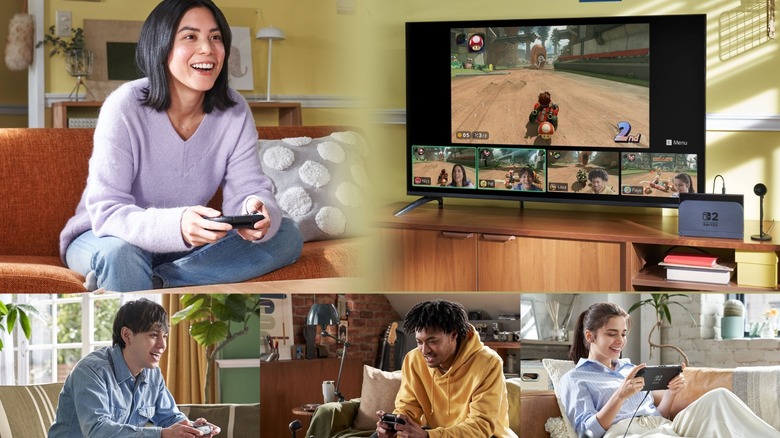
1. Native access to Nvidia DLSS
Switch 2 can use Nvidia’s dedicated AI upscaling tech at the platform level. PS5 can’t, because it isn’t built on Nvidia silicon. That single fact changes how developers can target performance and image quality.
2. Better image reconstruction for a small chip
Switch 2 can start from a lower internal render and still look much cleaner than you might expect. That’s extremely useful for a handheld-first device. PS5 doesn’t need that same trick nearly as often, because it has far more raw headroom.
3. A handheld-to-TV design that benefits from AI scaling
On Switch 2, DLSS isn’t just a nice extra. It’s part of the whole product logic. You can move between portable and docked play, and the machine has to adapt quickly. Sony’s console design doesn’t have that exact pressure point.
4. A more efficient path for ambitious third-party ports
When a game like Pragmata needs to fit a smaller thermal and power envelope, DLSS becomes a practical advantage, not just a spec-sheet flex. That is where the Switch 2 starts looking unusually smart. Pro tip: efficiency is often the real luxury.
My tip: when you compare consoles, don’t just stare at teraflops. Look at the platform’s escape hatches. DLSS is one of those for Switch 2, and PS5 simply doesn’t have an identical one. Personally, I find that more interesting than a lot of launch-window hype.

Why this comparison feels very Japan-coded
Unlike what we’re used to from giant living-room consoles, Nintendo has always treated hardware like a puzzle. The company loves constraints. It designs around them, then turns them into identity.
That feels very familiar if you’ve spent time around Japanese product culture. There’s a strong respect for compactness, restraint, and doing more with less. You see it in tiny ryokan rooms, perfectly packed convenience-store meals, and yes, in a handheld console that wants to punch above its weight. ありがとう (Arigato, thank you), engineering team.
And that’s why the Switch 2 vs PlayStation 5 debate is worth having. One machine is built to win on sheer horsepower. The other is trying to be clever, efficient, and flexible in ways the PS5 doesn’t need to be. Both approaches are valid. But they aren’t the same.
Before I forget: if you’re a Japanese learner, this is a neat vocab moment too. Words like tecchnology-adjacent スタイル (sutairu, style) aside, you’ll hear Japanese tech fans talk about 発動 (hatsudou, activation; triggering), 理想 (risou, ideal), and より良い (yori yoi, better; more desirable) design choices when they describe good hardware trade-offs. Same energy here. Different language.
So yes, the PS5 is still the brute-force monster. But the Switch 2 has a few very specific tricks up its sleeve, and DLSS is the headline one. That’s why this console comparison feels so fresh. It isn’t just about power. It’s about what kind of power actually matters.
Want more Japan tech and culture coverage? more Japan news on jpnerd.com
Frequently Asked Questions
Does the Nintendo Switch 2 have more raw power than the PlayStation 5?
No. The PS5 is much stronger in raw performance, but the Switch 2 has smart upscaling advantages.
Why is DLSS such a big deal on Switch 2?
Because it lets the console render at lower resolutions and still output a cleaner-looking image.
Can the PS5 use DLSS?
No. DLSS is tied to Nvidia hardware, and the PS5 uses AMD-based architecture instead.