
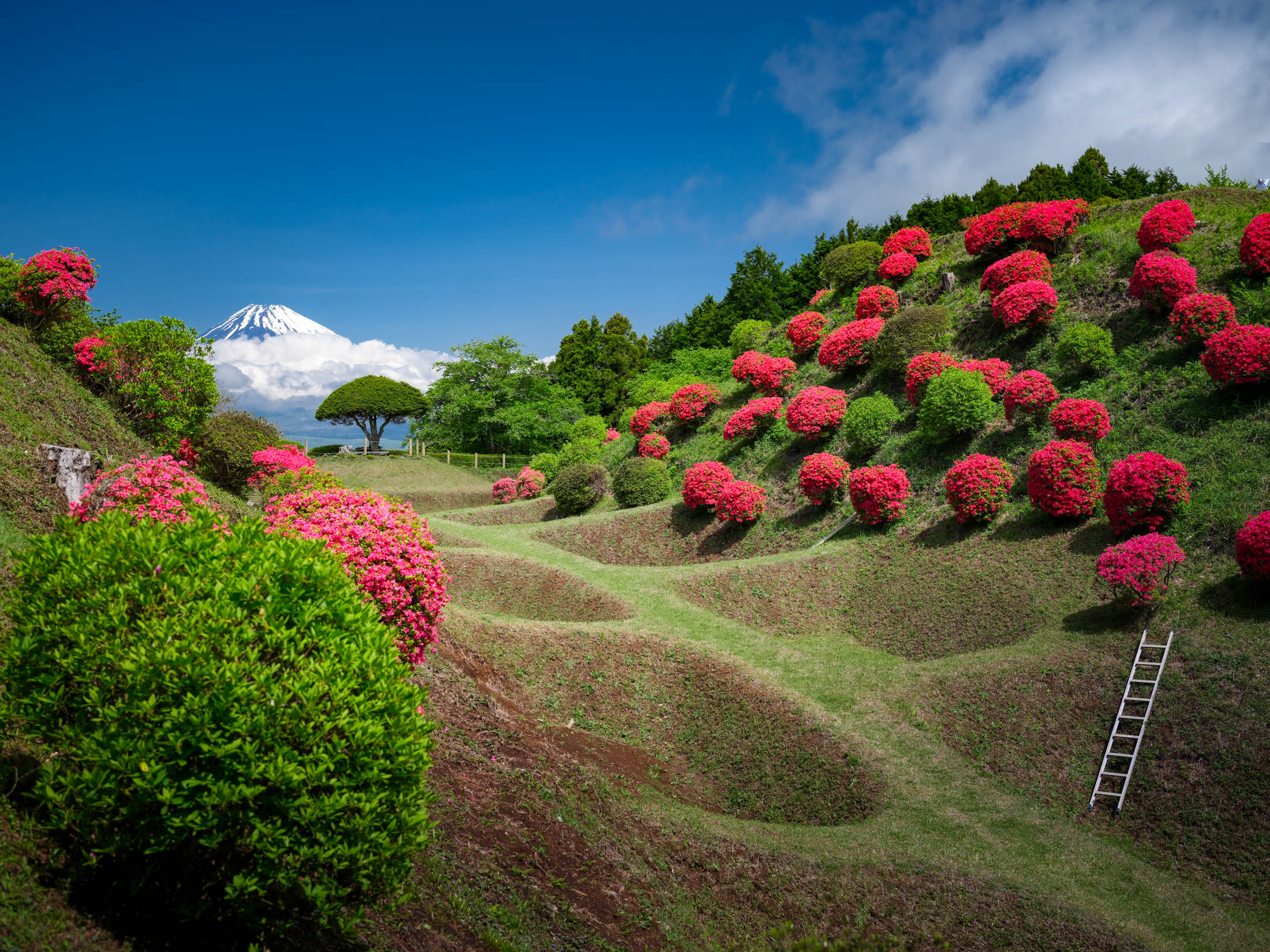
It’s not a polished castle town. That’s the charm. You get hillside history, pink blooms, and a landscape that feels quietly dramatic, not staged.
Yamanaka Castle Ruins: a hilltop stop with real atmosphere
Unlike what we’re used to in big-city sightseeing, the Yamanaka Castle Ruins don’t try to impress with keep towers or flashy reconstructions. The site sits in Mishima, Shizuoka Prefecture, on a ridge above the surrounding plains, and the remaining earthworks and moats still give you a strong sense of where the old fortifications stood. The castle itself was built in the 戦国 (Sengoku, Warring States period) period, around the late 16th century, and it was destroyed in 1590 after the Siege of Odawara, which makes the place feel even more dramatic when you walk it today.
What I especially like is that the ruins aren’t frozen behind ropes and signs. You can actually move through the slopes, paths, and wide open spaces, and that gives the whole visit a little more weight. My tip: take your time on the approach, because the site works best when you let the setting build up around you. Sounds good, right?
Azaleas at Yamanaka Castle Ruins: spring turns everything pink
Picture this: thousands of azaleas blooming across the hillside, with the old stone-less castle traces underneath and a clean mountain backdrop above. That’s the Yamanaka Castle Ruins in late April and early May, when the azalea season usually peaks. Local guides and tourism pages often talk about around 8,000 to 10,000 azalea bushes in the area, and even if you don’t count them, you can feel how dense the colour gets from certain angles.
And it gets better: the flowers aren’t arranged like a city park display. They spill across the slopes in a way that feels a bit wild, a bit local, and a lot more memorable. A great example: on a bright day, the pink and red blossoms can frame distant Mount Fuji so well that it looks like a postcard somebody forgot to Photoshop. Not bad, right?
Why the azalea season works so well here
No joke: the terrain is the secret. The castle ruins sit on elevated ground, so the azaleas don’t just sit at eye level, they spread across layers of paths and embankments. That gives you depth in every direction, and it makes even a simple photo look richer than you’d expect.
For Japanese learners, this is also a nice place to connect vocabulary with real scenery. Words like つつじ (tsutsuji) for azalea, 城跡 (shiroato) for castle ruins, and 景色 (keshiki, scenery; view) for view are easy to remember when you’re standing in front of the thing itself. That kind of memory sticks. Wait, there’s more.
Mount Fuji views from Yamanaka Castle Ruins: why people keep coming back
Trust me on this one: the Fuji view is a huge part of the appeal. On clear days, Mount Fuji rises beyond the flower-covered slopes, and the contrast between the old fort site and Japan’s most famous mountain is hard to beat. The best angles usually come from the higher parts of the walking route, where the line of sight opens up and the azaleas become a natural frame.
By the way, this is one of those spots where the weather decides your whole experience. If Fuji is shy, you still get the flowers and ruins. If Fuji shows up, though, the whole place jumps to another level. Classic Japan, isn’t it?
How to plan your visit
The azalea season is the main draw, so late April to early May is the sweet spot. Try to go in the morning if you can, because the light is softer and the paths are usually calmer. The site is in the Mishima area, so it also works well as a side trip from the wider Fuji and Hakone region.
On a related note, this is not a place that needs a long checklist. A few hours are enough unless you want to linger for photos, picnic-style breaks, or a slow wander through the slopes. If you’re building a Japan itinerary that mixes scenery and history, this one fits neatly between better-known stops. My verdict: absolutely worth the detour.
Why offbeat Japan lovers should put this on their list
For example, if you’re into the kind of travel where the best memories come from places that aren’t crowded with tour buses, Yamanaka Castle Ruins deliver exactly that. You get a Sengoku-period castle site, seasonal flowers, and a Fuji view, all in one compact outing. That combination feels very Japan, but not in the obvious, heavily marketed way.
Imagine a narrow alley in Tokyo. Now replace the city noise with birds, sloping grass, and a castle hillside covered in azaleas. That contrast is part of the fun, because it reminds you that Japan’s appeal doesn’t stop at temples, trains, and famous city landmarks. Offbeat spots like this often tell the better story. Sounds good, right?
If you’re learning Japanese, this is also a good example of how place-based travel can build vocabulary naturally. You might hear tsutsuji 祭り (matsuri) for azalea festival, or words like 風 (kaze) for wind and 山 (yama) for mountain while visiting the area. Small words, real scenes, better recall. more Japan news on jpnerd.com
Frequently Asked Questions
When is the best time to see the azaleas?
Late April to early May is usually the best window.
Can you see Mount Fuji from the ruins?
Yes, on clear days the view of Mount Fuji is one of the main reasons people visit.
Is this a good stop for first-time Japan travellers?
Yes, especially if you like scenery, history, and places that feel a little off the usual tourist track.


