What Actually Happened in Asakusa on 3 May
Picture this: you’ve just arrived in Asakusa, one of the most iconic spots in all of Tokyo. You’re walking past the lanterns, smelling yakitori smoke, maybe debating which izakaya to duck into for the evening. And then, out of nowhere, a dense cloud of bees descends on the street.



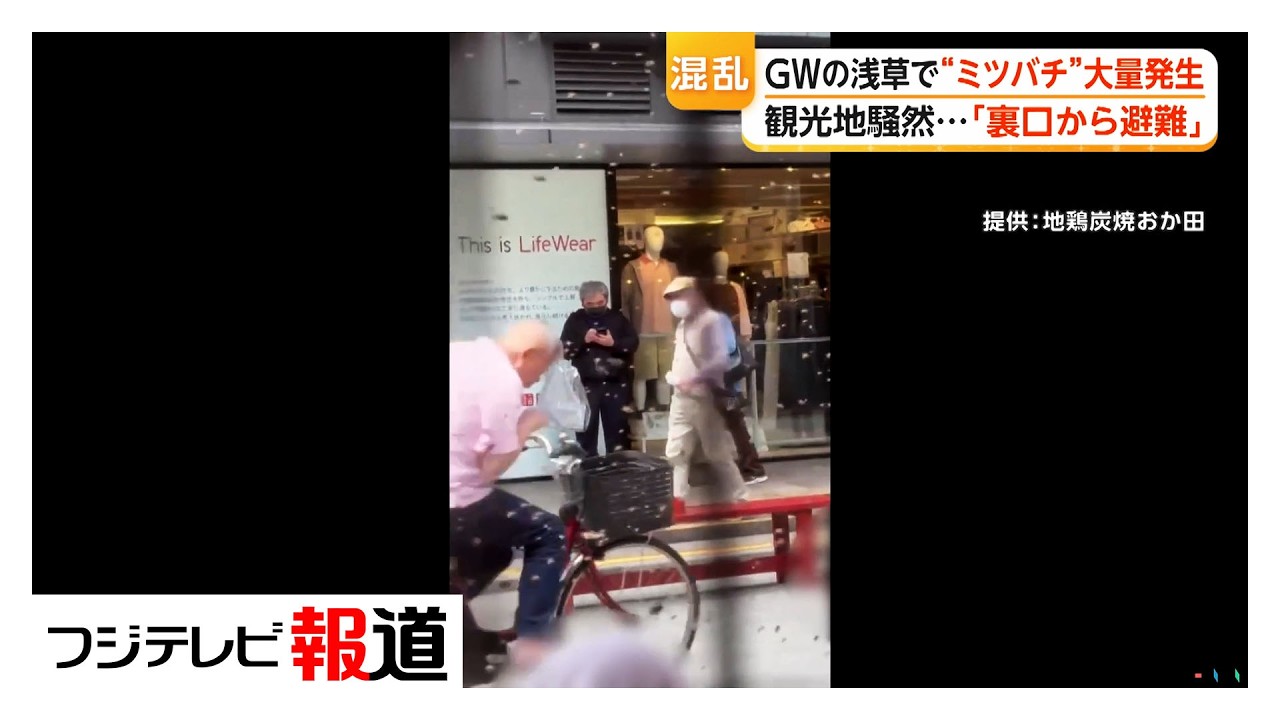
That’s exactly what happened on 3 May, Japan’s Constitution Day and the middle of Golden Week, when foot traffic in the area is about as heavy as it ever gets. A large swarm took up position near a popular izakaya on one of Asakusa’s busier side streets, close enough to the main tourist drag to cause immediate panic among the crowds.

Restaurant owners came out of their shops. Customers pushed back from outdoor tables. Sightseers pulled out their phones, because of course they did. Local reports noted that the swarm was substantial enough to be genuinely intimidating, not just a few dozen bees drifting past, but a proper, pulsing cluster of thousands.
No word on serious injuries, fortunately. But the disruption was real, and the timing could hardly have been worse. Golden Week in Asakusa means wall-to-wall visitors, both Japanese and international. Senso-ji alone draws enormous crowds on public holidays, and the surrounding streets are packed with people moving between the nakamise shopping arcade, the Kaminari-mon gate area and the various eating and drinking spots scattered through the neighbourhood.
Why This Keeps Happening in Japanese Cities
Hand on heart, this kind of urban bee swarm event is more common in Japan than most people realise. Honeybee swarming, or hachi no mure as you’d say in romaji, happens when a queen bee leads part of a colony to find a new nesting site. In the wild, that means forests. In a dense city like Tokyo, it means lamp posts, building ledges, bicycle racks and, apparently, the area outside your favourite izakaya.
Spring is peak swarming season, which makes early May a predictable window for exactly this kind of incident. Japanese beekeepers and pest control services are generally well-prepared, and in most cases, the swarms are docile while they cluster. Bees in a swarm have no hive to defend, so they’re less aggressive than you might expect. That said, a few thousand bees hovering at head height outside a restaurant isn’t what most people sign up for when they book a Golden Week city break.

The Izakaya Context Matters
The fact that this happened near an izakaya adds a very specific layer of Tokyo local colour. An izakaya is an informal Japanese gastropub, the kind of place where you order small plates of karaage or edamame alongside cold nama biru (draft beer), and you stay for hours. They’re everywhere in Asakusa, and the ones near the tourist core do serious business during holiday periods.
For the owner of an izakaya on a busy Golden Week evening, a bee swarm outside the front entrance is a genuine commercial disaster. You can’t seat outdoor tables. You can’t encourage people to linger near the entrance. Passing foot traffic, which is the lifeblood of any street-facing restaurant, suddenly turns the other direction. From my experience watching small restaurant owners navigate unexpected chaos in Tokyo, the combination of public embarrassment and lost evening revenue hits hard.
What This Story Tells You About Asakusa
Asakusa is one of those Tokyo neighbourhoods that genuinely earns its reputation. It has the temples, the old-school shotengai shopping streets, the rickshaw pullers in happi coats, the smell of ningyo-yaki being pressed in small iron moulds. It feels, more than almost anywhere else in Tokyo, like a living version of the city’s older shitamachi (downtown) identity.
And then a swarm of bees shows up and briefly takes the whole thing hostage. That’s Asakusa too.




No wonder, because the neighbourhood sits right at the intersection of traditional urban Japan and the relentless unpredictability of a city of fourteen million people. Wild animals, insects, unexpected weather, the occasional matsuri (festival) that blocks three streets without warning: it all happens here, and regularly.
My tip: if you’re visiting Asakusa during Golden Week specifically, build extra time into every plan. Something will slow you down, and it probably won’t be the bees. It might be the crowds at Kaminari-mon, or the queue outside a melonpan bakery, or simply the fact that the neighbourhood rewards slow wandering far more than it rewards a tight itinerary.
A Small Vocabulary Note for Japanese Learners
Ever wondered why Japanese has such vivid compound words for things like this? The word for bee in Japanese is hachi. A swarm is mure. So hachi no mure is literally a gathering of bees, and you’ll find that kind of clean, stacked structure all over the language. It’s one of the things I genuinely enjoy about studying Japanese, the way compound nouns build meaning piece by piece.
While we’re at it: the word for beekeeping in romaji is yohachi, and the broader category of insect in Japanese is konchu. Neither word will get you far at the izakaya, but they’re good examples of how Japanese handles natural world vocabulary in a way that rewards attention to component parts.

The best part: if you ever hear locals in Asakusa use the phrase okyakusan komarimashita, that roughly translates to the customers were in trouble, which is a very polite way of describing mild civic chaos. Japanese has an extraordinary range of ways to describe inconvenience without assigning blame, and that instinct runs deep in how people talk about events like this one.
Compared to back home, where a bee story might end with someone calling pest control and moving on, in Japan there’s often a quiet social choreography to how these moments are handled. Onlookers maintain decorum. Shop owners bow and apologise to customers who were inconvenienced. Someone, somewhere, takes a very good photo for social media. And then life resumes.
I’ll have plenty more to write about Tokyo’s stranger corners in the coming months. But for now, if you’re planning a trip to Asakusa, maybe just check the weather forecast. And possibly the bee forecast too.
In pictures

Frequently Asked Questions
When did the bee swarm happen in Asakusa?
The swarm occurred on 3 May, during Japan’s Golden Week holiday period, when Asakusa was especially busy with tourists and locals.
Was anyone hurt by the bees in Asakusa?
Reports did not indicate any serious injuries. Swarming bees tend to be less aggressive than bees defending a hive, but the swarm caused significant alarm and disruption near a busy restaurant area.
Why do bee swarms happen in urban areas like Tokyo?
Bee swarms occur in spring when a queen bee leads part of a colony to search for a new nesting site. In cities, they settle wherever they can find a surface to cluster on, including streets, buildings and shop fronts.