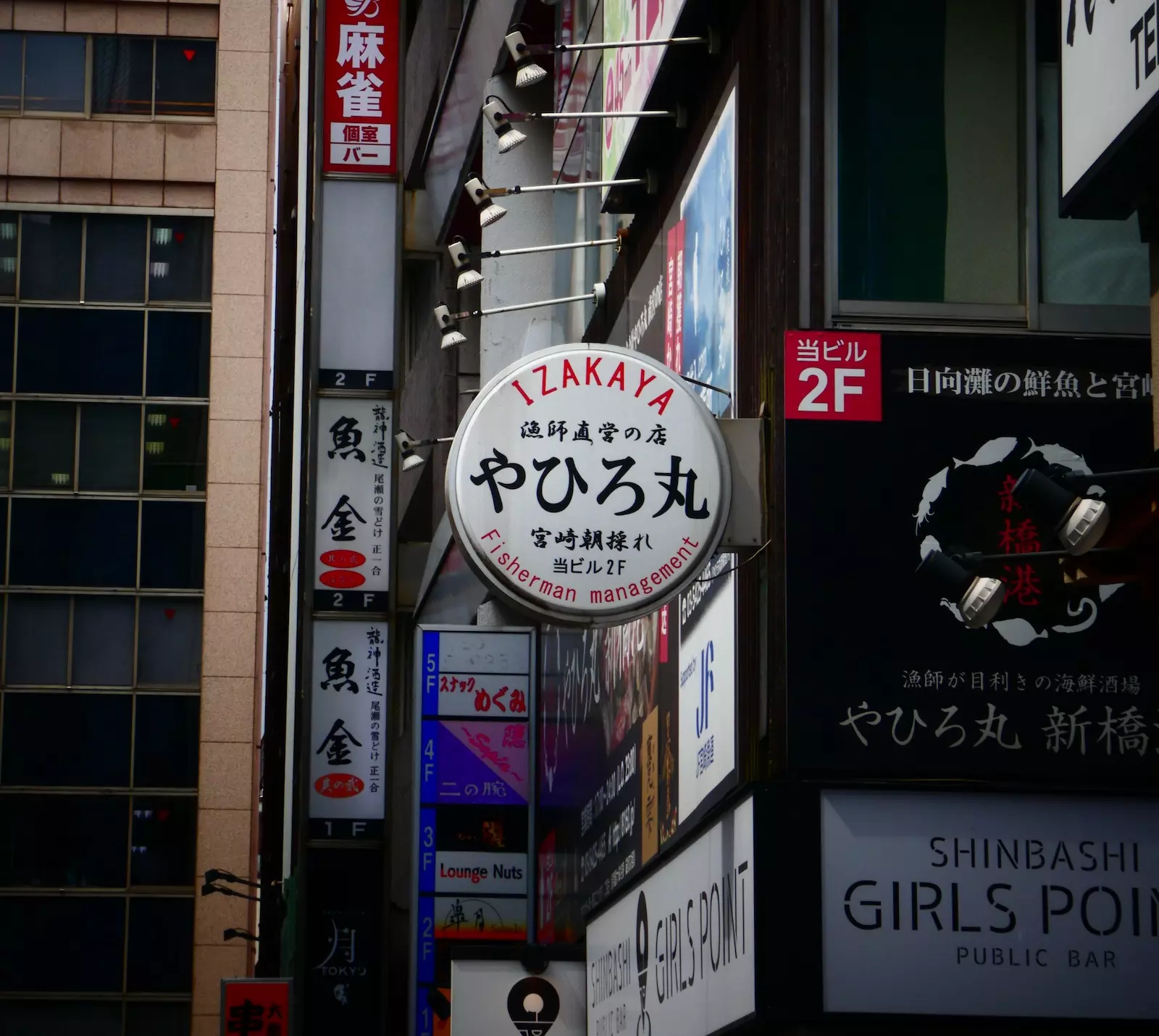
For Japanese learners, this pair is useful because it gives you real urban vocabulary with real texture: 居酒屋 (izakaya, Japanese pub) alleys, 立ち飲み (tachinomi, standing bar), commuter stations, bayward promenades, and the kind of place names that keep showing up in maps, timetables, and daily conversation. Read them once, then again, and the city starts to feel less like a blur.

Shimbashi and Shiodome sit side by side, but they don't feel like twins. Shimbashi is the older, lumpy, cigarette-smoke-and-after-work side of the story, while Shiodome is all polished height, wide sightlines, and business towers. The reason is simple: this is one of Tokyo's clearest before-and-after urban pairings, and you can read that change on foot.
What makes the comparison especially useful is the history under it. Shimbashi was where Japan's first railway line began in the 1870s, according to Tokyo - Wikipedia, and that alone gives the area weight. Not museum weight. Working-city weight. Shiodome, by contrast, was developed much later on reclaimed land and former rail property, which is why it feels newer, straighter, and more planned. Put them together and you get a compact lesson in Tokyo's urban layering. Classic Japan, isn't it?
Shimbashi: izakaya alleys and after-work Tokyo
Shimbashi is the district I'd send you to if you want the texture of place rather than a polished view from nowhere. Under and around the old elevated rail lines, you find narrow lanes packed with izakaya, tachinomi, and small restaurants that have served office workers for decades, as noted by Los Viajes de Gulliver. The atmosphere is dense, practical, and slightly rumpled in the best way. No one comes here for symmetry.
That matters if you're learning Japanese, because this is the sort of area where vocabulary suddenly stops being abstract. Izakaya isn't just a word in a textbook. Tachinomi isn't just a menu label. You see them in context, alongside beer signs, small counters, and the steady flow of salarymen unwinding after work. Hand on heart: this is one of the better places in central Tokyo to connect language with lived city rhythm.
Useful words to know
Start with izakaya, a casual drinking-and-eating place. Then tachinomi, a standing bar. Add 道 (michi, road) for road, 駅前 (ekimae, in front of the station) for near the station, and 北口 (kita-guchi, north exit) or 南口 (minami-guchi, south exit) if you are navigating station exits. These little pieces matter. They show up everywhere, and Shimbashi is a very good place to make them stick.
My tip: arrive early enough to see the district before the evening rush, then stay long enough for the after-work crowd to change the air. The shift isn't dramatic. It's better than that. It's gradual, and you can feel it. Wait, there's more.

Shiodome: glass towers, reclaimed land, and the bay edge
Shiodome feels newer because it is newer in the way Tokyo means new: built, rebuilt, rearranged, and made legible through infrastructure. The district’s modern identity comes from redevelopment, office towers, media buildings, and the kind of broad urban composition that makes you lift your head instead of tuck it away. From Shiodome, the city opens towards the bay side, including routes that connect on to Odaiba and the waterfront.
That connection matters. Tokyo has long reclaimed land from the sea, and Odaiba is the best-known example in the wider area, as Tokio - Wikipedia, la enciclopedia libre notes. Shiodome belongs to that same larger story of engineered land, modern transport, and the city pushing outward. If Shimbashi is compressed and social, Shiodome is vertical and schematic. Same district edge. Entirely different mood.
Speaking of which... the visual contrast between the two makes the walk worthwhile even if you are not chasing landmarks. One side gives you alley shadows and low ceilings. The other gives you open pavement, office entrances, and reflective surfaces. That shifting scale is the point. You are not just moving between neighbourhoods, you're moving between versions of Tokyo.
A small route that teaches a lot
If you only have a short window, walk from Shimbashi Station towards Shiodome, then keep going until you can feel the district breathing differently. There is no need to over-plan it. The area works best as a transition, not a checklist. First the rail city, then the redevelopment. First human density, then structural clarity. That's why this pair is so good for learners and repeat visitors alike.
Notice the station names, the exit signs, the izakaya wording, the office towers, and the way the street level changes as you move. That is the real lesson. Not just where to eat or what to photograph, but how Tokyo uses space. If you are studying Japanese, this kind of walk helps you attach words to geography, and geography to memory. The body remembers this stuff better than a flashcard deck does. More soon.
If you want to widen the walk, continue towards Hama-rikyu Gardens and then on towards the bay. That gives the route more breathing room, and a cleaner sense of how central Tokyo opens towards water. You don't need a grand plan. You need a pair of good shoes and a bit of attention. That's enough.
Frequently Asked Questions
What is the main difference between Shimbashi and Shiodome?
Shimbashi feels older, denser, and more social, while Shiodome is newer, taller, and more corporate.
Why is Shimbashi useful for Japanese learners?
It puts everyday vocabulary like izakaya, tachinomi, and station-exit terms into a real city setting.
Can you walk between the two areas easily?
Yes. They sit next to each other, so they work very well as a short urban walk.