Overview
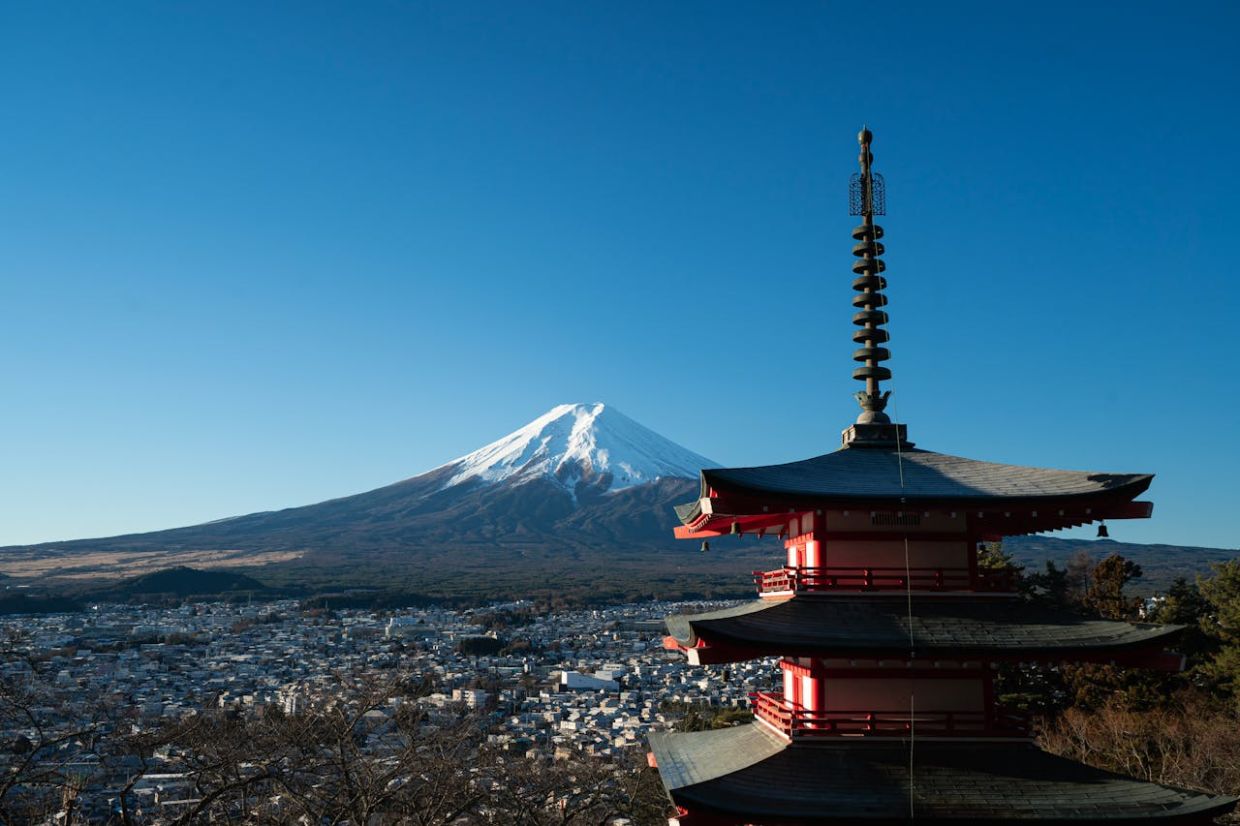
Chureito Pagoda is not old in the way many visitors assume. It was built in 1963 as an honor memorial, and yet the scene around it feels almost timeless: a red pagoda on a hillside, Mount Fuji rising beyond it, and 桜 (sakura, cherry blossoms) turning the foreground into something almost too neatly composed to be accidental. The viewpoint sits inside Arakurayama Sengen Park in Fujiyoshida, Yamanashi, roughly 100 kilometers west of Tokyo, which makes it a reachable day trip for many people and a stubbornly crowded one on the days that matter.
The classic view is straightforward and famous for a reason. You climb, you turn, and there it is: the pagoda, the mountain, and seasonally, the blossoms or autumn color. Mount Fuji stands at 3,776 meters, so even when it seems to float far back in the frame, it anchors the whole scene with a scale that photography can suggest but never fully contain. The result has been shared so often that the site now carries the weight of the image itself. That is the attraction. And the problem.
If you are looking for a Chureito Pagoda guide, the practical answer is simple: go for the view, but go with expectations trimmed down to size. It is not a remote ruin, and it is not a secret. It is a working viewpoint inside a city with a limited road network and a concentrated tourist pattern that peaks hard in spring. That matters. So does timing. On clear days and peak visiting days, several thousand visitors can arrive, and local officials have repeatedly warned about overcrowding. The place is beautiful. Also busy. Both are true.
What the viewpoint actually offers
The appeal of Chureito Pagoda is less about the structure alone and more about the composition it enables. The pagoda itself is a visual anchor, but the broader frame is what people travel for: sakura in April, the blue-grey mass of Fuji beyond, and in autumn the warm fringe of fall foliage. The site rewards patience in weather as much as in walking. Clear days matter. Hazy days do not, no matter how optimistic the ticket of us dorks may be. The famous image has very specific conditions behind it, and the mountain is rarely shy about refusing the shot when clouds move in.
This is also a place where the Japanese idea of 四季 (shiki, the four seasons), the seasons, becomes the main subject. Spring and autumn are the headline acts, but the viewpoint remains a usable destination outside those windows for people who care about landscape, urban edges, and the way one iconic mountain changes the feel of an entire prefecture. In the Japanese travel vocabulary, this is the sort of place where a 予約 (yoyaku, reservation), or reservation, may matter for nearby lodging in busy periods, and where a little 道 (michi, road; route), meaning the road or route in practical terms, can be slower than the map suggests. Parking and access do not always behave like a brochure.
Why the image matters so much
The photo from Fujiyoshida became viral because it compresses several deeply familiar Japanese visual ideas into one frame. There is the mountain, the pagoda, and the blossoms; there is symmetry; there is depth; there is that almost woodblock-like balance of foreground and distance. Some observers have compared the composition to Edo-period prints by artists such as Hiroshige and Hokusai. That comparison is not something I would treat as a hard fact in itself, but it points to why the image travels so easily. It looks legible. It looks like a Japan postcard without the postcard gloss.
The viral spread has also had consequences. Social media platforms such as Instagram, Threads, TikTok, and Twitter/X have helped amplify the image, and the site now sees annual tourist surges tied to that circulation. Fujiyoshida is a real city with real residents, and the pressure lands on narrow roads, parking capacity, hotel availability, litter, noise, and the ordinary friction between people who live there and people who arrive for the shot. That friction is part of the story now. The view remains the same; the human logistics around it do not.
How to plan a visit without pretending it will be quiet
If you want the best chance of seeing Chureito Pagoda in good conditions, aim for spring sakura season or autumn foliage, and go early. Very early. The site can handle a steady trickle, but several thousand visitors on peak days changes the feeling of the place completely. Wear shoes that make hill access easier, keep your load light, and be prepared for a little queueing and a lot of camera gear. The Japanese term 山 (yama, mountain), meaning mountain, is doing real work here; the climb and the elevation change are part of the experience, not an accessory to it.
For readers building a broader Japan itinerary, Fujiyoshida makes sense as a stop that links landscape, photography, and the slow business of being in one place long enough to notice its texture. Nearby, you will also hear the practical term 階段 (kaidan, stairs), which simply means stairs, because the route to the viewpoint asks for them. Nothing dramatic. Just enough to remind you that iconic scenes are often reached on foot, not by drone. That is the body of the thing. Not glamorous, but exact.
Related places and how Chureito fits into a wider Fuji trip
Chureito Pagoda belongs to a larger cluster of Fuji-area sightseeing rather than standing alone. Travelers who come for the view often pair it with other spots in Yamanashi or build the stop into a route through the Fuji Five Lakes region. The pagoda is not the only place to look at the mountain, and in a sense that is the point: its fame comes from the way it frames Fuji differently from lake shores, ropeways, and roadside pull-offs. If you are comparing where to experience Mount Fuji in Japan, this is the place for the iconic layered shot, while other nearby viewpoints are better for scale, reflection, or a quieter horizon.



It is also useful to think of the site in terms of おもてなし (omotenashi, Japanese-style hospitality; attentive service), the hospitality and care often associated with Japanese service culture. Around major seasonal peaks, that care is tested. Traffic control, signage, and crowd management all become part of the visitor experience. The best visits are the ones where you notice those systems working, then get out of the way and let local life continue. That is usually the right move.
- Best known for the red pagoda, Mount Fuji, and cherry blossom composition
- Most popular in April for sakura and in autumn for fall colors
- Expect heavy crowds on clear peak days
- About 100 kilometers west of Tokyo in Fujiyoshida, Yamanashi
- Built in 1963 as an honor memorial
Chureito Pagoda kanji, naming, and Japanese learning notes
For learners searching for Chureito Pagoda kanji or Chureito Pagoda japanisch lernen, the useful angle is not grammar trivia but recognition. Place names, seasonal words, and sightseeing vocabulary will recur in signs, maps, and guides around the Fuji area. Learning the romanized term shiki for seasons, yama for mountain, kaidan for stairs, and yoyaku for reservation gives you practical footholds. The attraction itself is also a good mental image for the word viewpoint in travel Japanese, because the whole site is built around one very specific act of looking.
If you are assembling a Japan study habit, this is the sort of location that helps vocabulary stick. Not because it is exotic, but because it is concrete. You can picture the climb, the crowd, the first glimpse of Fuji, the sakura when they cooperate. Words behave better when they have a slope under them.
Frequently Asked Questions
Where is Chureito Pagoda located?
Chureito Pagoda is in Arakurayama Sengen Park in Fujiyoshida, Yamanashi, about 100 kilometers west of Tokyo.
Why is Chureito Pagoda so famous?
It is famous for the classic view combining Mount Fuji, the red pagoda, and cherry blossoms, especially in spring and autumn.
When is the best time to visit Chureito Pagoda?
The most popular times are April for sakura season and autumn for fall foliage. Clear days are best for the Fuji view.
Is Chureito Pagoda crowded?
Yes. On clear days and peak visiting days, the viewpoint can receive several thousand visitors, and local officials have warned about overcrowding.
Was Chureito Pagoda built long ago?
No. It was built in 1963 as an honor memorial.
Sources
- Fujiyoshida City official tourism information - https://www.city.fujiyoshida.yamanashi.jp/
- Arakurayama Sengen Park visitor information - https://www.city.fujiyoshida.yamanashi.jp/
- OpenGov Japan population data for Fujiyoshida - https://opengov.jp/en/population/estimates/yamanashi/fujiyoshida/
- Yamanashi tourism information - https://www.yamanashi-kankou.jp/