Overview
A tiny bookshop tucked into a side street off Chuo-dori — Akihabara's central spine — has closed. There was no farewell event, no countdown on social media, nothing so orchestrated. Just a handwritten notice taped inside the window, the kind you almost walk past because you assume it's an out-to-lunch sign. It wasn't. The closure was first documented in a YouTube video shot on the shop's last day, and it's the source nearly every subsequent write-up cites back to, because there was no press release to draw from — there rarely is, for a shop this size. What follows is the fuller picture: what the shop actually was, why it went under, and what its disappearance says about Akihabara at large.



The Shop Itself: Two Shelves, a Folding Chair, and a Thermos
Call it small and you're underselling it. Multiple accounts compare it to a walk-in closet — a narrow entrance, shelves stacked floor to ceiling, the kind of place where two customers browsing at once counted as a crowd. One eyewitness description lists the entire interior inventory of furniture: two shelves and a folding chair. That's it. On the counter in the closure footage: a thermos, and bundles of 同人誌 (doujinshi, self-published fan comic/magazine) tied off with rubber bands, the workaday packaging of a business run by one person with no back office and no stockroom to speak of.
What filled those shelves was the point. This wasn't a shop for shrink-wrapped new releases. It dealt in secondhand manga, doujinshi — the self-published, fan-made comics that don't come with an ISBN or a spot on a chain store's shelf — rare back issues, and the kind of collector catalogues and niche reference material that Animate, Mandarake, Yodobashi Camera, and Tsutaya simply don't stock, either because the runs were too small or because nobody thought to preserve them at that scale. The owner, seen in the closure video, was a woman in her mid-50s in a black jacket and scarf, running the whole operation herself. Her clientele was a fair cross-section of Akihabara's actual population, as opposed to its tourist-brochure version: middle-aged collectors hunting specific back issues, budget-conscious students, cosplayers after obscure reference material, and the occasional tourist who wandered in without quite meaning to.
The Akihabara Cult Bookshop Closure: Rent, Foot Traffic, and the Pull of Online Marketplaces
The owner's own explanation, given in the video, was blunt and entirely unsentimental: rent, changing supply chains, and collectors who now buy online rather than in person. That tracks with the wider numbers. Commercial rents in central Akihabara reportedly climbed by as much as 40 percent between 2010 and 2020 — a brutal trajectory for a shop whose entire footprint might have run twenty square meters. Foot traffic, meanwhile, never fully recovered its old rhythm after the pandemic, and the browsing that used to happen in person — flipping through a bundle of doujinshi to check the condition before deciding it was worth the price — increasingly happens on Mercari or Yahoo Auctions Japan instead, where a seller can list from a spare room and a buyer never has to find the side street at all. None of these pressures is unique to this one shop. All of them compound, and they compound hardest against a business with two shelves and a single employee.



From Denki-gai to Otaku Hub: The Bigger Pattern
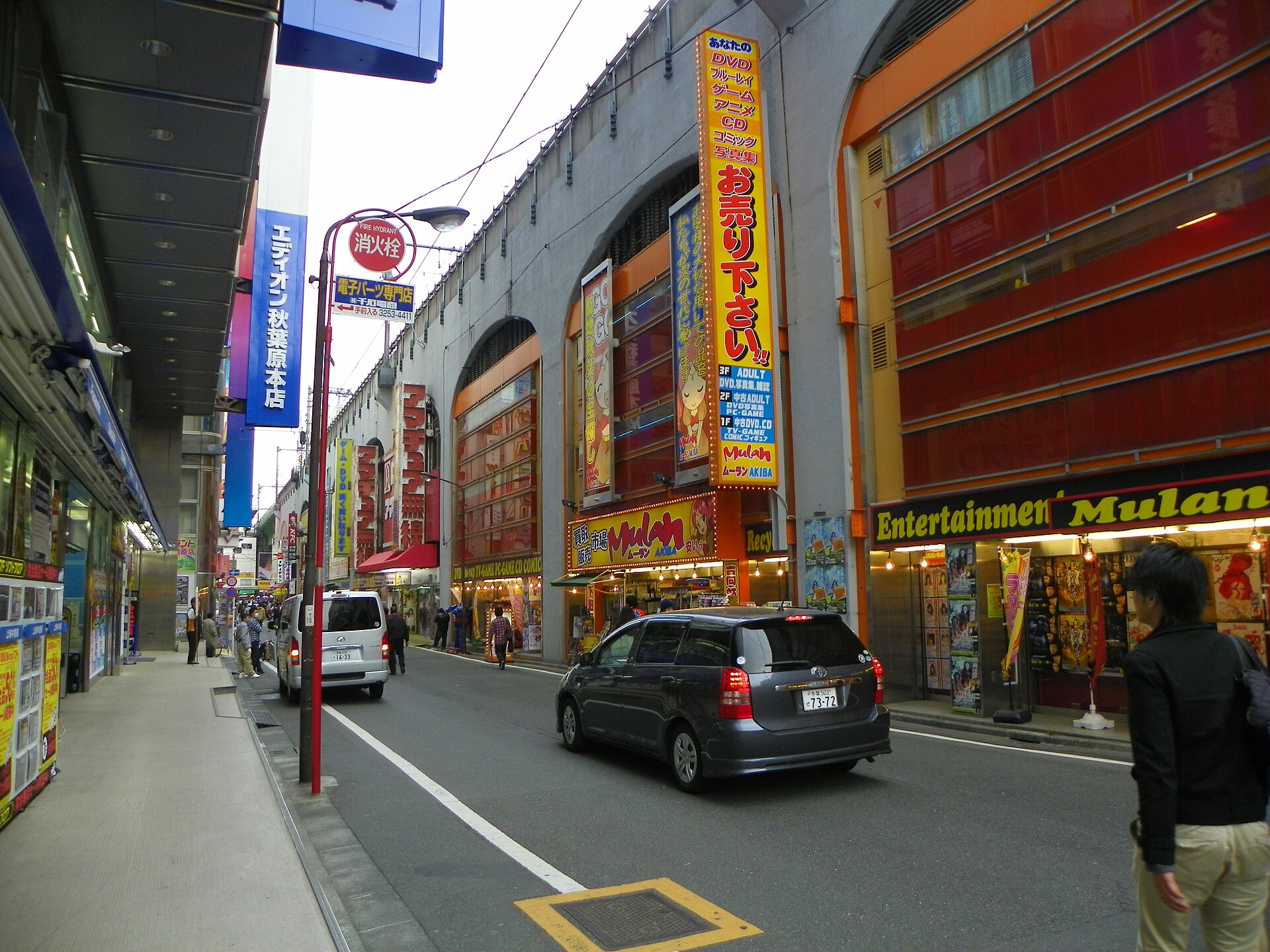
Akihabara's older nickname is 電気街 (Denki-gai, electronics district ('Electric Town')) — Electric Town — and it earned that name honestly, as a postwar cluster of electronics retailers, long before the district's identity shifted, especially after 2004, into the global center of オタク (otaku, geek/nerd, esp. anime-manga enthusiast) culture as most visitors now understand it: maid cafes, ガチャ (gacha, capsule-toy/random-prize vending machine) machines, and big-box anchors like Yodobashi Camera, Sofmap, Animate, and Mandarake lining the main drag. The shops that made Akihabara idiosyncratic in between — the 個人経営の店 (kojin-keiei no mise, individually/privately run shop), the individually-run stores where one person's specific obsession dictated the inventory — have been thinning out for years. This closure is one data point in that pattern, not an isolated story, which is exactly why it's been covered as emblematic rather than as a routine small-business footnote. Commentators have called it a loss of neighborhood memory, and I don't think that's overstatement. A shop with two shelves doesn't scale, doesn't franchise, doesn't survive a rent hike by opening a second location. It just goes quiet, one handwritten sign at a time.
Where to Feel What's Left
You can't visit this particular shop anymore — that's the whole point of writing about it in the past tense. But the texture it represented hasn't vanished from Akihabara entirely, and if you're headed there, it's worth walking for deliberately rather than assuming Chuo-dori tells the whole story.
- Turn off the main street. The side streets and alleys branching off Chuo-dori still hold a scattering of small used-book and doujinshi dealers; they don't advertise, and half the pleasure is not knowing what's behind the next narrow entrance.
- Budget real time, not just a stop between train stations. A shop with two shelves rewards slow browsing, not a five-minute detour on the way to somewhere louder.
- Treat Mandarake's multi-floor branches as a starting point, not a substitute. They're excellent for volume and reliability, but the specific, lumpy, one-owner inventory of a shop like this one was never going to show up there.
- Go on a weekday morning if your schedule allows it. Fewer tourists, more room to actually look at what's on the shelf.
- If a shop has a handwritten sign in the window, read it. That's often all the notice you're going to get.
A Few Words Worth Learning
If you want a handful of terms to carry into Akihabara with you: doujinshi (self-published fan comics, often the entire reason a shop like this existed), Chuo-dori (the main street, useful for orienting yourself before you deliberately leave it), and Denki-gai (Electric Town, the district's older identity, worth knowing if you want to understand what Akihabara was before it became what it is now). None of this requires fluency. It requires noticing — the same skill that makes a two-shelf bookshop worth finding in the first place.