
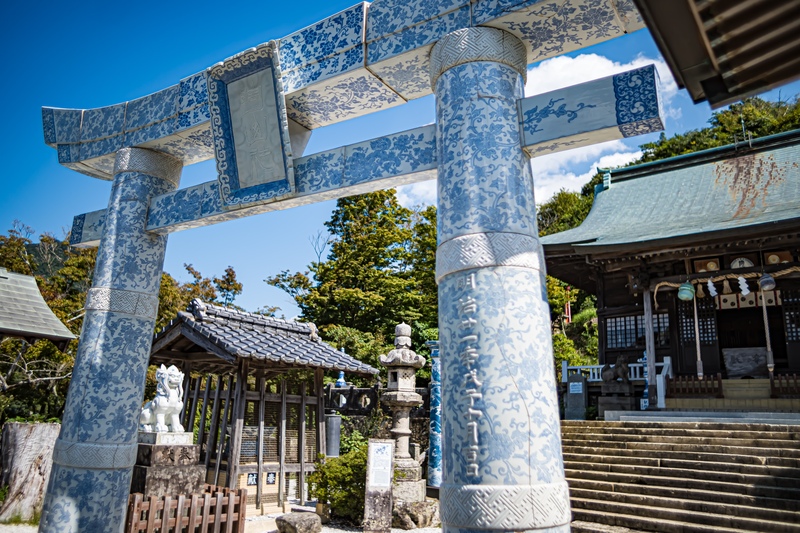
I went expecting a quick stop, then found myself slowing down, looking at glaze, edges, and weathered detail as if the whole town were speaking in ceramics.
What most people don’t know is that Sueyama Shrine in Arita isn’t just a shrine with decorative ceramics, but a compact expression of the town’s long relationship with porcelain. In a place that helped build Japan’s name for fine white ware, the shrine feels almost like a local archive you can walk through. It’s calm, exact, and strangely moving.
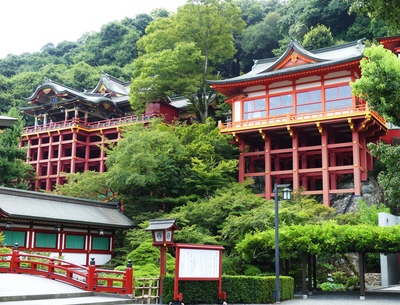
To be fair, you don’t come here for a grand mountain approach or a vast temple compound. You come for the details, and the details are the story. The porcelain 鳥居 (torii, shrine gate) at the entrance, the 狛犬 (komainu, shrine guardian dogs) beside the path, the lanterns set into the grounds, all of them carry the hand of Arita’s artisans, or 職人 (shokunin), and the town’s memory of cultivation, trade, and patient making.
Sueyama Shrine in Saga: a shrine built with porcelain confidence
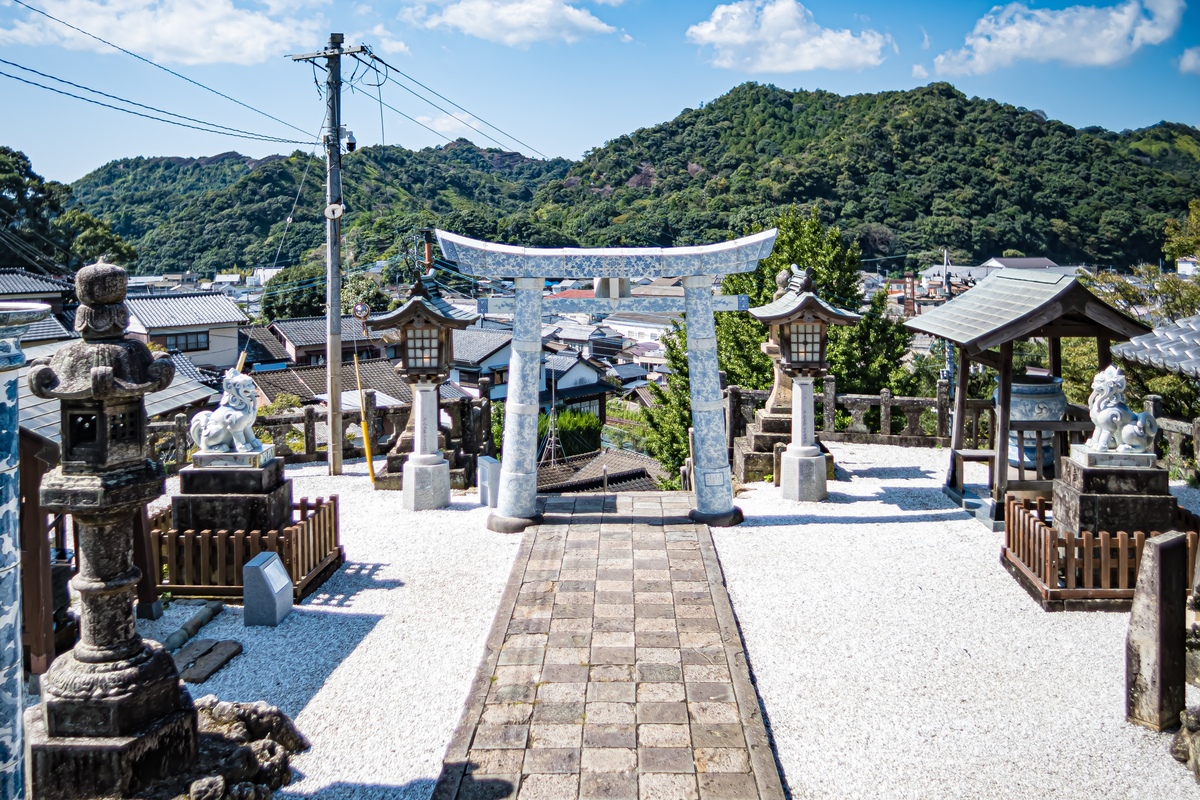
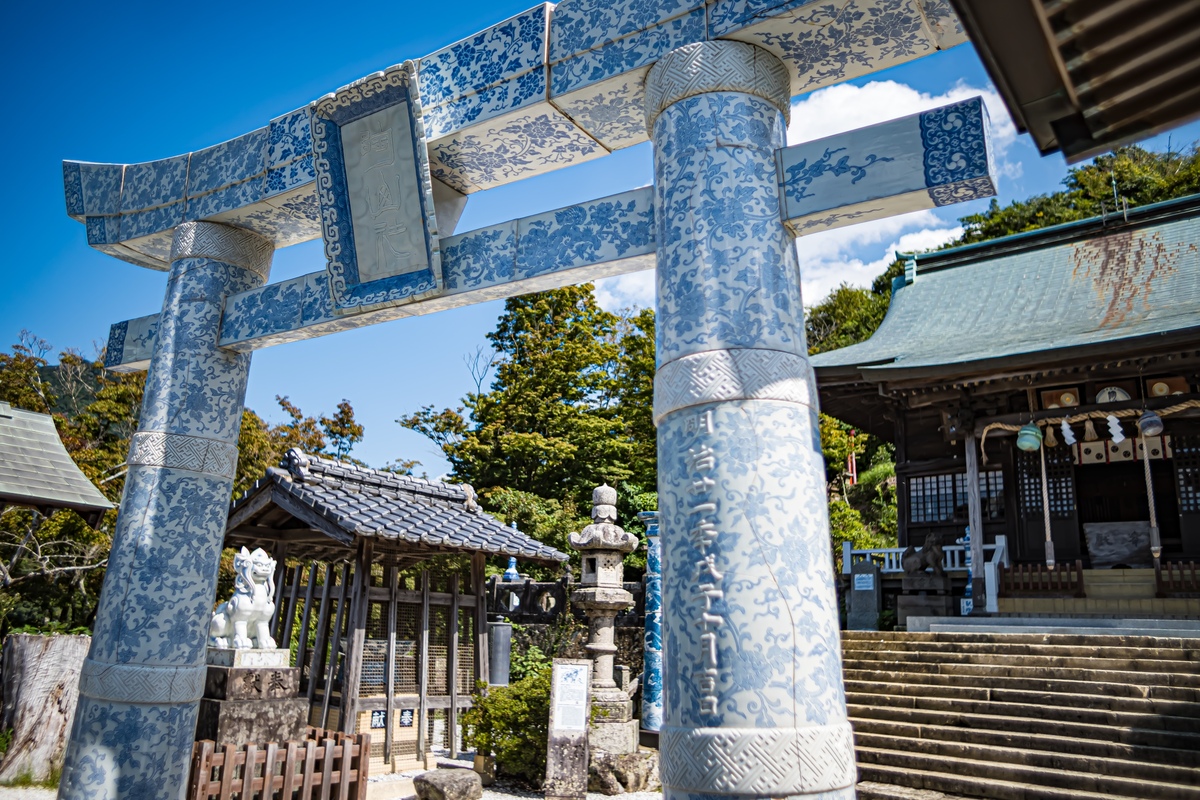
Picture this: a shrine gate that gleams not with gold leaf or lacquer, but with ceramics. Sueyama Shrine, also called Sueyama-jinja, stands in Arita, Saga Prefecture, and it’s known for its porcelain torii, said to have been built in 1875, during a period when local makers were already pushing 有田焼 (Arita ware, Arita porcelain) into more ambitious forms. The gate doesn’t shout. It stands there with quiet certainty, white and blue in a town that learned to make fired clay seem almost weightless.
By the way, the shrine is associated with Arita’s history as a centre of porcelain production, especially after the discovery of kaolin in the early 17th century. That discovery was a watershed for the town. It led to the development of Japanese porcelain production in Arita, and from there to export routes, domain patronage, and a craft culture that still shapes the streets today. If you care about ceramics, this isn’t background information. It’s the whole frame.
I like that the shrine doesn’t treat porcelain as a museum object. It uses it in public space, where weather, rain, and time can touch it. That feels honest. It also reminds me that craftsmanship is never only about display, but about use, repetition, and the courage to put beautiful things outdoors where they have to endure. Convinced yet?
Porcelain torii, komainu, and lanterns
The porcelain torii is the first thing most visitors photograph, and for good reason. Traditional torii are usually wood, stone, or metal, but here the material immediately changes the mood. A porcelain gate is lighter in feeling, even if not in weight, and the pale surface catches the daylight in a way that seems almost reserved.
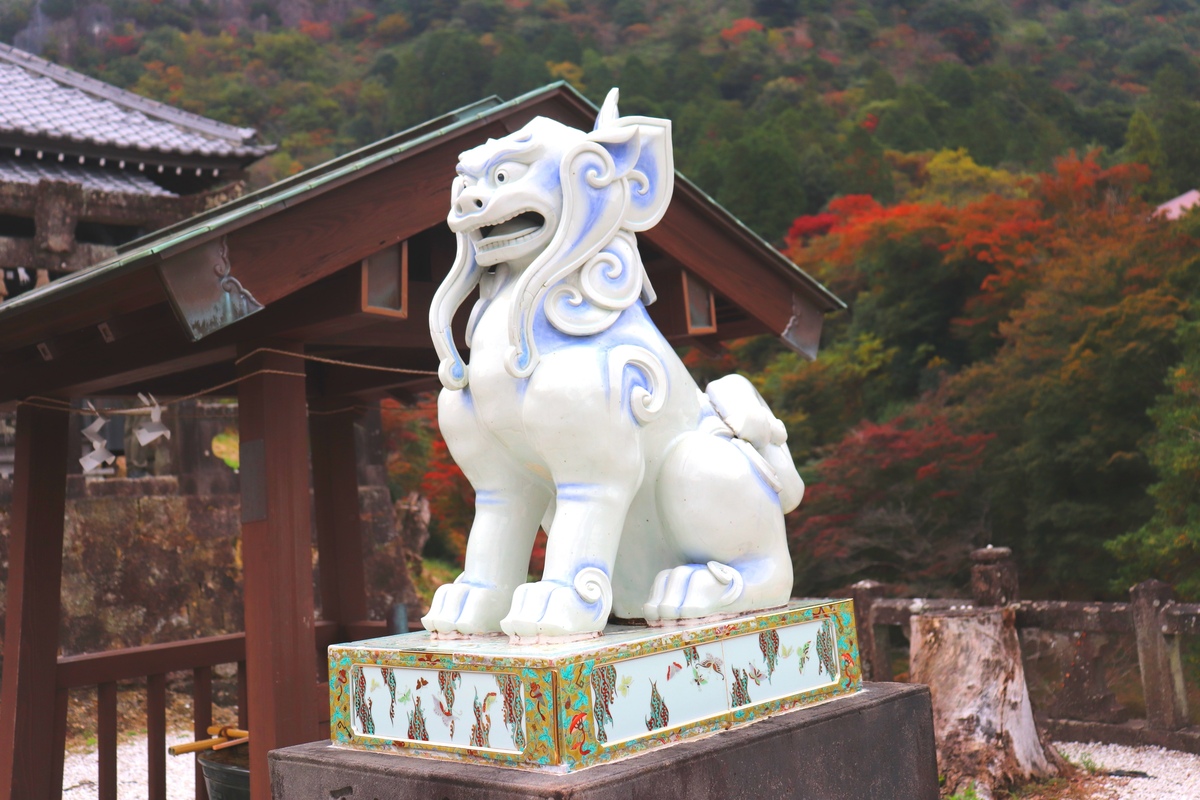
Take the komainu, for instance. These guardian dogs, often carved in stone, take on a different presence when associated with Arita ware. Their surfaces reveal the town’s ceramic skill in a form that is both protective and decorative. Nearby lanterns, too, add a rhythm to the grounds, a measured line of objects that make the shrine feel like a small exhibition of local craft rather than a tourist showpiece.
No wonder, because Arita’s artisans have spent generations testing what porcelain can do. Plates, bowls, vases, figure work, and architectural forms all belong to the same lineage. At Sueyama Shrine, those experiments aren’t kept behind glass. They’re part of worship, memory, and the everyday landscape. See what I mean?
Arita Ware and the town around Sueyama Shrine
Ever wondered why Arita ware still matters so much? The answer is partly history, partly geography, and partly the stubborn skill of local makers. Arita became one of Japan’s earliest porcelain production centres in the early 1600s, after ceramic clay and kaolin were found in the area. The town’s ware later became famous as 伊万里焼 (Imari ware, Imari porcelain) in export contexts, but inside Arita the local identity has remained deeply tied to making, teaching, and refining.
That brings us to the town itself. Around Sueyama Shrine, I found a walk that feels best when unhurried. There are kiln sites, studios, shops, and narrow streets where you can still sense the old industrial grain of the place. Even when the road bends towards a modern storefront, the ceramic tradition is close by, in window displays, in tiled surfaces, in the quiet confidence of a bowl set beside a tea cup.
My tip: don’t treat Arita as a place to tick off in an hour. Slow down. Visit a kiln shop, compare glazes, ask how a piece was fired, and notice how many shades of white and blue are actually there. Sounds odd, but it’s true. The town rewards careful looking. And for Japanese language learners, this is a good place to pick up words like yaki, meaning firing or ware, and to hear how locals talk about monozukuri, the making of things, with a seriousness that is never theatrical.
A walk through Arita town: studios, streets, and small discoveries
The first time I went to Japan, I thought craft towns would announce themselves loudly. Arita doesn’t. It unfolds. A narrow street may lead to a ceramic shop, then to a workshop, then to a quiet shrine or a small museum where the history of production becomes easier to read. That slower logic is part of the town’s charm.
I especially like how a town walk here links architecture and work. You can move from the shrine to a gallery, then to a studio where artisans are still shaping clay, glazing, stacking, and firing. You see porcelain not as a souvenir category, but as a local language. In Arita, even the act of walking becomes a kind of cataloguing, an attentive noticing of edges, textures, and labour.
Before long, I found myself thinking less about shopping and more about continuity. Who taught whom, which kiln survived, what pattern was revived, what was lost. That’s the quiet melancholy in places like this. Craft traditions endure, but they also need people willing to carry them. Sueyama Shrine makes that visible without explanation. It is a shrine, yes, but it is also a civic gesture, a promise made in porcelain. From my experience...
If you plan a visit to Saga, I’d build time around Arita rather than rushing through it. Start at Sueyama Shrine, then wander the town, then leave room for an extra cup of tea or a second look at a bowl you didn’t expect to care about. That’s often how these places work on me. One object, one gate, one street, and the day changes shape. And so it became a plan.
In pictures
Frequently Asked Questions
Where is Sueyama Shrine located?
It is in Arita, Saga Prefecture, a town long associated with Japanese porcelain.
Why is the shrine famous?
It is known for its porcelain torii, as well as ceramic komainu and lanterns made in the Arita tradition.
Is Arita worth visiting beyond the shrine?
Yes. The town has studios, shops, historic kiln sites, and a strong craft culture that makes it ideal for a slow walk.


