
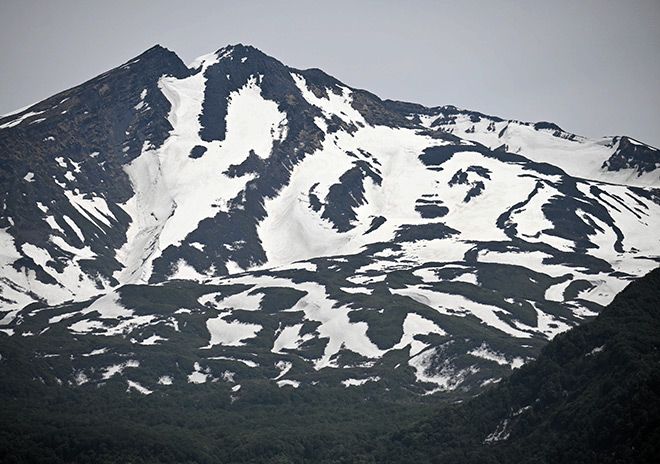
But let’s stick with Mount Chokai for now. This is a story about nature, travel, and a very Japanese kind of surprise, where a mountain view can turn into a memory you’ll keep talking about later.
Mount Chokai in Tohoku and the panda pattern
What makes Mount Chokai so interesting is that it’s not just another pretty peak in northern Japan. It stands on the border of Yamagata and Akita prefectures in Tohoku, and at 2,236 metres it’s one of the region’s major mountains, often called Chokaisan in Japanese. When snow and shadow line up in the right way, the slopes create a pattern that looks strikingly like a panda’s face. Sounds weird, but it’s true.

Asahi Shimbun recently highlighted the view in an English-language report, and that gave the mountain a fresh burst of attention. Here’s the kicker: the image isn’t some man-made stunt, it’s the result of weather, snow cover, and the mountain’s shape. Nature did the design work, and it did it with real style. Personally, I love that kind of accidental beauty, because it feels more memorable than any polished tourist campaign.
For Japanese language learners, this is a nice little vocabulary moment too. Words like 雪 (yuki) for snow, 山 (yama) for mountain, and 景色 (keshiki) for scenery show up all the time in travel writing. If you’re reading Japanese travel news, those simple words carry a lot of the atmosphere.
Why this Tohoku mountain view stands out
I still remember how often winter landscapes in Japan can surprise you. Unlike what we’re used to in many other places, snow here can shape the whole mood of a mountain, not just cover it. On Mount Chokai, that interplay creates a face-like panda pattern that feels playful, almost cartoonish, against a serious alpine backdrop.

Nature with a sense of humour
Take Mount Chokai, for instance. It’s famous for hiking, volcanic terrain, and deep seasonal changes, but now it also has a visual quirk that makes people grin. That’s why the story travels well online, especially among Japan fans who love odd scenic details, like heart-shaped rocks, misty 鳥居 (torii, shrine gate) gates, or a rice field that suddenly looks like art. Simple, but brilliant.
What I especially like is that this isn’t a crowded, overdone sightseeing icon. It’s a quiet mountain in Tohoku, and the panda effect gives it a story without flattening what it really is. The area still feels rugged, a little remote, and properly Japanese in the best sense of the word, where the scenery itself is the attraction. My tip: if you enjoy Japan’s less obvious landscapes, keep Tohoku on your list, because it rewards patient travellers. Personally...



Tohoku onsen towns near the mountain
By the way, the region around Mount Chokai is also recommended for travellers who like remote onsen. That matters more than it might sound at first. Tohoku is one of Japan’s best areas for ryokan stays with natural hot springs, and the atmosphere tends to be quieter than what you’ll find in more famous resort zones.
The reason is simple: Tohoku has space, mountains, and a long tradition of hot spring culture. After a day of cold-weather sightseeing, a soak in an open-air 露天風呂 (rotenburo, open-air bath) feels almost too perfect. Add snowy scenery, wooden inns, and a meal built around local fish, mountain vegetables, and rice, and you’ve got the kind of trip Japanese travellers still chase for good reason.
And it gets better: the region around Mount Chokai can work as a base for a slower trip, not just a quick photo stop. You can combine mountain views, hot spring villages, and regional food without racing through a packed itinerary. For learners of Japanese, this is also where practical words come alive, such as ryokan, onsen, and 森 (mori) for forest, because they’re part of the actual travel experience, not just textbook lists. Wait, there’s more.
A travel idea for Japan fans and learners
Plot twist: a panda-shaped mountain view is more than a cute headline. It’s a reminder that Japan travel often rewards people who look a little closer, whether at a hillside, a train window, or a local bathhouse menu. Mount Chokai gives you that mix of surprise and calm, and Tohoku gives you the wider setting to enjoy it properly.
If you’re building your own Japan trip, this is the kind of destination that pairs well with language learning. You can practise reading weather forecasts, onsen signs, and place names, then reward yourself with a real regional experience instead of another generic city break. That combination, travel plus language, is what keeps many of us hooked on Japan. My verdict: Mount Chokai is not just about a panda pattern, it’s about the whole mood of northern Japan, from mountain air to bathwater steam.
For more stories like this, read more Japan news on jpnerd.com.
Frequently Asked Questions
Where is Mount Chokai?
Mount Chokai is in Tohoku, on the border between Yamagata and Akita prefectures in northern Japan.
What is the panda pattern?
It is a natural-looking shape on the mountain slopes that can resemble a panda face when snow and shadow line up.
Why do people connect this area with onsen?
The surrounding region is known for remote hot spring towns, making it a strong choice for a slow travel trip.


