
I keep coming back to prints like this because they sit at the meeting point of craft and seeing. They’re quiet, but they’re never simple.



Kasamatsu Shiro and the long life of Fuji in ukiyo-e
Kasamatsu Shiro was born in 1898 and worked through a period when Japanese woodblock printmaking was changing shape. The older 浮世絵 (ukiyo-e, woodblock prints of the floating world) world of the Edo period had already given Japan some of its most famous images of Mount Fuji, from Hokusai's wave-broken vista to Hiroshige's weather-soaked landscapes. By the 20th century, artists were still returning to the mountain, but with new eyes, new publishing networks, and a more modern sense of design.
That’s where Kasamatsu stands out for me. He wasn’t copying the past, but conversing with it. His prints often feel balanced, refined, and attentive to atmosphere, with the discipline of a 職人 (shokunin, craftsman; artisan) at work rather than the swagger of a showman. See what I mean?
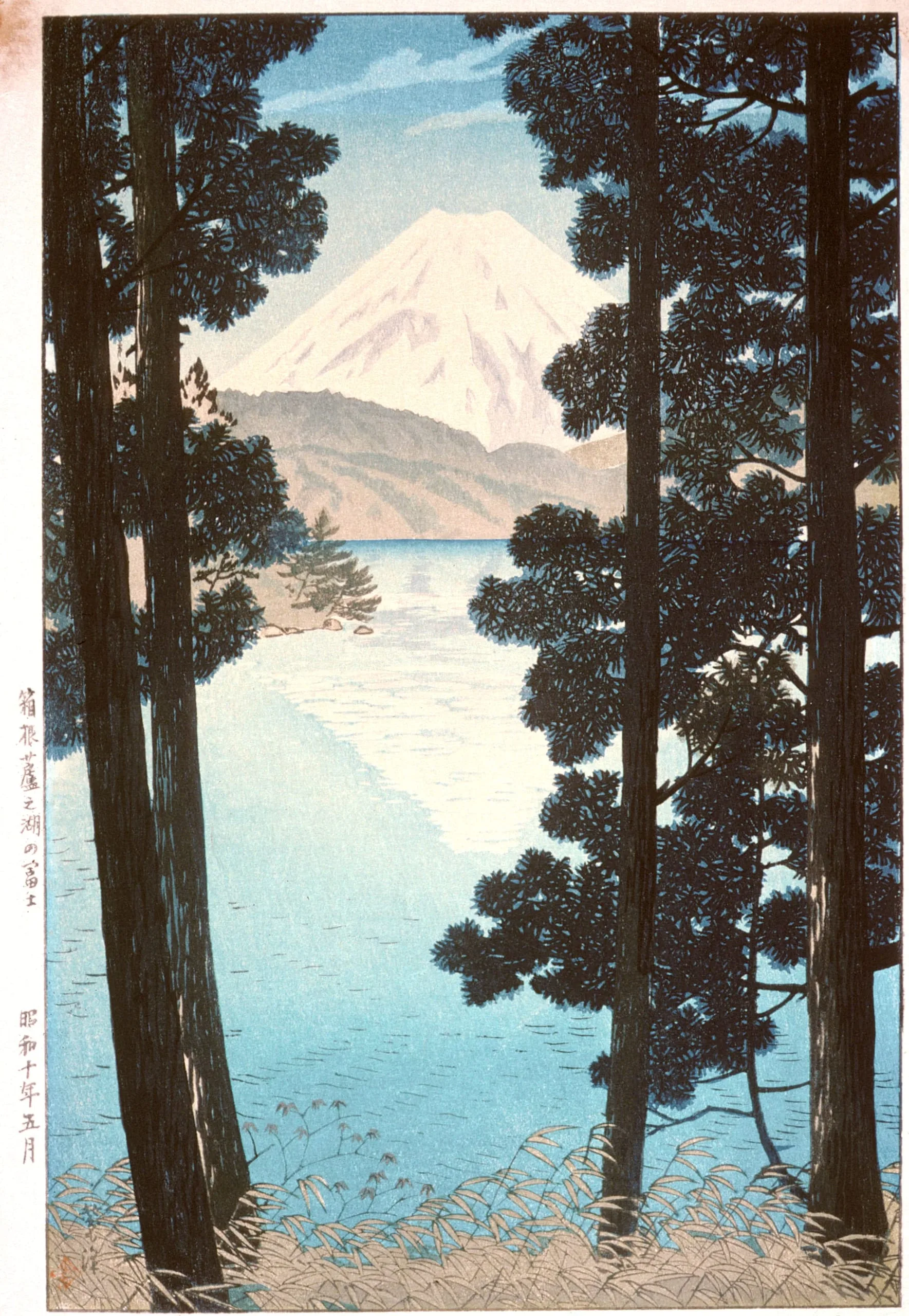
Mount Fuji from Lake Ashinoko, Hakone, May 1935
The print Mount Fuji from Lake Ashinoko, Hakone is dated May 1935, which places it in a Japan that was modernising quickly while still protecting older visual traditions. The scene itself is plain in the best sense. Lake Ashinoko stretches across the foreground, Hakone's wooded slopes frame the view, and Mount Fuji rises in the distance with a calm that feels almost ceremonial.
What I especially like is the way the image avoids drama. Fuji isn’t exploding out of the paper, not performing for the viewer. It sits beyond the lake, a mountain seen from a watershed of travel, pilgrimage, and rest. That restraint feels deeply Japanese to me, and also deeply human. Classic Japan, isn't it?
The print as a crafted object
This is a woodblock print, which means the image was built through carved wood blocks, careful registration, and layered ink or pigment. The technique demands trust between designer, carver, printer, and publisher. I think that collaboration matters as much as the finished image, because the beauty isn’t only visual, it’s social.
Woodblock prints also carry a specific kind of tactility. Even when viewed online, they suggest paper, pressure, grain, and repetition. And it gets better: the medium itself mirrors the subject. A mountain that seems eternal is rendered through fragile, perishable materials. That contrast is part of the spell.
Hakone, Lake Ashinoko, and the culture of the view
Hakone has long been a place of looking. Travellers passed through it on the old Tokaido road, and later visitors came for hot springs, inns, and mountain air. Lake Ashinoko, formed in the caldera of Mount Hakone, offers one of the great framed views of Fuji, especially when the weather clears and the mountain appears with that sharp, almost improbable outline.
Quick detour: when I think about Japanese landscape art, I often think about how carefully a view is composed. It’s never just scenery. It’s the cultivation of attention. A shore, a tree line, a cloud bank, a distant peak, all are arranged so the eye can rest and move at the same time. Kasamatsu understands this beautifully here.



From ukiyo-e to modern sensibility
Take Hokusai's Thirty-Six Views of Mount Fuji, for instance, and you'll see how a single mountain can become a whole visual system. Kasamatsu works in that same lineage, but the feeling is less theatrical, more poised. His Fuji is not a monument of force, but a presence in the distance, held by the surrounding land and water.
By the way: this is one reason I enjoy teaching Japanese art vocabulary alongside the images themselves. Words like 山 (yama, mountain) for mountain, 水 (mizu, water) for water, and 風 (kaze, wind) for wind are simple, but they become richer when tied to a print like this. The artwork gives the vocabulary a place to live. And when learners meet recurring terms in art, travel writing, and seasonal descriptions, the language starts to feel less like a list and more like a landscape. Wait, there's more.
Why this LACMA Collection print still feels alive
The fact that this work sits in the LACMA Collection matters, because it means the print is part of a major museum conversation about Japanese art, not a decorative footnote. LACMA's holdings let viewers trace the shift from classical ukiyo-e to later print traditions, and Kasamatsu Shiro belongs firmly in that longer story.
What I find moving is the print's humility. It doesn't try to dominate the viewer, and that is precisely why it stays with me. It asks for the slower kind of looking, the kind that notices how a slope darkens towards the lake, how the mountain pulls the composition upward, how a single distant peak can make the rest of the world seem briefly hushed. From my experience...
My tip: if you're learning Japanese, try describing this print in a few short lines in romaji. Start with Fuji ga 見える (mieru, can be seen), then add where and how you see it, maybe Ashinoko kara or 静か (shizuka, quiet; calm). Simple sentences like that train your eye and your memory at the same time. Simply brilliant.
Kasamatsu's Mount Fuji from Lake Ashinoko, Hakone is dated, grounded, and quietly enduring. In a tradition crowded with famous Fuji images, it earns its place by refusing to shout. That kind of confidence is rare, and in Japanese print culture, it feels like a form of grace. And so it became a plan.
Frequently Asked Questions
Who was Kasamatsu Shiro?
He was a Japanese woodblock print artist born in 1898, known for refined landscape prints and work that continued the ukiyo-e tradition into the 20th century.
What is Mount Fuji from Lake Ashinoko, Hakone?
It is a woodblock print by Kasamatsu Shiro, dated May 1935, showing Mount Fuji viewed from Lake Ashinoko in Hakone.
Why is this print important for Japan fans and learners?
It connects art, geography, and cultural history, and it offers a clear example of how Japanese landscape imagery developed from ukiyo-e into later printmaking.


