
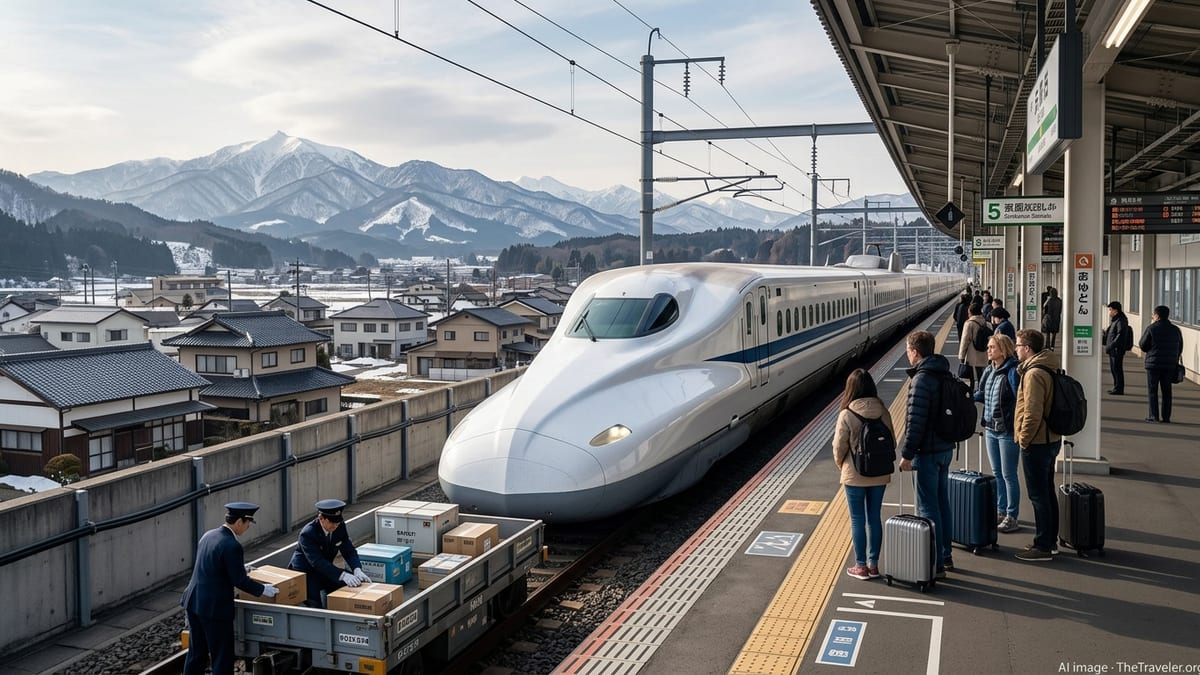
Bullet Trains Carrying Cargo: Japan's Bold Logistics Experiment
Here's the thing: Japan has a serious logistics problem. The country is facing a chronic shortage of truck drivers, a situation so severe that the Japanese government and transport industry have started calling it the "2024 logistics crisis" (物流危機, butsuryu kiki). Regulations tightening overtime for drivers kicked in fully in April 2024, which cut available freight capacity almost overnight. Something had to give.
Plot twist: the answer wasn't more trucks. It was the Shinkansen.
In 2024, JR East officially launched Japan's first dedicated Shinkansen freight service, using modified Hayabusa bullet trains on the Tohoku Shinkansen line between Tokyo and Sendai. These trains can carry temperature-sensitive cargo, fresh seafood from Hokkaido, agricultural produce, and express parcels at speeds up to 320 km/h. Compared to back home, where freight rail is often slow and unreliable, seeing a bullet train handle next-day delivery feels almost surreal. Not bad, right?
The reason is simple: Japan already has thousands of kilometres of Shinkansen track, reliable to the minute, running dozens of daily services. Using spare cargo capacity in passenger trains or running dedicated freight runs during off-peak hours costs far less than building new infrastructure. It's an elegant fix and very classically Japanese in its efficiency.
What the Numbers Actually Look Like
JR East's initial freight pilot moved roughly 100 tonnes of cargo per month along the Tohoku corridor. That sounds modest, but the symbolic weight is enormous. The government has signalled plans to expand Shinkansen freight to the Hokuriku Shinkansen and eventually the Tokaido line, which connects Tokyo, Nagoya, and Osaka. That's the busiest rail corridor on Earth. Wait, there's more.
According to Railway Supply, the broader goal is to shift up to 50% of certain express freight categories from road to rail by the early 2030s. For a country as mountainous and geographically tricky as Japan, that's a genuinely ambitious target.
How Shinkansen Freight Actually Boosts Tourism
You might be wondering what cargo trains have to do with your next trip to Kyoto or Kanazawa. Quite a lot, actually.
When freight logistics improve on the Shinkansen network, rail operators have stronger financial reasons to maintain and expand services, invest in new rolling stock, and push for faster journey times. The Hokuriku Shinkansen extension to Tsuruga, which opened in March 2024, is a perfect example. The line now connects Kanazawa directly to Tokyo in around two and a half hours, and freight integration plans are already being discussed for that corridor. Tourism numbers in Ishikawa Prefecture jumped sharply after the extension opened, with Kanazawa Station handling record passenger volumes in spring 2024.
A great example: fresh crab from the Sea of Japan coast (a regional delicacy known as Echizen-gani, 越前蟹) can now reach Tokyo restaurants within hours via Shinkansen freight. That creates a direct food tourism loop. Visitors eat incredible local seafood in Tokyo, get curious about the origin, and book a trip to Fukui or Kanazawa to eat it fresh at the source. The Shinkansen becomes both the supply chain and the vehicle for the journey itself. Classic Japan, isn't it?



Regional Tourism Gets a Real Boost
Hand on heart: one of Japan's biggest tourism challenges has always been over-concentration. Tokyo, Kyoto, Osaka, and Hiroshima absorb the vast majority of international visitors, while incredible regions like Tohoku, the San'in Coast, or Shikoku stay relatively quiet. Shinkansen freight investment is changing that dynamic because it forces infrastructure upgrades in regions that were previously underserved.
What most people don't know is that the Nagasaki Shinkansen (西九州新幹線, Nishi-Kyushu Shinkansen), which opened in September 2022, is also being examined as a freight corridor to support Kyushu's famous agricultural exports, including Kumamoto strawberries and Saga beef. Better freight connectivity means better economic reasons to maintain full passenger services, which means more reliable travel options for tourists heading off the beaten track.
My tip: if you're planning a trip to Japan in the next year or two, seriously consider routing through a second-tier Shinkansen city like Sendai, Kanazawa, or Nagasaki. These places have all the cultural depth of Kyoto with a fraction of the crowds, and the bullet train connections are only getting better.
What This Means for Japan Learners and Culture Fans
Quick detour: if you're learning Japanese, the Shinkansen freight story is actually a brilliant vocabulary entry point. The word for freight or cargo is 貨物 (kamotsu), and you'll see it paired with 列車 (ressha, train) to make 貨物列車 (kamotsu ressha), freight train. The specific term being used in Japanese media for this new concept is 新幹線貨物 (Shinkansen kamotsu), and it's showing up constantly in business news and transport reporting right now.
Seriously though, understanding how Japan talks about its infrastructure tells you a lot about its values. The Japanese concept of kaizen (改善), meaning continuous improvement, is deeply embedded in how JR operators approach even incremental changes to their network. The Shinkansen wasn't built in a day, and neither is this freight revolution. It's a slow, methodical expansion, tested carefully before scaling.
According to The Traveler, the broader cultural context here is also significant: Japan's aging population and declining rural workforce make efficient logistics a matter of national resilience, not just convenience. Keeping remote regions economically viable keeps their culture, festivals, and traditions alive. And that matters enormously for anyone who loves Japan beyond just its city centres.
What I especially like about this whole story is how it collapses the boundary between practicality and beauty. The Shinkansen was always a symbol of Japan's postwar ambition and precision. Watching it quietly take on a second life as a cargo carrier, without losing any of its elegance or punctuality, feels very true to the Japanese character. Sounds good, right?
Frequently Asked Questions
When did Japan's Shinkansen freight service officially launch?
JR East launched Japan's first official Shinkansen freight service in 2024, initially running modified Hayabusa trains on the Tohoku Shinkansen line between Tokyo and Sendai, carrying fresh produce and express cargo at speeds up to 320 km/h.
Does Shinkansen freight affect regular passenger services?
Generally no. Freight runs are planned around existing passenger timetables, using off-peak slots or spare cargo space in passenger cars. The aim is to integrate freight without disrupting the punctuality that the Shinkansen is famous for.
Which Japanese word should I learn if I want to follow this story in Japanese media?
Start with 貨物 (kamotsu), meaning cargo or freight, and 新幹線貨物 (Shinkansen kamotsu) for the specific concept. You'll also see 物流 (butsuryu), meaning logistics, used heavily in Japanese news coverage of this topic.
Sources
- The Traveler: Shinkansen Freight Push Reshapes Japan's Tourism Future
- DER SPIEGEL: Japan nimmt ersten Shinkansen-Hochgeschwindigkeitsgüterzug in Betrieb
- Travel And Tour World: Japan's Shinkansen Transforms the Tourism Scene
- Travel And Tour World: Japan's Bullet Train Secret Revealed
- Railway Supply: Shinkansen Freight Services Ease Logistics in Japan


