
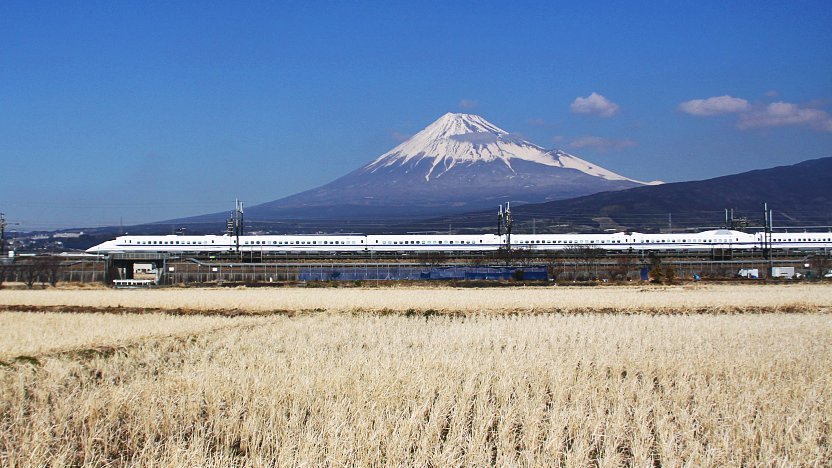
Why Your Seat Choice on the Shinkansen Actually Matters
Picture this: you've saved up for months, flown halfway around the world, and you're finally on the 東海道 (Tokaido, Tōkaidō (East Sea Road)) 新幹線 (shinkansen, bullet train), the legendary bullet train connecting Tokyo and Osaka via Kyoto. The train hits around 285 km/h. You're ready for that postcard moment with 富士山 (Fuji-San, Mount Fuji) in the background. Then you realise you're sitting on the wrong side.



What most people don't know is that the shinkansen doesn't slow down near Mount Fuji. You get roughly 30 to 60 seconds of visibility on a clear day, so there's zero time to scramble across the aisle or argue with the person in the window seat next to you. The seat choice you make at booking is the seat choice you live with.
My tip? Treat your shinkansen seat the same way you'd treat a concert ticket. Row and position matter, a lot.
The Right Side: Tokyo to Kyoto (and Back)
Here's the deal: if you're travelling from Tokyo toward Kyoto or Osaka on the Tokaido Shinkansen, you want to sit on the right side of the train, specifically in seats with the letter D or E in row configurations. Mount Fuji appears on your right, roughly between Shin-Fuji and Shizuoka stations, about 40 to 50 minutes after departing Tokyo. On a cloudless day, you'll see the full cone of Fuji-san rising above the foothills at an altitude of 3,776 metres. Absolutely worth it.
Travelling in the opposite direction, from Kyoto or Osaka back toward Tokyo? Flip it. You'll want the left side of the train, so seats in the A column. The mountain appears on your left as you head northeast. Sounds simple, right? It is, once you know it.
Best Seats by Direction
On the Tokaido Shinkansen Nozomi or Hikari services, the standard car layout puts three seats on the left (A, B, C) and two seats on the right (D, E) in each row. For the Fuji view heading from Tokyo to Kyoto, aim for seat E, the window seat on the right-hand side. Seat D is the aisle seat next to it, still on the right side but without a window. Going from Kyoto to Tokyo, seat A is your window target. Book early, because the E and A window seats go fast, especially on weekends and during cherry blossom season in late March and April.
What I especially like is that you can reserve these specific seats easily through the official JR website, the JR Pass exchange offices, or the app Ekinet. No guesswork at the ticket machine.
Large Luggage on the Shinkansen: Don't Get Caught Out
While we're at it, there's another thing that catches travellers off guard: Japan introduced stricter luggage rules on the shinkansen back in 2020. If your bag or suitcase exceeds 160 cm in total dimensions (length plus width plus height), you're now required to book a designated oversized baggage area seat in advance. Travelling without doing this can technically result in a fee of 1,000 yen on the spot.



To be fair, enforcement varies, and many travellers with large bags don't get stopped. But the overhead compartments on the shinkansen are genuinely small compared to what you might be used to on European trains or domestic flights. A standard 70-litre travel backpack or a large rolling suitcase won't fit. Plan for this.
The reserved baggage spots are located at the last row of certain cars, with space behind the final seats. Book through JR's reservation system and specify that you need the oversized baggage option. If you're travelling light with a smaller bag under 160 cm total, you're fine in any seat. Personally, I'd recommend shipping your heavy luggage ahead using Japan's 宅急便 (takkyubin, parcel delivery service) delivery service, which sends bags from your hotel to the next one overnight for around 1,500 to 2,000 yen per piece. It changes the entire travel experience.
Timing, Weather and the Fuji-San Reality Check
Hand on heart, Mount Fuji is covered in clouds more often than most travel photos suggest. The clearest views happen in winter and early spring, roughly November through February, when the air is dry and the snow cap is fully visible. Summer, especially July and August, brings heavy humidity and cloud cover. The mountain is technically visible from the shinkansen corridor for only a short window between the towns of Shin-Fuji and Kakegawa, so keep your camera ready before you reach Shizuoka.
I still remember exactly the first time I caught a full, unobstructed Fuji view from the shinkansen on a cold January morning. The mountain just appeared above the tree line, huge and perfectly symmetrical, and it was gone again in under a minute. That 60-second window is genuinely unforgettable when you're in the right seat.
The Japanese term for this kind of travel moment is 旅の記憶 (tabi no kioku, travel memory), a travel memory. Learning a few travel-related words in romaji, like shinkansen (bullet train), 座席 (zaseki, seat) (seat), 右 (migi, right) (right) and hidari (left), can also help you navigate station staff and seat reservations with more confidence. But that's not all. Knowing fuji-san simply means Mount Fuji (with san being an honorific suffix meaning mountain) adds a small but satisfying layer of cultural appreciation to the whole experience.
The best part? None of this requires expert Japan knowledge. A quick seat check before booking, a bag under 160 cm or a pre-booked baggage spot, and a clear morning in winter. That's genuinely all it takes to turn a fast train ride into one of the highlights of your Japan trip.
Frequently Asked Questions
Which seat should I book to see Mount Fuji on the Shinkansen?
Travelling from Tokyo to Kyoto or Osaka, book a window seat on the right side of the train, typically seat E in standard cars. Going the other direction, from Kyoto or Osaka to Tokyo, book a window seat on the left side, typically seat A.
When is the best time of year to see Mount Fuji from the Shinkansen?
Winter months, particularly November through February, offer the clearest views. The air is drier, the mountain's snow cap is at its fullest, and cloud cover is much less likely than in summer.
What are the luggage rules on the Shinkansen?
Bags with total dimensions exceeding 160 cm (length plus width plus height) must be placed in a designated oversized luggage area, which you need to reserve in advance when booking your ticket. Smaller bags can go in the overhead compartment.


