What Makes Hakone Jinja Worth the Trip
Let's be honest: Japan has no shortage of beautiful shrines. So why does Hakone 神社 (jinja, Shinto shrine) keep appearing on every serious Japan traveller's list? Founded in 757 CE during the Nara period, the shrine sits at roughly 725 metres above sea level on the wooded slopes of Mount Hakone, overlooking Lake Ashi. It's dedicated to three 神 (kami, divine spirit; god) (spirits): Nininigi-no-mikoto, Konohanasakuya-hime and Hikohohodemi-no-mikoto. That's quite a spiritual roster.



The approach to the main hall is lined with towering cedar trees, some over 800 years old. Walking beneath them in near silence, with the light filtering through, genuinely feels like stepping out of ordinary time. Fun fact: the famous 鳥居 (torii, shrine gate) gate that appears to rise directly from the waters of Lake Ashi is actually the Heiwa-no-torii, added in 1952 to commemorate Japan's post-war peace. It's arguably the most photographed spot in all of Hakone.
For Japanese learners, here's a handy bit of vocabulary: jinja means Shinto shrine, torii is the iconic gate structure you'll see at shrine entrances, and kami refers to the divine spirits or gods enshrined within. Getting comfortable with these terms makes exploring any shrine in Japan feel a lot more grounded.
My verdict? Even if you've visited dozens of shrines across Japan, Hakone Jinja earns its place. The combination of old-growth forest, lakeside setting and genuine spiritual atmosphere is hard to match.
Hydrangeas in May 2026: Timing Your Visit
Ever wondered why hydrangeas feel so deeply Japanese? The 紫陽花 (ajisai, hydrangea), as they're called in romaji, bloom across Japan from late May through July, and Hakone happens to be one of the finest places to see them. For spring 2026, the peak hydrangea season around Hakone Jinja is expected to fall between late May and mid-June, with late May often delivering the freshest, most vivid blooms.
The shrine grounds and the surrounding forest paths turn into a wash of blue, purple and white during this period. The colours shift depending on soil acidity, which is why you'll notice clusters that look almost violet next to others that lean more lilac or soft pink. It's not a single shade; it's a whole gradient.
Where to See the Best Blooms Near the Shrine
The main approach path leading up from the lakeside is lined with ajisai that frame the cedar trees beautifully. A short walk further into the forested areas around the shrine reveals quieter spots where the flowers grow in dense, almost theatrical clusters. By the way, if you arrive early in the morning, the mist that often sits over Lake Ashi adds a completely different, dreamlike quality to the whole scene. Insider tip: aim for a weekday morning to avoid the weekend crowds that tend to build up by mid-morning.
But that's not all. The Hakone area also hosts dedicated ajisai festivals and seasonal events in early June at nearby spots like the Hakone Open-Air Museum, so combining the shrine visit with a broader Hakone day makes excellent sense.



Catching Mount Fuji from Hakone Jinja
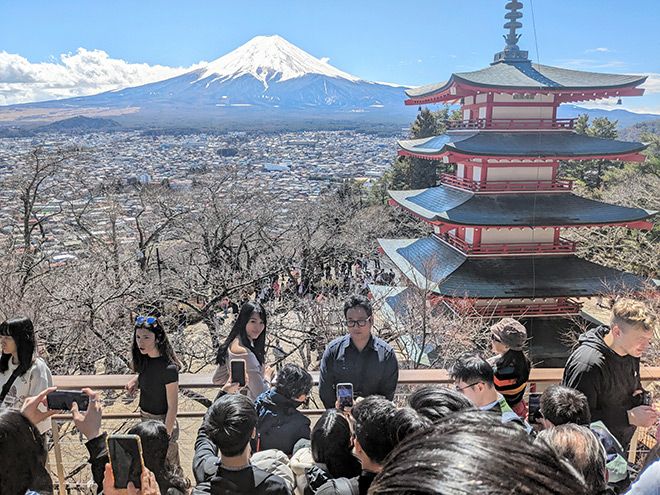
I still remember exactly the moment I first saw Fuji-san from the shores of Lake Ashi. It doesn't matter how many photos you've seen beforehand; the real thing, framed by water and forest, is a completely different experience. From Hakone Jinja and the lakeside area below it, you get one of the most celebrated views of Fuji in all of Kanagawa Prefecture.
The catch? Fuji is notoriously shy. Cloud cover hides it for the majority of days, especially in the rainy season that follows late June. For spring 2026 visitors aiming for that clear Fuji view, late May is statistically your best window before the 梅雨 (tsuyu, rainy season) (rainy season) sets in. Morning hours, before the day's heat builds up haze, give you the best odds. Wild, isn't it, that one of the country's most iconic views is also one of the hardest to reliably catch?
What I especially like is the combination of the Heiwa-no-torii rising from the lake with Fuji visible in the background. It creates a composition that somehow manages to look even better in person than in photographs. That's a rare thing.
Hakone Jinja as a Spiritual Retreat in Kanagawa
Hakone-machi sits within Kanagawa Prefecture, roughly 90 kilometres south-west of Tokyo. It's reachable by the Romancecar express train from Shinjuku in about 85 minutes, making it an entirely realistic day trip or an even better overnight stay. Pairing the shrine visit with a night in a traditional ryokan around the Hakone area turns a sightseeing trip into something that actually feels restorative.
Basically, Hakone Jinja works on two levels simultaneously. As a sightseeing destination, it delivers scenery, history and photographic moments. But as a place to slow down, it offers something harder to quantify. The forest, the lake, the cedar-lined paths and the sound of water all work together in a way that feels genuinely calming. Japanese culture has a concept called 自然 (shizen, nature), meaning nature, that is deeply intertwined with spiritual life. Being at Hakone Jinja in spring makes that connection feel completely natural rather than abstract.
Oh, almost forgot! The shrine also sells お守り (omamori, protective charm) (protective charms) and ema (wooden wishing plaques), which make meaningful, lightweight souvenirs. For language learners, reading the ema written by Japanese visitors is actually a lovely way to pick up natural, casual written Japanese in a real context. Just be respectful about it.
My tip? If you can, visit on a misty morning in late May 2026. The hydrangeas will be fresh, the crowds lighter, and if luck's on your side, Fuji will be waiting for you across the water.
Frequently Asked Questions
When is the best time to visit Hakone Jinja in spring 2026?
Late May 2026 is ideal. The hydrangeas are at their freshest, the weather is mild before the rainy season begins, and you have the best statistical chance of seeing Mount Fuji clearly from the lake.
How do I get to Hakone Jinja from Tokyo?
Take the Romancecar express train from Shinjuku Station to Hakone-Yumoto, then connect by bus or local train toward Lake Ashi. The total journey takes around 90 minutes. From the lakeside, the shrine is a short walk through the cedar forest.
Is Hakone Jinja suitable for a day trip?
Yes, it works well as a day trip from Tokyo, but staying overnight in the Hakone area at a traditional inn lets you explore more slowly and catch the early morning light, which is genuinely worth the extra effort.