Overview
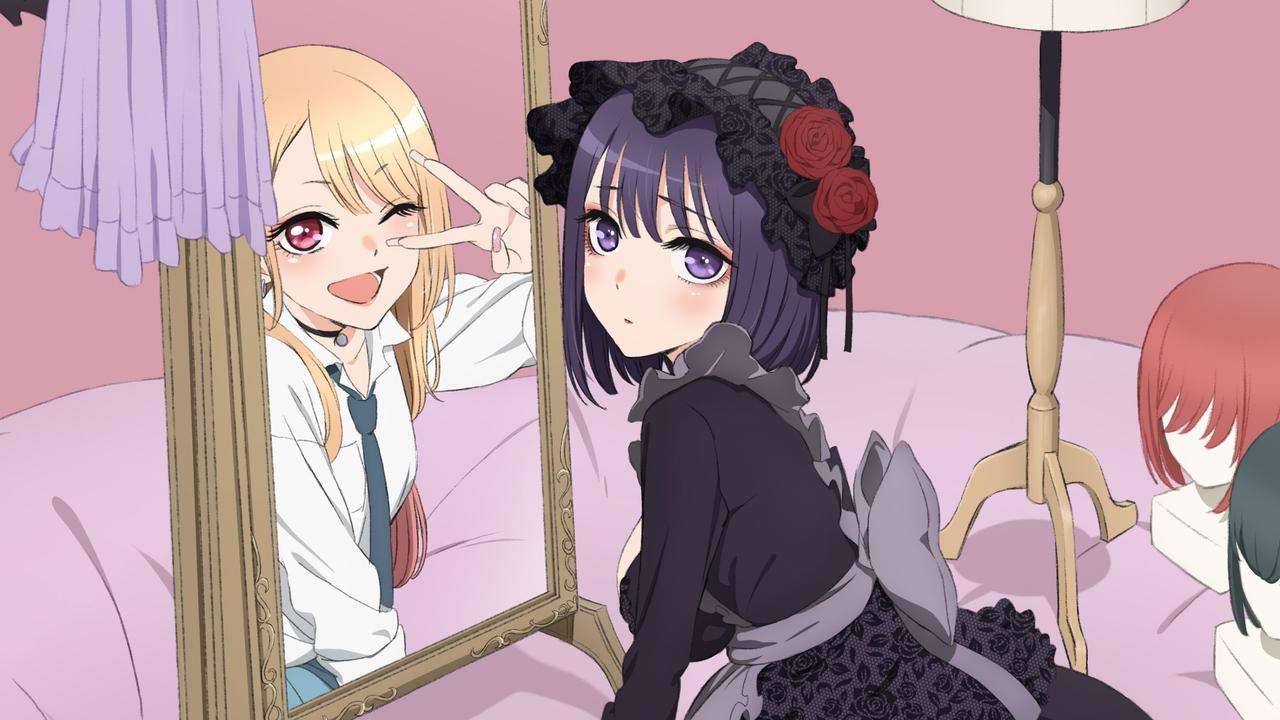
My Dress-Up Darling began in 2022 as a CloverWorks adaptation of Shinichi Fukuda’s manga, and it made its point quickly: this is a romance that understands labor. Wakana Gojo is a quiet hina doll craftsman, the kind of character who lives in the details, while Marin Kitagawa is an outgoing cosplayer whose enthusiasm drags him out of his shell and into a world where seams, fabric choice, and timing matter as much as feelings. That sounds simple on paper. In practice, it’s the entire engine of the series.
The first season aired from January to March 2022 and ran for 12 episodes, which is just enough time for the show to establish its tone without over-explaining itself. If you came in expecting a standard high-school romance, the series does something better: it treats cosplay as a serious creative practice rather than a joke, a fetish, or a shortcut to easy visual spectacle. That gives it unusual weight. It also means the emotional beats land because the work behind them is visible.

For readers looking for a practical entry point, this is the useful framing. My Dress-Up Darling review conversations tend to split into two camps: those focused on the chemistry between the leads, and those focused on the craft itself. I think the smarter read is that the two are inseparable. The romance works because the production keeps showing you why these two people need each other. That’s not decorative. It’s structure.
What the series is actually about
At its core, the story follows Gojo and Marin as they grow closer through cosplay and craftsmanship. Gojo brings technical discipline; Marin brings confidence, taste, and the sort of social ease that makes him visibly uncomfortable at first. The drama comes from watching each of them revise the other’s assumptions about what counts as important. Marin is not there to simply brighten the frame, and Gojo is not there to be a passive prop in her orbit. The show understands that mutual recognition is more interesting than a one-way crush.
This is also where the series earns its staying power. Cosplay is not treated as a costume gimmick. It’s a kind of collaboration. There are measurements, prototypes, adjustments, and enough quiet problem-solving to make the whole thing feel grounded. If you want a Japanese term that actually fits the subject, hyougen here means expression, and that’s exactly what cosplay becomes in the series: a way of turning emotion into visible form.
Why the first season worked
The first season succeeded because it resisted the usual anime shortcut of pretending enthusiasm is enough. It isn’t. Marin’s confidence matters, but so does Gojo’s craftsmanship, and the show repeatedly proves that the finished costume only works because both sides contribute something specific. There’s a quiet elegance to that idea. The series never needs to declare itself deep; it just keeps showing you the consequences of care.
For anime viewers interested in production craft, this is the kind of series that rewards attention. Clothing construction, posing, materials, and visual presentation all shape the scenes. The direction doesn’t drown in fetishized close-ups of process, but it knows when to linger long enough for the audience to understand why a solution works. That balance is harder than it looks. Many shows either skip the work or turn it into jargon soup. This one does neither.
The adaptation also benefits from CloverWorks’ polished presentation, which gives Marin and Gojo the visual clarity they need. Character acting does a lot of the heavy lifting. So does timing. A glance, a pause, a change in posture, and suddenly the emotional read is obvious without the script needing to underline it. That kind of discipline is why the show remains a reliable recommendation rather than a temporary seasonal obsession.
Where the story goes from manga to anime
Shinichi Fukuda’s manga was completed in 2025 with volume 15, which gives the anime a stable completed framework rather than an endless serialization haze. For viewers who care about adaptation context, that matters. You’re not looking at a story that drifted off into future uncertainty forever. There is a defined source shape behind it, and that helps explain why the anime’s early material feels so focused.
If you want to dig deeper into the character side of the franchise, the coverage around Marin has also kept the series visible outside the anime itself. The Marin Kitagawa figure pipeline is a good example of how this property continues to live as a character brand as well as a story. A Marin Kitagawa figure announcement is not just merch noise; it reflects how strongly the character design and personality have stuck in the wider anime market.
That said, merchandising is secondary. The reason the franchise keeps resonating is simpler: people respond to characters who feel useful to each other. The romance works because each person changes the other’s world in a concrete way. No mystical destiny required. Just skill, attention, and a willingness to show up.

How to watch it now
If you are looking for My Dress-Up Darling where to watch, the current practical answer is Netflix, where season 2 has started globally and is available worldwide. That makes the series unusually easy to catch up with compared with titles that bounce around platforms like an afterthought. For a modern anime viewer, convenience is not trivial. It is often the difference between actually starting a show and leaving it in the infinitely postponed pile.
If you are using the series as a My Dress-Up Darling guide for new viewers, I’d recommend starting from season 1 and treating the second season as a continuation rather than a reset. The show’s appeal is cumulative. Small habits, private insecurities, and the repeated act of making things together all matter more once you understand how the characters function. That’s the kind of writing that rewards patience, not speed.
For Japanese learners, the series also has an indirect bonus. A search like My Dress-Up Darling kanji or My Dress-Up Darling japanisch lernen makes sense because the show is full of everyday craft-adjacent vocabulary, school-life speech, and character interactions that are easier to follow when you already know some basics. The word 予約 (yoyaku), meaning a reservation or booking, is a useful example of the practical language you’ll notice around event planning and purchases in fan culture. The term 手伝い (tetsudai), meaning helping out, also fits the story’s emotional logic: people keep showing up to assist each other, and that’s often where the real relationship work happens.
Why it still matters
Plenty of anime get attention for being cute, stylish, or emotionally warm. Far fewer understand how to make those qualities feel earned. My Dress-Up Darling matters because it ties attraction to competence, and competence to trust. That is a better foundation than empty wish fulfillment. It also gives the series a rare kind of rewatch value: once you know how the characters move through each scene, you start noticing how carefully the show sets up every payoff.
Which is why My Dress-Up Darling remains easy to recommend even after the initial buzz has faded. The premise is straightforward, the craft is visible, and the emotional logic is sturdy. In other words, the show knows exactly what makes it tick, and it keeps proving it in practice, not just in theory.
Frequently Asked Questions
What is My Dress-Up Darling about?
It follows Wakana Gojo, a quiet hina doll craftsman, and Marin Kitagawa, an outgoing cosplayer, as they grow closer through cosplay and craftsmanship.
How many episodes are in season 1?
The first season aired in 2022 and ran for 12 episodes.
Where can I watch My Dress-Up Darling?
Season 2 has started globally on Netflix, where it is available worldwide.
Is the manga finished?
Yes. Shinichi Fukuda’s manga was completed in 2025 with volume 15.
Why do people call it a craft-focused romance?
Because the story uses cosplay as a real creative process, with measurements, materials, and collaboration driving the relationship between the leads.