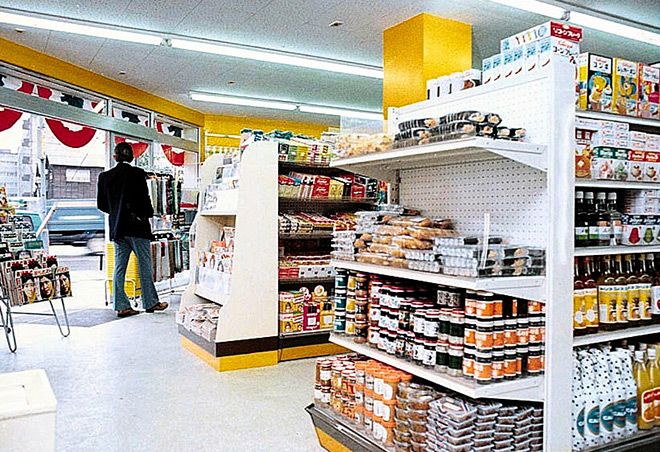
Overview: why the konbini matters
If you want to understand modern Japan without romanticizing it, start at the コンビニ (konbini, convenience store). The convenience store is where the day gets mended: lunch is bought, a bill is paid, a charger is borrowed, cash is withdrawn, and someone standing under fluorescent lights at 11:40 p.m. decides not to make a bigger problem of a small one. That ordinary usefulness is the point. Konbini culture is not about spectacle. It is about reliability, speed, and the texture of place, the sense that a neighborhood has a pulse even when the rest of the street has gone quiet.
The model became even more powerful as store hours stretched and product quality improved. What began as a retail format turned into an everyday infrastructure. In Japan, the konbini is a place for 弁当 (bento, boxed lunch), おにぎり (onigiri, rice ball), coffee, cash access, tickets, mobile charging, and those strange little errands that would be annoying anywhere else. Here, they are just part of the route.

How 7-Eleven helped define the modern system
7-Eleven arrived in Japan through the Ito-Yokado group in the 1970s, and from there it grew into a national institution under the Seven & I ecosystem. That expansion mattered not only because the stores multiplied, but because the idea behind them took hold: make the basic acts of daily life easier, and make them available at nearly any hour. The article retrospective on the entrepreneur behind 7-Eleven in Japan frames him as a pioneer who changed the rhythm of errands, meals, and small emergencies across the country. That is exactly right. The shift was structural, not decorative.
Japan’s konbini culture became increasingly convenient over time as the stores extended their hours and improved what they sold. The result is a system that feels obvious now, which is usually how you know something has won. It stops looking new and starts looking necessary. More than a snack shop, the konbini became a service point for a society that values speed but also expects a certain standard. That combination is hard to fake.
What you actually do at a konbini
The best way to read konbini culture is through the small acts it supports. You walk in for breakfast and leave with coffee and an onigiri. You stop by at night for a bottle of tea and a forgotten cable. You use the ATM, pick up tickets, top up your plans for the day, and move on. None of this is dramatic, and that is the beauty of it. The konbini reduces friction. It clears the lumpy parts out of the day.

For first-time visitors, these habits can feel almost too efficient, like a system that knows your next move before you do. For residents, they are simply part of life. In practical terms, the konbini is where a lot of the country’s everyday rhythm becomes visible. It tells you what people need, when they need it, and how little ceremony they want around the transaction.
- Bento and onigiri for fast meals with decent quality
- Coffee and drinks for the long walk, the commute, or the late shift
- ATM access for cash when you need it now, not later
- Mobile charging and other small practical fixes
- Tickets and other routine errands that save another detour
Why the format spread so widely
The konbini succeeded because it matched a real need: dependable access. Extended hours turned it into a 24/7 convenience system, often open all night, and better product quality made it useful rather than merely available. That distinction matters. A store can be open and still not deserve your trust. The Japanese konbini earned trust by becoming predictably good at small things. The onigiri is fresh enough. The coffee is quick. The checkout is fast. The shelves are legible. The body relaxes a little because nothing is being asked of it.
There is also a deeper cultural fit. Japan has long had strong habits around service, discretion, and precision, and the konbini condenses those habits into a few square meters. おもてなし (omotenashi, hospitality; attentive service), the carefully practiced hospitality that often appears in Japanese service, is present here in a very practical form: not ceremonial, just useful. And 予約 (yoyaku, reservation; booking), meaning a reservation, has its own place in the wider ecosystem of organized errands and pickups. You feel the logic of the system even when you are only inside for a bottle of water.

Related contexts for readers who want the bigger picture
If konbini culture interests you, it sits alongside a few other Japanese patterns that reward close attention. There is the supermarket bento economy, of course, but also the commuter rhythm that shapes what gets sold at what hour, and the broader culture of compact service spaces that solve multiple problems at once. If you are studying Japanese, this is also one of the best places to learn the language of everyday life, because the vocabulary is concrete and repeated: receipts, payment, pickup, stock, heating, disposal, and all the small actions that come with moving through a day.
For readers exploring Konbini Culture kanji or looking for Konbini Culture japanisch lernen material, the practical benefit is simple: you encounter useful words in context. Signs, packaging, payment instructions, and service prompts all reinforce the same basic literacy. That is not glamorous. It is useful. Which, in Japan, often matters more.
Where to experience konbini culture in Japan
You do not need a special destination. You experience konbini culture by using it, and Japan makes that very easy. Step into a store in a residential neighborhood, a station area, a business district, or a roadside stretch between cities, and you will see how consistent the format is while still reflecting the local surroundings. Early morning, late night, rain, heat, a long transfer, a tired walk home: the konbini is there for all of it.
If you want the fullest sense of the system, spend a few days paying attention to how often you enter one without thinking. That is the answer. Not a landmark, but a pattern. Not a novelty, but a piece of everyday infrastructure. More soon.