
Overview
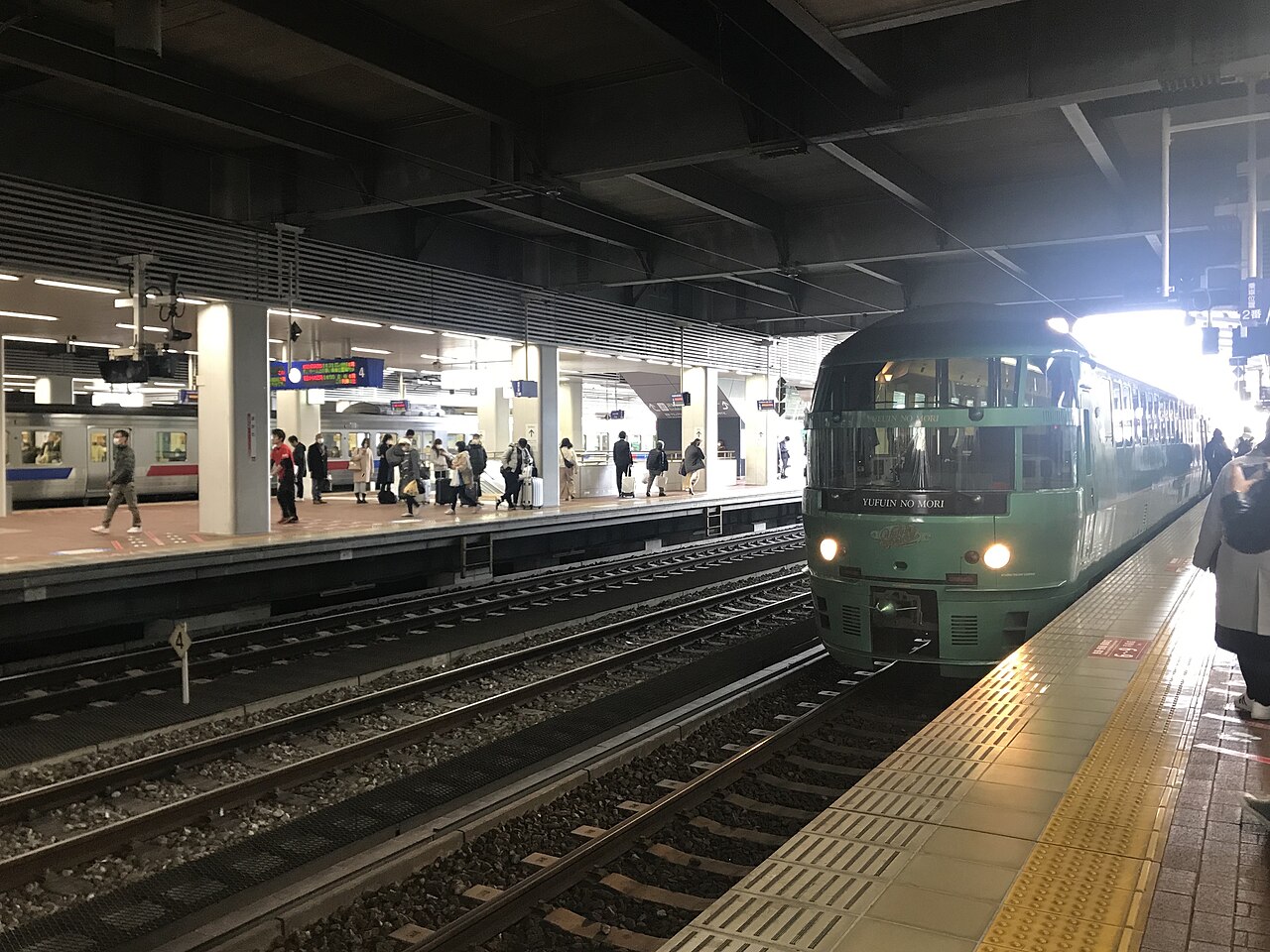
The Yufuin no Mori isn't a bullet train, and it doesn't pretend to be one. It's a JR Kyushu limited express — 特急 (tokkyu, limited express (train)), in timetable shorthand — built specifically for sightseeing rather than commuting, and it has been doing that one job, well, since 1989. The route runs between Hakata Station in Fukuoka, the transit hub for most of Kyushu, and Yufuin Station in the mountain town of the same name in Oita Prefecture, with some services continuing toward or connecting with Beppu on the coast. Cover roughly 119 kilometers of increasingly lumpy terrain in about two hours to two hours and fifteen minutes, and you go from a city concourse to a basin ringed by volcanic peaks. That's the whole appeal, distilled: the train is the on-ramp to Yufuin, and JR Kyushu built it so the on-ramp is worth doing in its own right.
The designer behind the livery
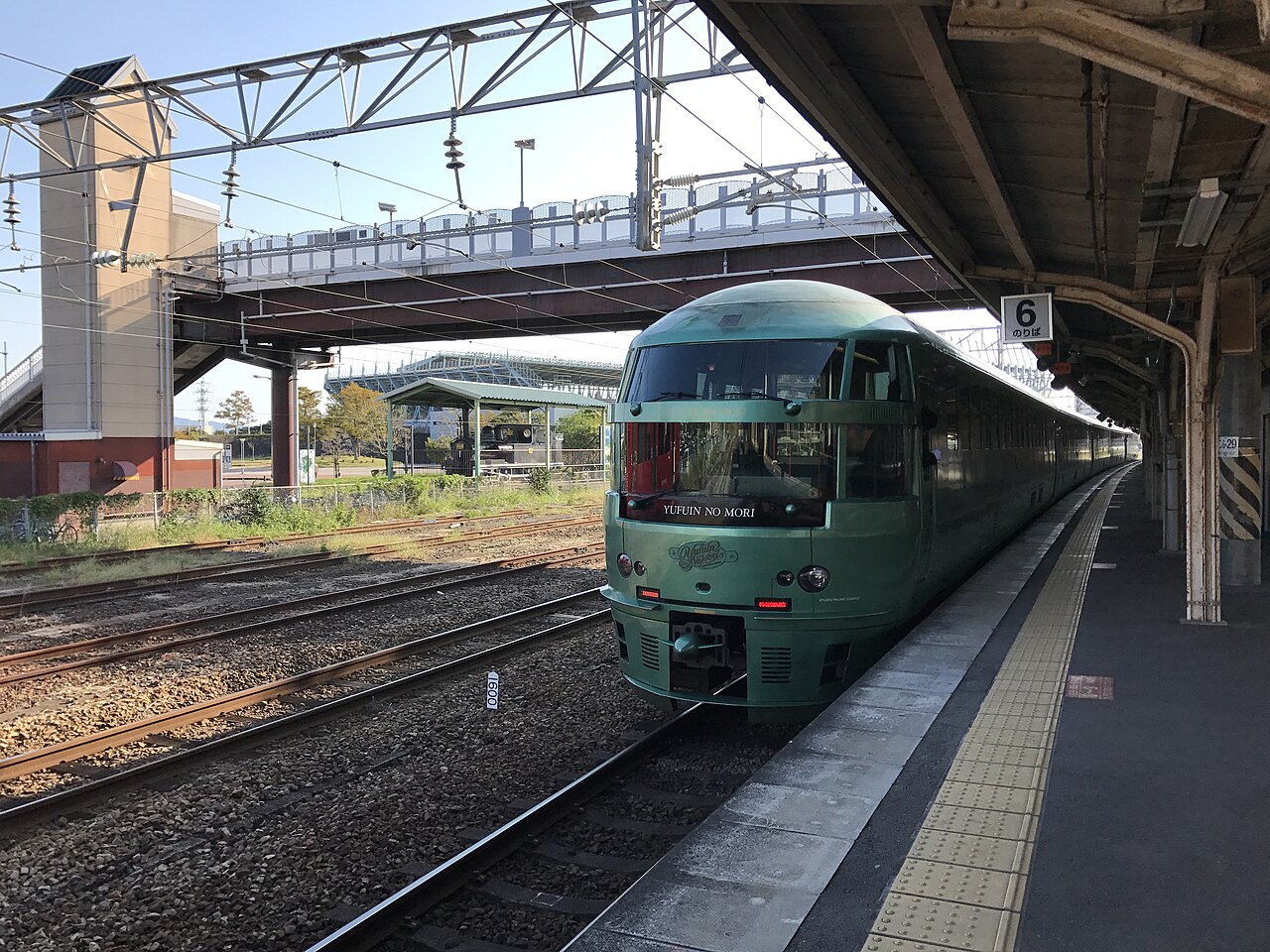
Credit for the look goes to Eiji Mitooka, the industrial designer JR Kyushu has leaned on for decades to make its regional trains feel like more than transport. Mitooka also designed the Aru Ressha, a dessert-and-cocktail excursion train, and the 787 series Tsubame, and there's a family resemblance running through his work: dark, saturated body colors, brass or brass-toned trim, and interiors that borrow more from a good hotel bar than a rail car. On the Yufuin no Mori, that shows up as the deep bottle-green livery — closer to forest than to anything you'd call corporate — paired with large panoramic windows built for looking out, not just letting light in.
Three trains, one name
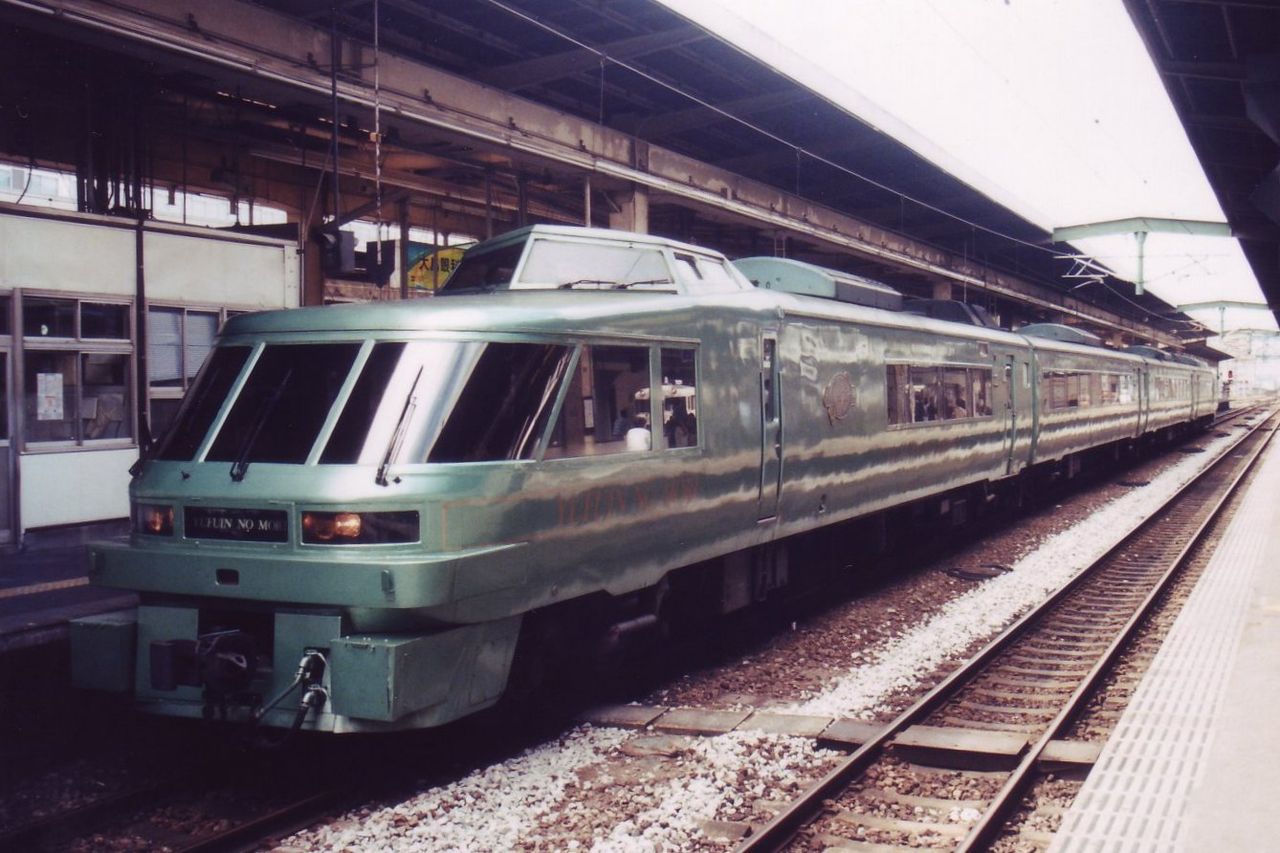
Here's where it gets slightly tangled, and worth untangling if you care about rolling stock the way some of us do. What runs today as the Yufuin no Mori is actually two distinct train sets sharing one livery and one name: the Type I, built on Kiha 71 series cars, and the Type III, built on Kiha 72 series cars. Both wear the dark green paint and the big windows; both do the same job. The numbering skips a generation on purpose. A true second generation existed — the Kiha 183 series, marketed as Yufuin no Mori II — and it ran this route from 1992 to 1999. It isn't part of the current fleet, though: JR Kyushu later converted those cars into the Aso Boy! train, which now runs a different line under a different name, fronted by a much-loved train mascot rather than a stretch of scenery. The Kiha 72 series sets you'll actually board today are, in other words, the third generation, in service since 1999 and marketed as Yufuin no Mori III, even if the 'III' rarely makes it onto English-language signage.
The route itself
Hakata to Yufuin covers about 119 kilometers and takes roughly two hours to two hours and fifteen minutes depending on the service — not fast by shinkansen standards, and entirely the point. The train works its way through Kurume and Hita and a handful of smaller stations that never make anyone's list, gradually trading flat city rail corridor for river valleys and pine-covered slopes as Oita Prefecture closes in around the track. It's a good stretch for doing nothing in particular: watching the country change out the window, which is a different kind of attention than sightseeing on foot, but a related one.
Onboard, the short version
Inside, the design logic matches the exterior: wood-panelled walls, wide and heavily padded seats, brass fittings on details you'd expect to be plastic, and at least one salon or lounge-style car built explicitly for standing at the window rather than sitting facing forward. That's not incidental — the whole cabin is arranged around the idea that passengers came to look at something, and the observation-first layout backs it up. Some services carry an Oita Wagyu 弁当 (bento, boxed meal), a boxed meal built around the prefecture's beef, available to order onboard, which turns the ride into lunch as much as transport.
A few practical notes for riding it
- Book seats on the right side of the train (seats C/D) when travelling from Hakata to Yufuin — the mountain views and Jion Falls sit on that side.
- Reverse it for the return leg: the left side gives the better view heading back from Yufuin to Hakata.
- This is a reserved-seat limited express, so reservations matter — good window seats go early on weekends and during peak seasons.
- If an Oita Wagyu bento is offered on your service, it's generally worth pre-ordering rather than hoping one's left.
Where the track ends: Yufuin
Step off and you're in a mountain basin at roughly 500 meters elevation, ringed by volcanic peaks including the twin-summit Yufu-dake, which does the thing good mountains do and changes shape depending on where you're standing. The town's main street, Yunotsubo Kaido, runs from the station toward Lake Kinrin and is dense with galleries, small boutique cafes, and traditional 旅館 (ryokan, traditional Japanese inn) — dense enough that Yufuin routinely places among Japan's most-visited 温泉 (onsen, hot spring) resort towns. What sets it apart is the water: Yufuin's onsen are locally reputed to be particularly good for the skin, and a large share of the ryokan here offer private open-air baths, 露天風呂 (rotenburo, open-air bath), tucked into their own gardens rather than shared communal ones. After two hours of sitting and looking out a window, that's not a bad way to arrive.
A little vocabulary for the ride
Part of what makes a trip like this worth logging, at least for language nerds, is the vocabulary that comes bundled in. Tokkyu (limited express) is the class of train the Yufuin no Mori belongs to, one step down from shinkansen and one step up from 快速 (kaisoku, rapid (train service)) (rapid) or 普通 (futsu, local (train) / ordinary) (local) service. 指定席 (shitei-seki, reserved seat) means reserved seat, which is what you're locking in when you book seat C or D. And once you've arrived, onsen, rotenburo, and ryokan are words worth having anyway — they cover, respectively, the hot spring itself, the private open-air bath, and the traditional inn built around both. None of it is complicated. It's just useful, in the specific way a handful of words are useful when you're standing at a ticket machine trying not to hold up the line.

