Overview
Besichtigung eines kostenlosen Hauses in Japan sounds simple on paper, and then the country reminds you that nothing about housing is ever simple. The term 空き家 (akiya, vacant or abandoned house) refers to an empty, unused, or abandoned house, and the scale is large: around 9 million vacant or abandoned homes and housing units were reported in 2023, roughly 14 percent of the housing stock. That number exists because of population decline, rural depopulation, and a very human pattern: elderly homeowners die, their children move away, and the property is left behind because keeping it is expensive, awkward, or emotionally loaded. That is the texture of the issue. Not a gimmick. A structural one.
If you are looking for a Besichtigung eines kostenlosen Hauses in Japan guide, start with the basic reality: municipal akiya bank registries exist to connect would-be occupants or buyers with vacant properties. Some of these homes are offered at very low prices; some are effectively free under local conditions, usually tied to renovation and a promise to actually live there. That last part matters. A house is not really free if it comes with roof repairs, paperwork, inheritance disputes, and the need to make the place livable again. Still, the idea is real enough that it keeps drawing attention, and the process is documented in local listings and regional housing programs.
Why akiya exist in the first place
There is a reason akiya are not rare curiosities but a nationwide condition. Japan’s demographics have shifted for decades, and many rural places have lost residents faster than they have gained them. Houses remain standing while families disperse. A property can become trapped in inheritance limbo because the land records are unclear, the heirs are uninterested, or the cost of demolition exceeds the value of the structure. Add taxes, repairs, and legal paperwork, and you have a house that is easier to leave alone than to pass on cleanly. That is how abandoned homes accumulate. Quietly. Then all at once, when you notice the numbers.
This is also why akiya banks matter. Municipalities created them as practical registries, not romantic fantasies. They are there to match supply with people who might actually use the space. In some regions, especially places often cited for affordable rural housing such as Yamanashi Prefecture, the listings can be strikingly low-cost. Sometimes the house is near zero in price. Sometimes it is described as a single yen. Sometimes it is free. Always, the fine print is doing more work than the headline.
What you see during a house visit
An abandoned house walkthrough can be disarmingly physical. The body registers it before the mind catches up: stale air, dust, warped flooring, old wallpaper, a latch that no longer quite trusts itself. Many Japanese houses left untouched for years still contain furniture, appliances, clothing, documents, photos, dishes, futons, and other daily objects. This is where the story stops being abstract. A room can look as if someone stepped out for a minute and never came back.
One of the most common tasks around these properties is 遺品整理 (ihin seiri, sorting and clearing a deceased person's belongings), the careful clearing of belongings after a death. Specialized companies do this room by room, because grief and logistics are often tangled together. Families may keep a house untouched for years out of attachment to the person who lived there, or because the task of sorting everything is too much to face. If you are seeing a property with a lot still inside, you are seeing the aftermath of delay, not only neglect.
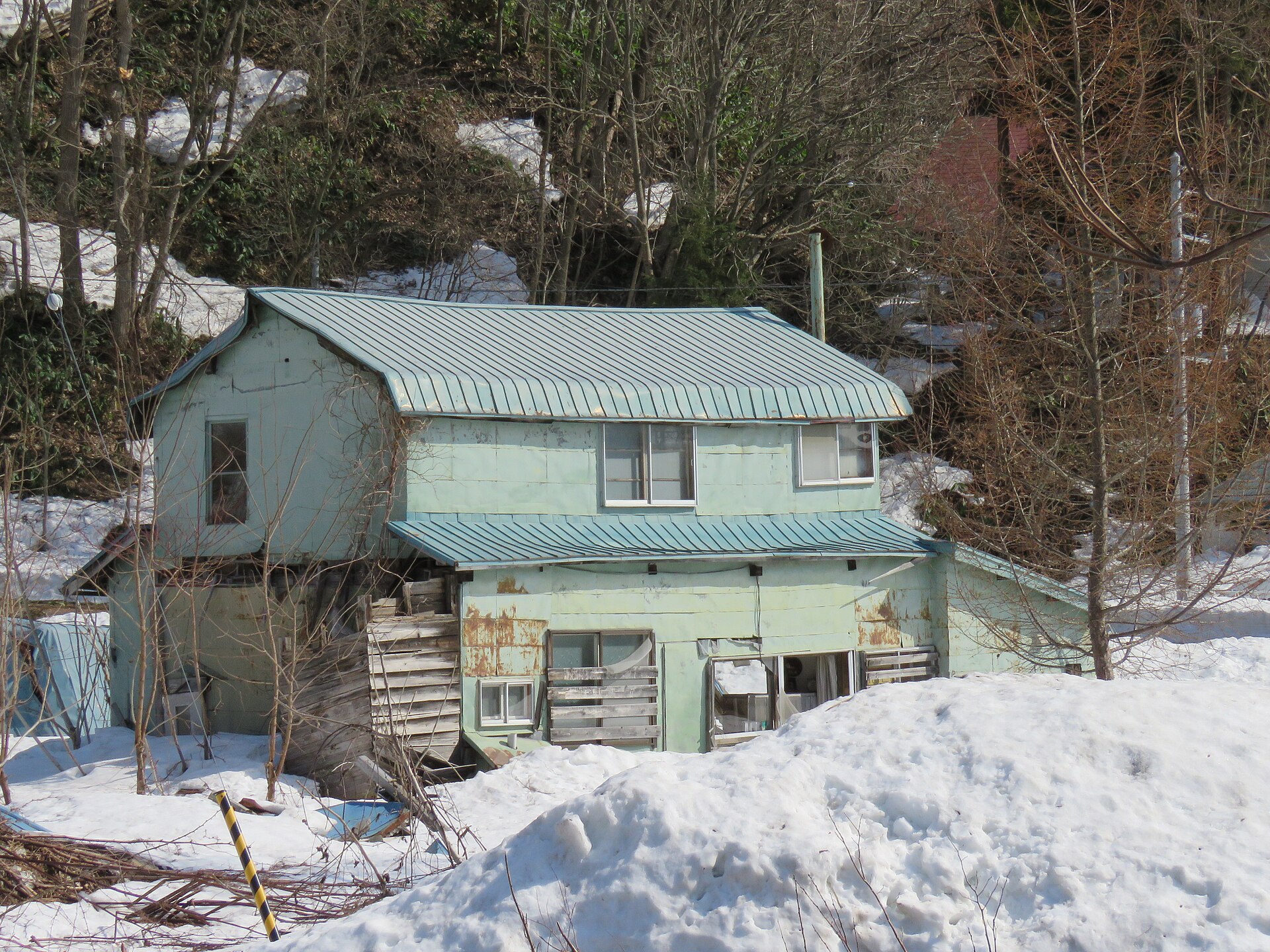
Some walk-throughs of rural homes describe the exterior as a mix of charm and visible decay, with a traditional tiled roof still legible even when the rest of the house has clearly slipped. I would treat that kind of report as useful but still cautious; conditions vary a lot, and not every property will match the same picture. But the pattern is familiar enough: the shell remains, and the details are lumpy with age.
How to search and what to check
If you want to experience this in Japan, the practical route is through municipal akiya bank websites and local government housing pages. Search by region, then narrow by conditions. Look carefully at whether the property is truly free or merely inexpensive. Read the requirements for renovation, occupancy, and time limits. Some agreements expect you to move in within a set period and maintain residence for a number of years. That is the deal. No mystery there.
Use these terms when you search, because they matter in the field: akiya, meaning a vacant or abandoned house; akiya bank, the registry that lists available properties; 予約 (yoyaku, reservation; booking), a reservation or booking if a viewing must be arranged in advance; and ihin seiri, the clearing of a deceased person’s belongings. If you are studying the language around it, Besichtigung eines kostenlosen Hauses in Japan kanji can be a useful search phrase for people who want the written forms later, but the real work is understanding how the system functions on the ground. For Besichtigung eines kostenlosen Hauses in Japan japanisch lernen, these are the vocabulary items that recur in local notices, not the decorative ones.
The safest approach is practical: ask about structural condition, utilities, water damage, roof status, access roads, and whether the land itself has any unresolved issues. A free house is still a house. Sometimes especially so.
Related places and adjacent experiences
Yamanashi Prefecture comes up often because it has both rural settings and examples of affordable housing programs, making it a useful reference point for anyone exploring akiya in the real world. More broadly, rural municipalities are where the experience is most visible: low-density neighborhoods, rice paddies, older streets, and the slow arithmetic of depopulation. If you want to see the system rather than just read about it, that is where to go.
If you are interested in the wider context behind these homes, it can also help to look at reports on abandoned houses in Japan and what gets left behind inside them. Those pieces show the same problem from another angle: not just the building, but the remains of ordinary life. That is the part that stays with you.
For readers who want a starting point inside the topic rather than a theory of it, here are the facts that matter most: the scale is large, municipalities are actively listing properties, some houses are sold for almost nothing, and the hidden costs are usually in the repair and paperwork. That is the whole shape of it. You can see why people are drawn to the idea. You can also see why many houses sit empty for years.
- Akiya are common because of demographic decline and inheritance complications.
- Municipal akiya banks are the main way to find them.
- Free or near-free houses usually come with conditions.
- Many abandoned homes still contain belongings and need ihin seiri.
- Rural areas like parts of Yamanashi Prefecture are among the clearest places to experience the phenomenon.
Frequently Asked Questions
What is an akiya?
An akiya is a vacant or abandoned house in Japan. Many are empty because of population decline, rural depopulation, and inheritance problems.
Can a house in Japan really be free?
Yes, some properties are offered at extremely low prices or even free through local authority programs, but they usually come with renovation and residency conditions.
What do abandoned Japanese houses usually contain?
They often still contain everyday belongings such as furniture, appliances, clothing, documents, photos, dishes, and futons.
What is ihin seiri?
Ihin seiri is the clearing and sorting of belongings left behind after a death. Specialized companies often handle it room by room.
Where should I look if I want to see akiya in Japan?
Municipal akiya bank websites and rural areas such as parts of Yamanashi Prefecture are practical starting points for seeing how the system works.