
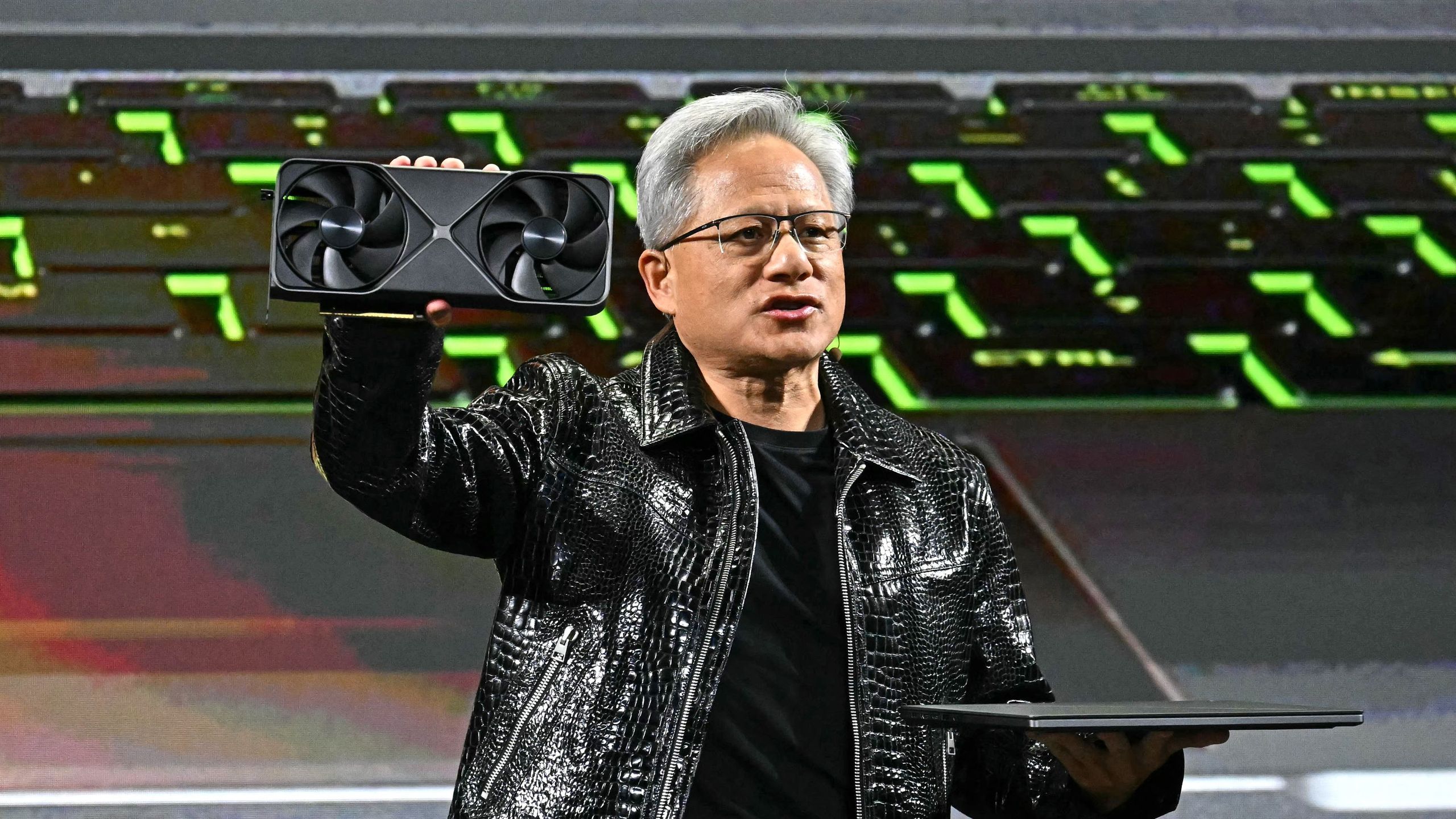
What makes this story so good is the mix of money, risk, and pure arcade-era nostalgia. If you grew up with Daytona USA, this one hits even harder.
![Dragon Ball Z: Kakarot [Master Edition]](https://s.pacn.ws/1/p/1eh/dragon-ball-z-kakarot-master-edition-908785.1.jpg?v=t8ja8t&width=400)


Okay, here’s the thing: Sega did not just fund a chipmaker
Know that feeling when a company you associate with blue hedgehogs and arcades turns out to have quietly changed tech history? That’s basically what happened here. Sega, during the Dreamcast era, put $5 million into Nvidia, and that decision helped keep Jensen Huang’s company alive when it was close to the edge.
This wasn’t some grand strategic masterplan with polished slides. It was a rescue, plain and simple. Sega had been working with Nvidia on graphics technology, and when one payment was on the table, Huang reportedly suggested turning it into an equity investment instead. Risky? Absolutely. But that’s also why it matters.
Here’s the catch: the money came at a moment when Nvidia was still tiny, fragile, and nowhere near the name it would later become. We all know the green logo now. Back then, it was a company trying to survive long enough to prove that its chips mattered. Wild, isn’t it?
My tip: if you like Japanese gaming history, this is the kind of story that shows how interconnected the industry really was. Sega was not just a console maker. It was a major technical force, and for one crucial moment, it ended up acting like a startup investor too. See what I mean?
Jensen Huang, Sega, and the Dreamcast-era gamble
Jensen Huang has built Nvidia into a company that now sits at the centre of gaming, AI, and semiconductors. But let me explain the beginning, because the early 1990s were a very different world. Nvidia was founded in 1993 in California, and by 1995 it was still fighting for relevance in a brutally competitive graphics market.
That’s where Sega enters the picture. The Dreamcast was still years away from launch, but Sega was already thinking hard about graphics, speed, and what kind of visual punch the next generation of games would need. Nvidia’s technology offered promise, and Sega saw enough potential to back it with real money.
Take Sega, for instance. The company had money flowing through arcade culture, home consoles, and licensing deals, yet it still made one of the boldest calls in gaming hardware history. Five million dollars sounds modest now, especially next to today’s Nvidia valuation, but in the mid-90s it was enough to matter a lot.
And the thing is: this wasn’t just charity. Sega expected results. The investment was tied to a relationship that could support future graphics ambitions, and that makes the whole episode feel very Sega. Fast-moving, slightly chaotic, and weirdly ahead of its time. Pretty brilliant.
Daytona USA, arcade nostalgia, and why this story still lands
That brings us to Daytona USA, one of those games that instantly summons the smell of an arcade floor and the sound of loud cabinets lined up under bright lights. Released in 1993, Sega’s racing hit became a symbol of the company’s technical swagger. If you were around that era, you probably remember the sense that Sega was always trying to outpace everyone else.
Daytona USA matters here because it captures the mindset behind the whole Nvidia story. Sega was obsessed with spectacle, with motion, with making hardware feel alive. That same obsession helps explain why it would spot potential in Nvidia before most people had even heard the name.
Seriously though: this is where gaming history gets really fun. A racing cabinet from the early 90s, a chipmaker on the brink, and a young Jensen Huang trying to keep the lights on. It sounds like trivia, but it’s actually a clean little lesson in how the industry works. The people who survive are often the ones who get a little help at exactly the right moment.
For Japanese learners, there’s a neat cultural angle too. Sega’s arcade roots are part of a broader Japanese game culture built on speed, competition, and public social spaces like game centres. Words like ゲームセンター (geemu senta, arcade game center) and 会館 (kaikan, hall; public hall) may come up in older discussions, but the real lesson is simpler: technology and play have always moved together in Japan, not separately.
Thirty years later, the full circle moment
Unlike what we’re used to in corporate history, this story has a genuinely satisfying loop. Three decades later, Sega and Nvidia are once again linked through graphics and gaming conversations, but now the scale is absurdly different. Nvidia is no longer the startup needing help. It is one of the most valuable tech companies on Earth.
What’s interesting is how clean the contrast feels. In the 1990s, Sega could see enough value in Nvidia to risk five million dollars. In the 2020s, Nvidia’s influence stretches from PC gaming to AI accelerators and high-end rendering. That arc is exactly why Jensen Huang’s name keeps coming up whenever this old investment story resurfaces.
I especially like stories like this because they remind you that the game industry is built on a lot more than hit releases. It’s built on trust, timing, and people making decisions before the outcome is obvious. If you’re studying Japanese or just love Japan’s tech and game culture, this one is worth keeping in your pocket.
And yes, there’s a little nostalgia baked into all of it. Sega helped save Nvidia. Nvidia went on to help redefine gaming. That’s a pretty good trade, if you ask me. From my experience, the best tech stories are the ones that feel almost impossible until you look back and realise they were right there all along.
My verdict: the Sega-Nvidia deal is one of those rare industry stories that is both financially huge and emotionally fun. It has Jensen Huang, a Dreamcast-era lifeline, and Daytona USA in the background. That combination is hard to beat.
Frequently Asked Questions
How much did Sega invest in Nvidia?
Sega invested 5 million dollars in Nvidia during the Dreamcast era.
Who was Nvidia's CEO during this period?
Jensen Huang was Nvidia's CEO, and he played a key role in the company's survival.
Why does Daytona USA matter to this story?
Daytona USA represents Sega's arcade-era confidence and technical ambition, which helps explain why Sega was willing to back Nvidia.


