
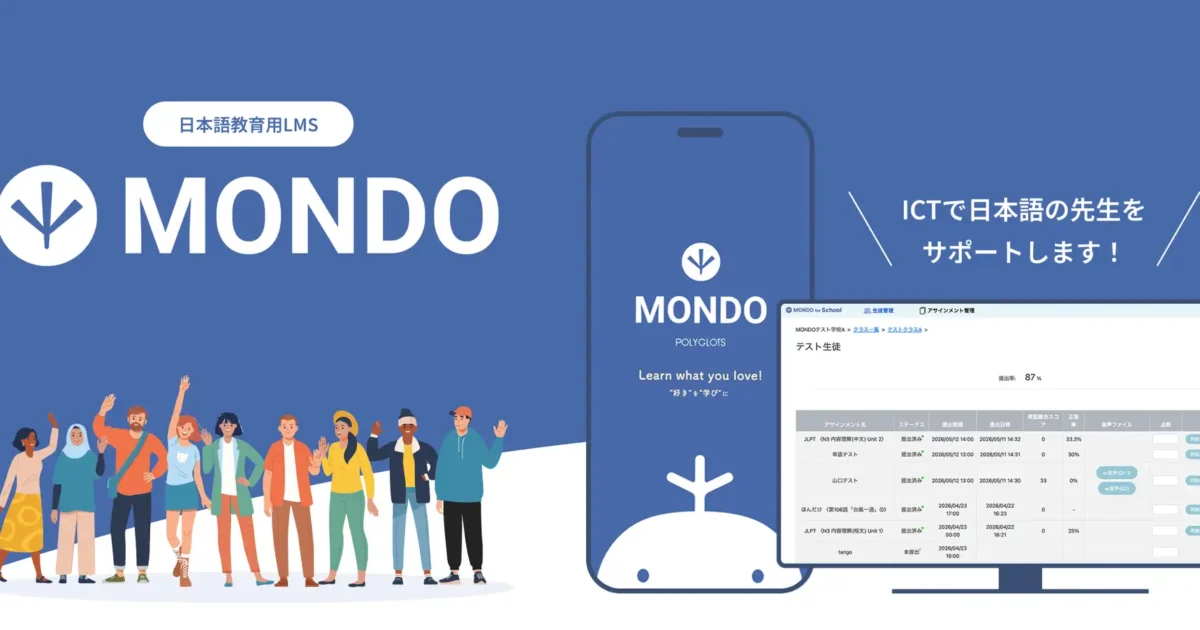
What I especially like is the angle: this isn’t just another study app, it’s trying to solve everyday problems for people learning Japanese inside Japan. That makes it relevant for anyone who’s ever struggled with jinbun, keigo, or just sounding a bit more natural when speaking.
MONDO and the reality of Japanese education in Japan
MONDO has arrived as a platform built for Japanese education, and that matters more than it might sound at first glance. Japan now has over 4 million foreign residents, according to recent population figures, and that creates a massive need for language support that works in schools, workplaces, and local communities. Compared with back home, where Japanese is often studied as a hobby or exam subject, learning in Japan is a daily-life issue, tied to jobs, forms, trains, and parent-teacher meetings.
The timing is smart. A learner in Tokyo, Osaka, or Fukuoka doesn’t only need vocabulary lists, they need language that helps them survive a doctor visit, ask a landlord a question, or understand a school notice. MONDO is positioned right in that gap, and that’s why this launch is getting attention among people who follow Japanese education closely.
To be fair, there are already plenty of apps and online tools. But many of them are built for solo self-study, not for the messy reality of a classroom or a mixed-level group. MONDO seems to be aiming at both sides, the teacher and the student, and that makes it feel more grounded than yet another flashcard platform. From my experience, that practical focus is exactly what Japanese learners in Japan have been waiting for.
Support for teachers is the big story
Guess what? The strongest part of MONDO may not be the learner side at all, but the teacher support. A lot of Japanese teachers, especially those working with foreign residents, are stretched thin. They need lesson structure, assessment ideas, and materials that can be adapted quickly, because every class has a different mix of ages, goals, and language levels.
MONDO is said to support teaching in a more organised way, which is a huge deal. Imagine a class where one student is preparing for JLPT N4, another is trying to read work emails, and another just wants to stop freezing during conversations. Teachers need a system that can handle that kind of spread without turning every lesson into chaos. That’s where a platform like this can really shine.
Why this matters for real classrooms
Take community Japanese classes, for instance. These are often taught by dedicated people, but not always with a big budget or polished materials. If MONDO can help with planning, tracking progress, and sharing tasks, that could save time and reduce pressure. Oh, and it could also make lessons feel more consistent, which students usually appreciate even if they don’t say it out loud.
On the flip side, a platform is only as useful as the time teachers actually have to learn it. If the interface is clunky, it’ll fail fast. But if it’s clean, flexible, and easy to adapt, then it could become the kind of thing teachers quietly rely on every week. My verdict: that’s the real test, not flashy branding.
JLPT, pronunciation, and assessment: where MONDO looks useful
Here’s the catch: lots of learners say they want to improve Japanese, but they don’t always know what to improve first. JLPT grammar? Listening? Pronunciation? Written output? MONDO seems to focus on three very concrete areas, JLPT preparation, pronunciation, and evaluation. That’s a sensible combination, because these are the spots where learners most often need outside feedback.
The JLPT angle is obvious. The exam still shapes how many people study Japanese, from N5 beginners to N1 grinders. If MONDO can help learners practise in a way that connects test skills with real communication, that would be seriously useful. And pronunciation support is just as important, because a lot of learners can read and understand far more than they can comfortably say.
Why pronunciation feedback matters so much
Picture this: you know the word, you understand the word, but when you say it, the rhythm is off and nobody catches it. That problem is painfully familiar to anyone studying Japanese. The language has pitch patterns, long vowels, short vowels, and sounds that can change meaning fast, so pronunciation feedback isn’t a luxury, it’s a necessity.
That’s also why assessment matters. If a learner gets only vague comments like “good job”, they won’t know what to fix. A system that can show where a sentence breaks down, or where spoken Japanese sounds unnatural, gives learners something concrete to work on. That reminds me of how good teachers in Japan often correct one tiny detail at a time, because those small fixes add up.
Compared with back home, where language classes can lean heavily on written tests, Japanese learning in Japan often rewards speaking confidence and listening speed. MONDO appears to understand that balance. If it can link assessment to everyday use, not just exam scores, it could become very useful for both serious learners and people who just want to function better in Japan. From my experience, that is where the best language tools earn their keep.
What Japan learners should watch next
The first time I went to Japan, I was surprised by how much language learning happened outside the classroom. A train announcement, a convenience store conversation, a note from city hall, all of it was part of the lesson whether I wanted it or not. That’s why a platform like MONDO feels relevant, because it connects study to the actual social reality of living in Japan.
For Japan fans abroad, this launch is still worth watching. A tool designed around Japanese education in Japan often ends up revealing what the country needs most: clearer support, better feedback, and less guesswork. Wild, isn’t it? The best learning tools are often the ones that solve boring problems well.
My tip: if you study Japanese, look beyond vocabulary drills and ask how a platform handles feedback, speaking practice, and exam prep. Those three things can change your progress much faster than adding another app to your phone. And if you teach Japanese, especially to foreign residents, a system like MONDO could save time and make lesson planning feel far less heavy. Wait, there’s more.
For readers who like following Japan news that affects real learners, this is exactly the kind of development worth tracking. It’s not just about tech, it’s about how people live, study, and communicate in Japan right now. more Japan news on jpnerd.com
Frequently Asked Questions
What is MONDO?
MONDO is a new platform focused on Japanese education, with support for learners and teachers.
Why is this launch relevant for Japanese learners?
It connects directly to JLPT study, pronunciation practice, and better feedback for real classroom use.
Who benefits most from this platform?
Teachers working with foreign residents in Japan, and learners who want practical Japanese support, may benefit the most.


