
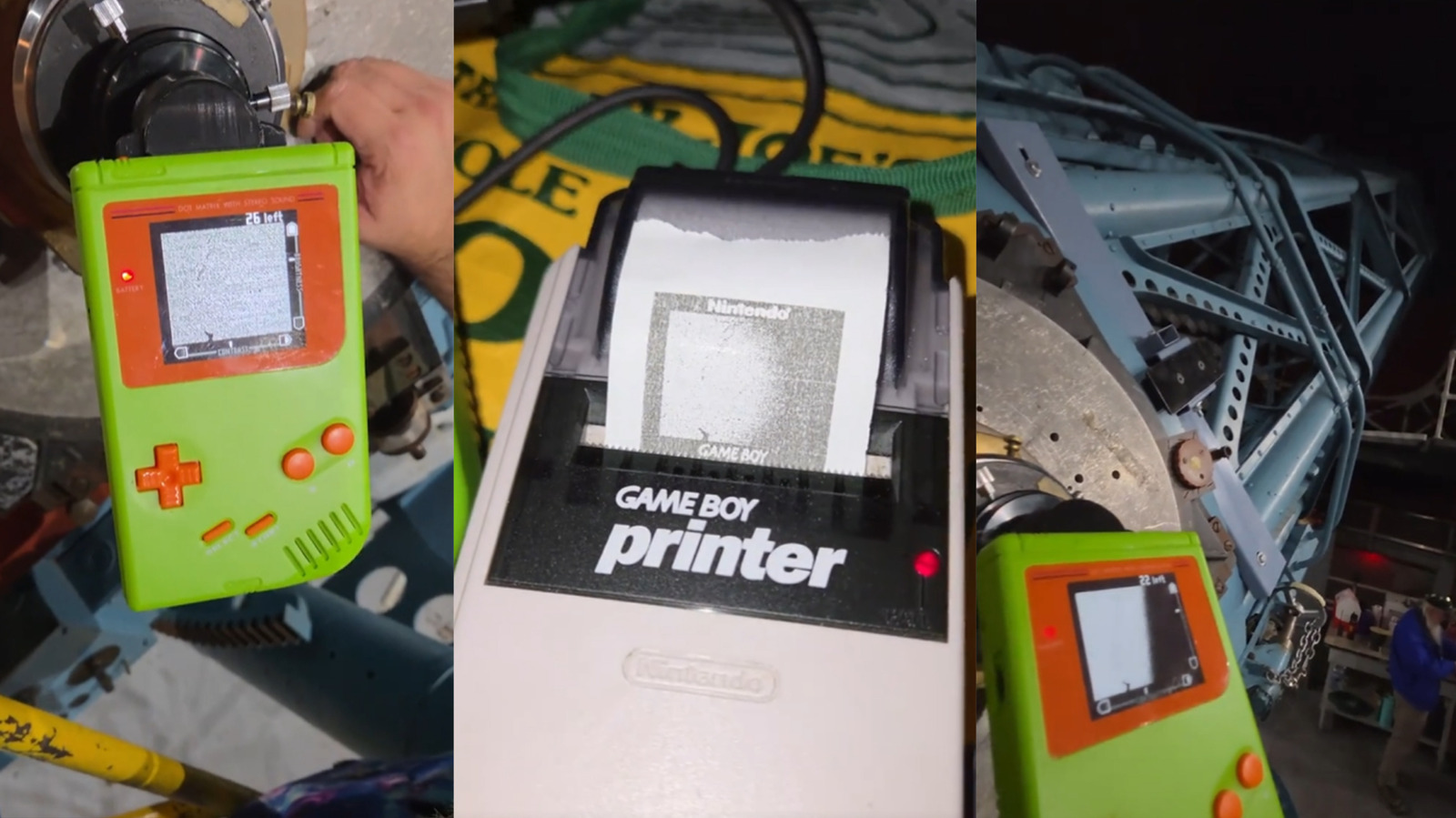
For Japan fans, this one hits a sweet spot, because it connects Nintendo history, space science, and that very Japanese knack for making the most of limited hardware.
![Dragon Ball Z: Kakarot [Master Edition]](https://s.pacn.ws/1/p/1eh/dragon-ball-z-kakarot-master-edition-908785.1.jpg?v=t8ja8t&width=400)


Game Boy Camera Meets Astronomy
Ever wondered why a tiny 1998 accessory from Nintendo is suddenly part of a serious astronomy story? The Game Boy Camera, known in Japan as the Pocket Camera, was never meant for deep space work, and that’s exactly why this story is so fun. It was designed for kids, gamers, and anyone who wanted to take grainy black-and-white selfies on a handheld console, not for observatories watching Jupiter.
That’s why the recent telescope project feels so delightfully unexpected. A team working with NASA-style scientific observation adapted Game Boy Camera hardware to capture astronomy footage, and the result is a reminder that old tech doesn’t always lose value. Hand on heart: I love this kind of reuse, because it turns nostalgia into something practical, and that’s very Japanese in spirit too, a bit like giving an old 茶碗 (chawan, tea bowl) a second life instead of throwing it away.
Why the Nintendo Game Boy Camera still matters
The reason is simple: the Game Boy Camera is small, flexible, and surprisingly hackable. Released by Nintendo in 1998 for the Game Boy and Game Boy Color, it used a tiny sensor and very little memory, which means images were crude by modern standards, but the hardware’s easy to understand and modify. For makers and retro-technology fans, that simplicity is gold.

Compared with back home, where old electronics often get boxed up and forgotten, Japan has a strong culture of preserving and repurposing hardware. You see that mindset in retro game shops in Akihabara, in repair cafés, and in the way people still treasure first-generation gadgets. Speaking of which, the Game Boy Camera has always had a cult following among collectors, speedrunners, and hobbyists who like pushing devices beyond their original purpose. From my experience, those are exactly the people who end up building the coolest science projects.
From toy to tool
Here’s the kicker: the camera’s limitations are part of the charm. Low resolution, odd colour handling, and a noisy image pipeline sound like deal-breakers, but in scientific work, raw character can sometimes be useful if you know how to calibrate around it. Scientists and engineers often care less about beauty and more about repeatability, and that makes the Game Boy Camera a surprisingly interesting test platform.
Guess what? The image sensor’s age also makes the whole thing feel very analogue. It reminds me of older Japanese digital culture, where tiny displays, chiptune sound, and compact design all had to work together. Simply brilliant.

Jupiter, scientific observation, and what the telescope actually did
Did you know that Jupiter is one of the easiest planets to observe with amateur astronomy gear, yet still one of the hardest to study well? It’s bright, fast-moving, and full of atmospheric detail. That makes it a perfect target for testing a strange camera setup like this one, because even a modest system can pick up bands, brightness changes, and the planet’s strong contrast.
The telescope project used the Game Boy Camera as part of an observation setup aimed at proving that retro hardware can contribute to real scientific observation. This isn’t about replacing modern detectors or Hubble-style instruments. It’s about experimentation, calibration, and seeing how far a classic Nintendo accessory can be stretched when paired with modern optics and careful processing. Seriously though, that kind of work matters, because science often begins with “let’s see what happens” before it becomes a polished lab result.

My tip: if you enjoy Japanese tech history, compare this with the way old consumer gadgets in Japan often get revived for niche communities. A Walkman becomes a collector’s item, a Super Famicom becomes a mod platform, and now a Game Boy Camera ends up in an astronomy context. That mix of playfulness and engineering is very much the Japanese fan culture sweet spot. Sounds good, right?
Why Japan fans should care about this retro science mashup
Oh, almost forgot: there’s a language-learning angle here too. If you’re studying Japanese, this story is a neat excuse to remember words like カメラ (kamera, camera), 天文 (tenmon, astronomy), 星 (hoshi, star), and 宇宙 (uchu, space). You can also think of Nintendo itself as part of modern pop culture vocabulary, because Japanese media and hardware names pop up everywhere in English-language tech coverage.
And there’s a deeper cultural point. Japan’s hobby culture often celebrates tinkering, from model kits to vintage consoles, and that mindset is exactly what made the Game Boy Camera project feel possible. It’s not just about nostalgia, it’s about curiosity. If a 1998 handheld accessory can help with astronomy, then there’s a good chance the next clever scientific observation project is sitting in someone’s drawer right now. Convinced yet?
In pictures


Frequently Asked Questions
What is the Nintendo Game Boy Camera?
It is a small camera accessory released in 1998 for the Game Boy line, designed for taking very low-resolution images and short effects-based photos.
Why would astronomers use such old hardware?
Because old hardware can be repurposed for experiments, testing ideas, and exploring how simple sensors behave in controlled observation setups.
What planet was mentioned in the project?
Jupiter was the main astronomical target discussed in the project.
For more stories like this, read more Japan news on jpnerd.com.


