
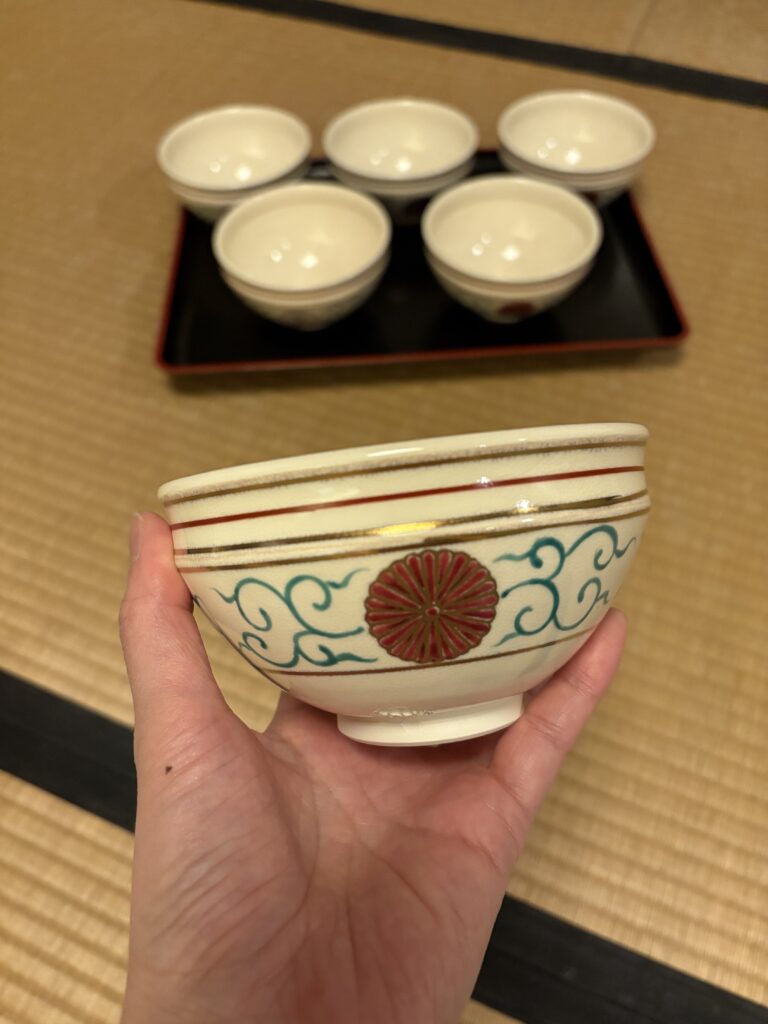
That matching wasn’t decoration for its own sake. It was a careful form of hospitality, and it told me a great deal about Japanese tea culture, the group experience, and the craft choices behind the bowl in your hands.
Matcha bowls in tea ceremony: the quiet logic behind the choice
Guess what? The first thing I learned was that a 抹茶 (Matcha, powdered green tea) bowl, or 茶碗 (chawan, tea bowl), is never just a container. Its shape, weight, glaze, and colour all affect how matcha tastes, feels, and looks when it’s whisked into a bright green foam. In a proper tea ceremony, that bowl becomes part of the dialogue between host, guest, season, and craft.
At the Asakusa tea ceremony I attended, the room was small and calm, with 畳 (tatami, straw mat flooring) underfoot and a low, unhurried rhythm to everything. The host didn’t hand out random bowls. Instead, each person in the group received a bowl that fit the overall theme, and the set felt intentional, almost like a carefully arranged chorus. It was subtle, but once I noticed it, I couldn’t stop noticing it.
Asakusa tea ceremony and the group experience
Fun fact: a group tea ceremony in Asakusa often has to work with a wide range of guests, from first-timers to people who already know how to bow, turn the bowl, and hold it properly. That means the host has to create a shared experience that feels coherent without becoming stiff. Matching bowls help with that. They give the group a visual thread, a sense that everyone is part of the same moment, even if each guest is receiving a slightly different bowl.
Here’s the kicker: matching doesn’t always mean identical. In one case, the bowls may share the same glaze family, such as soft celadon tones or a dark iron-like surface. In another, they may differ in shape but still belong together through colour, season, or the work of one kiln. What matters is the feeling of correspondence. I found that deeply moving, because it makes the group feel considered rather than processed.
Why the host chooses matching bowls
Basically, the host is balancing aesthetics, practicality, and a kind of social poetry. If a group is sitting together in Asakusa, especially in a tea ceremony studio that welcomes visitors, the bowls may be chosen to help everyone feel included. A matching set can also make the learning process easier, since beginners are less distracted by visual noise and can focus on the gestures, the temperature, and the etiquette of receiving tea.
Here’s the catch: the bowls are rarely chosen only for convenience. The host is also thinking like a curator. A spring gathering might lean towards pale, fresh glazes. Autumn might bring earthy browns, greys, or crackled surfaces that seem to hold the season inside them. The bowl is small, but the decision around it isn’t. Wait, there’s more.
What matcha bowls reveal about Japanese craft
Unlike what we’re used to in many Western table settings, Japanese tea ceremony gives objects a social role. The bowl is made by 職人 (shokunin, artisan; craftsman), craftspeople whose work often carries the mark of a kiln, a region, and a long line of inherited technique. I like that this isn’t hidden. The clay can be felt. The hand can be sensed. The glaze can break in a way that makes the bowl more alive, not less.
And it gets better: different bowls change the experience of drinking matcha in practical ways. A wider bowl can make whisking easier. A deeper one can hold warmth longer. A rougher surface can make the bowl feel more grounded in the hands, while a thin-walled one may seem almost delicate enough to disappear. My tip: if you ever have the chance to attend a tea ceremony in Asakusa or elsewhere, pause before drinking and study the bowl for a few seconds. That pause isn’t wasted time. From my experience, it’s where the room begins to speak.
Season, glaze, and the feeling of a set
Know that feeling when something looks ordinary until it suddenly doesn’t? That was my experience with a coordinated set of matcha bowls. One bowl can be beautiful, but a group of matching bowls creates rhythm. You see variation within order. You see an artisan’s thinking extended across several objects, almost like a sentence repeated with small changes in tone.
In Japanese tea culture, that matters because the gathering isn’t only about tea. It’s about relation. The host, the guests, the utensils, the room, and the season all meet in a temporary arrangement. When the group receives matching bowls, the ceremony becomes easier to read, and somehow more intimate. It says: we’re here together, and this moment has been composed for us with care.
Why this matters for Japanese learners and Japan fans
For language learners, tea ceremony is a gentle place to notice how Japanese culture uses language through form and context, not just vocabulary lists. Words like chawan, 茶の湯 (chanoyu, tea ceremony), and おもてなし (omotenashi, hospitality) appear often, but so does something harder to translate: the social sense that beauty should serve the group, not only the individual. In Asakusa, that became very clear to me. The bowl wasn’t a trophy. It was a bridge.
I also think tea ceremony is a good reminder that Japanese practice often rewards observation before explanation. You don’t need to know every technical term to feel what a set of bowls is doing. Still, learning the words helps. Chawan for bowl, 濃茶 (koicha) for thick tea, usucha for thin tea, and omotenashi for hospitality all open different doors. Highly recommended: learn them alongside an actual tea experience, if you can. The terms stick better when your hands have already met the object.
What I especially like is the restraint. No one in the room needed to announce that the bowls matched. The logic was visible. The hospitality was quiet. And the craft, as it often does in Japan, carried the meaning without insisting on it. See what I mean?
Frequently Asked Questions
Why are bowls matched in a tea ceremony?
Matching bowls help create visual harmony, support the theme of the gathering, and make the group feel part of one shared experience.
Do all guests receive identical bowls?
No. They may be similar in style, colour, or season, but not necessarily identical.
Is this common in beginner tea ceremonies in Asakusa?
Yes, many host venues use coordinated bowls to create an accessible and memorable group experience.


