
And that’s exactly the sort of thing I love about Japanese food culture: recipes travel, social media gets involved, and suddenly a yoghurt tub can become an international talking point. Honestly, it’s the kind of culinary loop only the internet could’ve come up with.
Japanese Cheesecake, the Viral Recipe That Went on Holiday
I still remember exactly the sort of internet moment this was: a recipe so simple that people looked at it twice, then a third time, because surely a cheesecake made from a yoghurt packet was either a prank or a miracle. It turned out to be neither, and somehow both. The original idea, as covered by BuzzFeed Japan, starts with an everyday yoghurt container, which is emptied, refilled with ingredients, and used as a measuring cup. Low-budget genius, basically, which is why the clip travelled so well.
What many overlook is that the charm isn’t just the finished cake, but the format. Japanese home recipes often lean on neat proportions, practical tools, and a tiny bit of theatre. You get a yoghurt pack, a few simple ingredients, and the satisfying sense that someone, somewhere, has decided the kitchen should behave like a tidy desk drawer. The result is soft, lightly sweet, and very much in the Japanese dessert lane, where restraint is often the whole point. See what I mean?
Why Overseas Social Media Called It Japanese Cheesecake
Here’s the kicker: overseas, this humble recipe was picked up and recast as Japanese cheesecake, a label that travelled faster than the cake itself. People outside Japan saw a fluffy, wobbling, almost absurdly light dessert and immediately connected it to the famous style they already knew, the sort that made its name through Japanese café culture and travel videos. Social media did the rest, as it always does, with all the grace of a shopping trolley on a slope.
The reason is simple: Japan has long been associated with desserts that look delicate and taste cleaner than their Western cousins. Think of the famous cotton-soft cheesecake served at places like Rikuro Ojisan no Mise in Osaka, or the souffl and basque-adjacent variations that pop up in cafes from Tokyo to Fukuoka. So when a recipe looked airy, pale, and pleasingly jiggly, people abroad were primed to call it Japanese. Not bad, right?
The Japanese learning angle: recipe words you’ll actually hear
If you’re learning Japanese, this little food saga is useful because recipes are packed with everyday vocabulary. You’ll see words like 加工 (kakou, processing) for mixing, ヨーグルト (yoguruto, yoghurt) for yoghurt, kaji for heating, and mou for moulds or trays, depending on the context. And if a video shows a dessert being whisked into shape in seconds, you may hear 簡単 (kantan, easy) (easy) more often than 本格 (honkaku, authentic; genuine) (authentic), which is a very Japanese balance of practicality and modesty, really.
Insider tip: recipe videos are brilliant listening practice because the language is visual, repetitive, and usually tied to one action at a time. You don’t need to understand every syllable to follow along, which is a relief, because few of us are born with perfect kitchen vocabulary. I’m certainly not. But that’s not all.
Matcha Japanese Cheesecake and the Return Trend to Japan
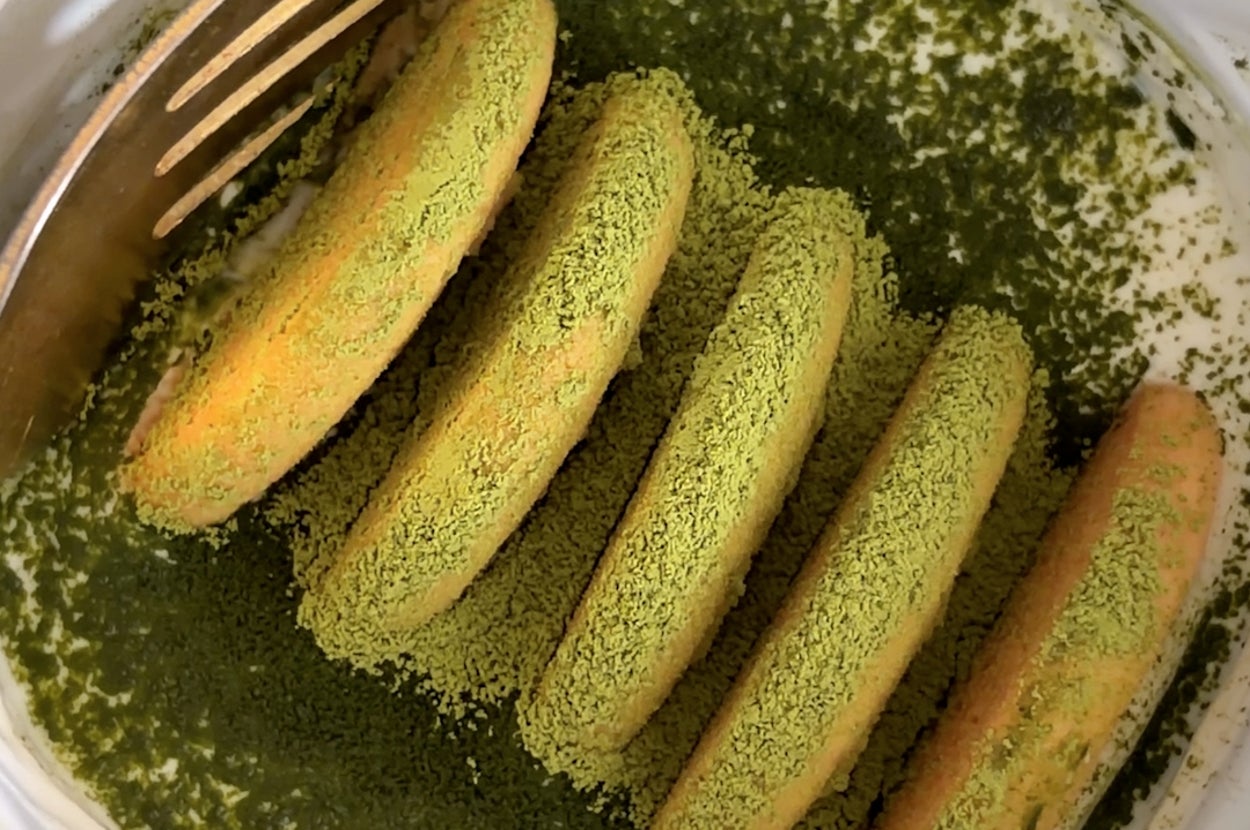
Speaking of which... the cake didn’t stay in its overseas internet costume forever. A 抹茶 (matcha, powdered green tea) version appeared, and that feels almost inevitable, doesn’t it? Matcha has a way of entering any dessert conversation and politely refusing to leave. The green tea powder gives the cheesecake a deeper aroma, a faint bitterness to balance the sweetness, and, crucially, the exact shade of green that makes social media stop scrolling for half a second.
And here comes the reverse trend, which is the bit I find most entertaining. A dessert that was exported, rebranded, and viralised abroad comes back to Japan with overseas popularity attached, like a package returning to sender with extra stickers. Japanese readers then see the foreign buzz, rediscover the cake, and the whole thing loops back into domestic conversation. It is a bit like hearing a song you ignored for years, only to find it has become a club anthem in another country. Humans are peculiar creatures.
Quick detour: this isn’t the first time Japan has watched its own food culture boomerang back after a stint abroad. Pancakes, soufflé cakes, convenience store sweets, even matcha itself have all been reinterpreted overseas and then re-imported with fresh status. The internet has made this process much faster, of course, and also slightly sillier, which I count as a win. All here, all in confectionery.
What This Says About Japanese Food Culture and Social Media
Know that feeling when a recipe is so simple it seems almost rude? That is part of the appeal here. A yoghurt-pack cheesecake speaks to a very Japanese kind of domestic cleverness, where everyday packaging becomes part of the method, and nothing is wasted unless it absolutely must be. At the same time, social media loves recipes with a visual hook, and this one gives you a neat origin story, a tidy technique, and a cake that jiggles like it has confidence. See what I mean?
My tip: if you want to understand Japanese food culture, don’t just look at the restaurants with the prettiest plating. Watch the home recipes, the convenience-store experiments, the café specials, the YouTube remakes, the seasonal matcha releases, and the comments section that inevitably argues about texture. That’s where the living culture is, not in the brochure. And yes, I do realise that sounds slightly serious for a story involving a yoghurt tub.
On the flip side, the reverse trend also shows how Japan isn’t just exporting food culture, but receiving it back through a global filter. The world takes a Japanese idea, labels it, reshapes it, then sends it home dressed a little differently. Sometimes that means a richer texture, sometimes a greener colour, sometimes just a good excuse to post a clip with cheerful music and a suspiciously perfect slice. I can’t pretend that isn’t amusing. Highly recommended:
If you’re a Japan fan, this is exactly the kind of story that makes learning language and following food trends feel like the same hobby. You get the vocabulary, the context, the cultural loop, and the small delight of realising that a dessert can cross borders, pick up a new identity, and then come back for an encore. Honestly, Japan never stops providing these little circular surprises. And that’s why we keep watching.
Frequently Asked Questions
What is Japanese cheesecake?
It is a soft, airy cheesecake style that is lighter than many Western versions and often has a souffl-like texture.
Why did the yoghurt-pack recipe go viral?
Because it was simple, visually neat, and easy to copy, which is exactly the kind of thing social media loves.
Why is matcha such a common variation?
Matcha adds colour, aroma, and a familiar Japanese flavour that works very well with creamy desserts.


