For Japan fans who like travel that has a bit of texture, this is the sort of day that makes sense. You get the spectacle of a major race, then the quieter work of moving through grassland, slopes, and village roads on two wheels. Sounds good, right?
Tour de Kyushu 2026 brings race day to Aso
Tour de Kyushu 2026 is setting up one of those neatly layered Kyushu days: the race finish in Minamiaso, then a guided 32.9-kilometre cycling route through Aso’s countryside, according to Fukuoka Now. That number matters. It’s long enough to feel real, short enough to leave room for looking around, which is usually the right balance in this part of Japan.

What most people don't know is that Aso isn’t just a scenic stop, it’s a working landscape shaped by volcanoes, grazing land, and roads that keep changing character as you move. The finish in Minamiaso gives the event a strong local anchor, and the follow-up ride turns the area from backdrop into route. That’s the good stuff. Not a postcard. A place you move through.
Before I forget, this kind of tour format says a lot about how Kyushu is being presented to visitors now. Not only temples, not only hot springs, not only food, though all of those are close by and matter. It’s also about distance, elevation, wind, and the basic pleasure of having a reason to keep pedalling. Classic Japan, isn’t it?

Why Aso works so well for cycling
The reason is simple: Aso has space, and space changes the feel of a ride. The roads around Minamiaso can open out into broad views, then tighten into lumpy little climbs or long descending stretches, the sort that make you notice your cadence and your breathing. If you only know Kyushu from city time in Fukuoka or Beppu, Aso is a different register altogether.
Compared with home, a ride like this often feels less segmented. You aren’t bouncing from one attraction to the next; you’re inside the terrain. That matters for Japan learning too, because the words you hear here tend to be grounded in place: 山 (yama) for mountain, 里 (sato) for village, 川 (kawa) for river, and the ever-useful 桜 (sakura, cherry blossom) when spring is involved. On a bike, those words stop being vocabulary lists and start being labels for what is in front of you.
A great example: a route that is mostly downhill still asks for attention. You still need to read the road, watch the surface, and keep your line. The body is doing the work, even when the effort feels light. That is part of why cycling in Japan can feel so precise. Small shifts matter. A corner. A gust. A patch of shade. A few kilometres can change the whole mood.



Taking your own bike on the bus
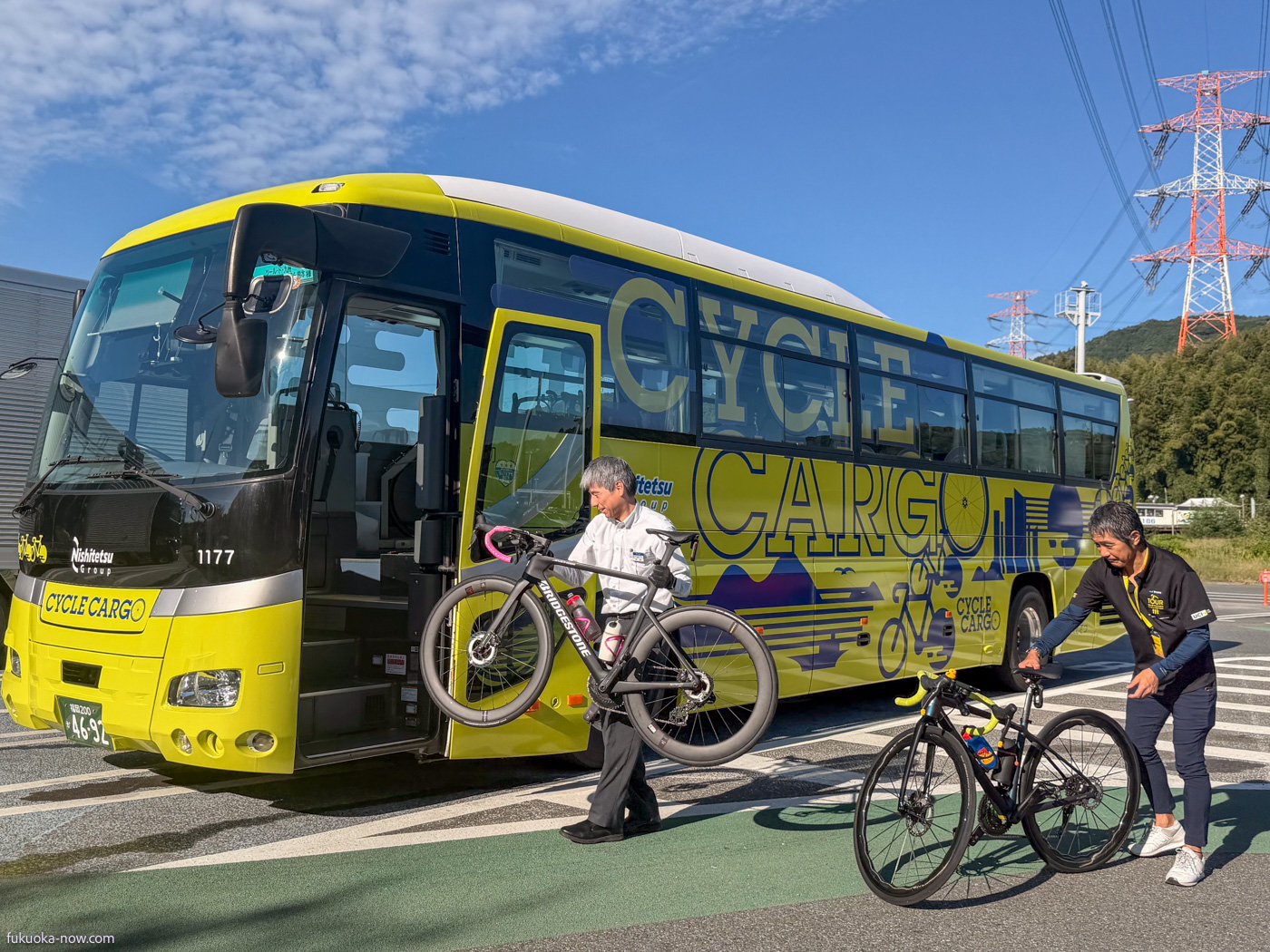
The Fukuoka Now report notes that Nick and Emiko brought their own bikes aboard Nishitetsu's Cycle Cargo bus to get to the finish area. That detail is worth pausing on, because it shows how Japanese transport can be adapted for bike travel without turning the day into a logistical puzzle. Take the bike, take the bus, get to the place, then ride. Clean. Efficient. Very Japan.
While we're at it, this is useful context for anyone planning a cycling trip in Kyushu. A route doesn’t have to start at a train station to be workable, and it doesn’t have to be a major multi-day tour to feel rewarding. Sometimes the best day is the one with a transfer, a finish line, and a manageable ride afterwards. The body likes that structure. So does the mind.

Let’s be honest: bike travel can get fussy fast if every kilometre needs to be engineered by hand. A bus that accepts bicycles changes the equation. It lets you focus on the road itself, which is the point. Not the packaging around the ride. The road.
Why this matters for Japan fans and learners
The best part is that this story sits right at the overlap of travel and language. If you are learning Japanese, a cycling day in Aso gives you concrete words to latch onto, and not in a classroom way. You see 南 (minami) for south in Minamiaso, you hear place names that carry geography in them, and you get a reminder that Japanese often works best when tied to context rather than memorised in isolation. That is useful, and a little humbling.
My tip: when you read travel coverage like this, keep a small note of the terms that repeat. Aso, minami, sato, yama, onsen if your day extends farther into Kyushu. These are not just words, they are ways of organising the landscape. And if you are the sort of person who likes quiet structure, the combination of pro racing, a countryside ride, and an efficient bus transfer is very appealing. More soon.
In pictures


Frequently Asked Questions
What is Tour de Kyushu 2026 in this story?
It is the race event that finishes in Minamiaso, with the article focusing on the Aso cycling follow-up described by Fukuoka Now.
How long is the guided ride mentioned here?
The guided ride is 32.9 kilometres.
Why is Aso a good cycling area?
Because it offers open countryside, changing terrain, and a strong sense of place, which makes the ride feel connected to the landscape rather than separate from it.