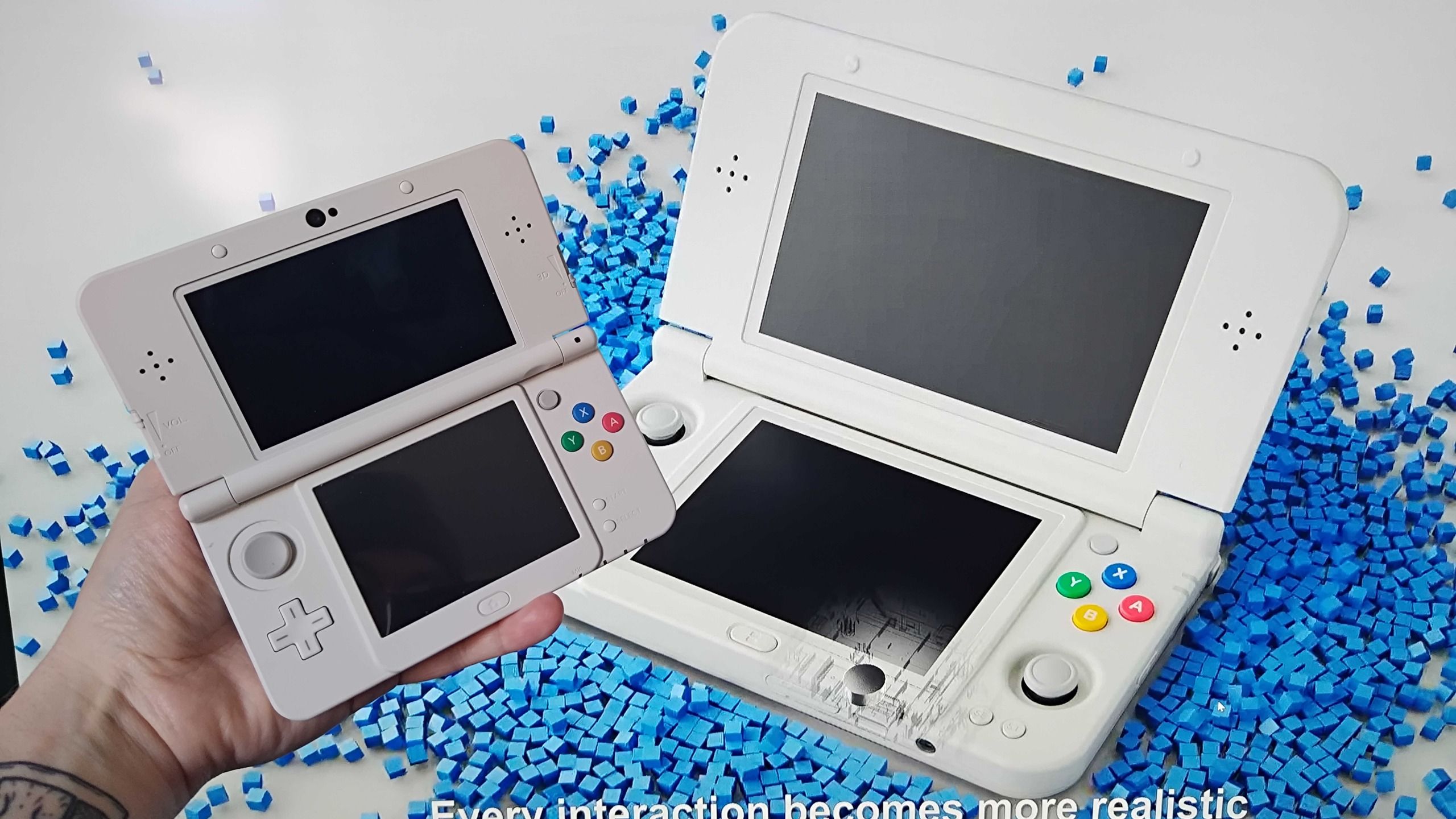
That number matters, because this isn’t just another clamshell novelty. Anbernic is leaning hard into the old 3DS shape, stylus support, and dual-screen layout, which means the RG DDS is aiming at a very specific kind of nostalgia, one that Japan fans and Japanese language learners will recognise straight away.


Here’s something that probably doesn’t get enough attention: the Anbernic RG DDS isn’t just borrowing the Nintendo 3DS silhouette, it’s building the whole experience around two IPS screens, a stylus, and a layout that makes old dual-screen gaming feel like the point rather than the gimmick.
Anbernic RG DDS goes straight for the 3DS feel
The basic pitch is simple. The RG DDS uses two custom IPS panels, and Anbernic is clearly chasing that familiar Nintendo 3DS profile instead of the usual single-screen handheld formula. According to Anbernic's own product page, the upper display is approximately 4.7 inches with a 1200 x 720 resolution, while the lower display is approximately 4 inches at 960 x 720. Both panels are listed at 300 PPI and 500 nits.
What many overlook is that those numbers are doing a lot of work here. A bright screen matters on a portable device, especially one that wants to mimic the crisp, layered look of the 3DS library. The company is also leaning on the dual-screen format for navigation and touch input, which makes the device feel more like a dedicated system than a generic Android slab with a hinge attached. And there’s more.
Why the dual-screen format still has a case
A great example is the Nintendo DS and 3DS, which were built around the idea that the lower screen could hold menus, maps, inventories, or touch controls while the upper screen handled the main action. That split still makes sense for a lot of retro software, and it also lines up neatly with the way Japanese games often organise information, with compact UI, context-heavy menus, and a strong emphasis on quick hand-eye coordination.
Speaking of which, if you learn Japanese, this kind of hardware is a small but useful reminder of how often games rely on short labels and repeating interface language. Terms like 決定 (kettei, confirm / decision), 戻る (modoru, to go back / return), and menu-style options show up everywhere, and a handheld that preserves two-screen interaction can make that learning context feel more natural. I’m not claiming the RG DDS is a language-learning device, because that would be a stretch, but the format does support the kind of screen literacy that Japan fans end up building over time. My verdict: the shape is the message.
![Dragon Ball Z: Kakarot [Master Edition]](https://s.pacn.ws/1/p/1eh/dragon-ball-z-kakarot-master-edition-908785.1.jpg?v=t8ja8t&width=400)
Specs, scale, and the part Anbernic is betting on
Notebookcheck reports that the RG DDS is powered by a Qualcomm Snapdragon G2 Gen 2 chipset, paired with a 6,000 mAh battery and those 500-nit displays. That puts it in a more ambitious bracket than a basic throwback handheld. It isn’t just trying to run old games, it’s trying to sell the idea of a premium dual-screen retro machine, and that’s a very different pitch from the cheap plastic nostalgia box market.
By the way, the obvious question is whether this is style over substance. In practice, the answer depends on what you want. If you want one screen and minimal fuss, the whole dual-display concept may feel like excess. If you care about DS and 3DS software, or you simply miss the era when handheld design had personality, then the RG DDS starts to make sense very quickly. I’d call that a narrow audience, but not a tiny one.
What this says about retro handhelds now
Compared with back home, where handheld gadgets often chase broad utility first, Japanese gaming hardware has long tolerated a bit more specificity. Clamshells, second screens, styluses, odd proportions, these weren’t bugs, they were the product. And that history gives devices like the RG DDS an easier job in front of Japan fans, because the reference point is already culturally legible.
To be fair, no one should pretend the RG DDS is a 3DS replacement in the full sense. It lacks the defining 3D trick, and that omission matters more than the marketing copy might want to admit. Still, the combination of two IPS screens, a 3DS-like layout, and a reasonably serious chipset gives it a clearer identity than many retro handhelds manage. What I especially like is that it seems to understand the thing people actually miss, not just the logo. Personally...
Frequently Asked Questions
What is the Anbernic RG DDS?
It is a new dual-screen retro handheld from Anbernic with two IPS displays and a design inspired by the Nintendo 3DS.
Does the RG DDS have two different screens?
Yes. Anbernic lists an approximately 4.7-inch upper display and an approximately 4-inch lower display, both IPS panels.
Is the RG DDS the same as a Nintendo 3DS?
No. It uses a similar clamshell style, but it does not include the 3D feature that defined the original 3DS.