
Overview
Hotel vs. 旅館 (ryokan, traditional Japanese inn) is one of those decisions that looks simple until you are standing in front of a booking screen, trying to decide whether you want reliability or atmosphere, a business room or a room that asks you to remove your shoes and pay attention. In practical terms, hotels are usually the safer, more comfortable choice for Japan trips, especially if you want predictable room layouts, strong Wi-Fi, and a 24-hour front desk. Ryokan are different. They are not just somewhere to sleep; they are a built environment for a certain kind of stay, one shaped by 畳 (tatami, woven straw mat flooring) flooring, 布団 (futon, floor bedding mattress) bedding, seasonal meals, and the quiet discipline of hospitality called おもてなし (omotenashi, thoughtful, attentive hospitality), meaning attentive service that is meant to feel considered rather than transactional.


If you are trying to read the Japan lodging landscape with a little more clarity, the useful question is not which option is better in some abstract sense. It is what you want the body to do after a day of moving through streets, stations, and weather. Hotels keep things efficient. Ryokan slow the whole frame down. That's the real split.
What a hotel stay gives you
In major Japanese cities, typical business hotels often cost about 8,000 to 15,000 JPY per night, while premium hotels can run to 30,000 JPY or more. That price spread makes hotels the most flexible option for many trips, especially when the goal is clean logistics rather than immersion. International chains such as Park Hyatt Tokyo and Hilton Tokyo are often cited for the kind of predictable comforts that matter after a long day: reliable Wi-Fi, larger beds, and 24-hour reception. No drama. No extra choreography.
The standard hotel formula works because it removes friction. You know where the desk is. You know how breakfast works. You know the room will usually be configured in familiar ways. For short city stays, early departures, late arrivals, or trips where you will spend most of the day out on the train network, that consistency has real value. There is a reason so many people default to it. The body wants easy answers sometimes.
What makes a ryokan different
A ryokan is built around a more traditional rhythm. The room is often finished with tatami, the woven straw mat flooring that changes the feel of a room immediately; the bed is usually a futon, a floor mattress laid out by staff; and dinner may be a 懐石 (kaiseki, multi-course traditional meal) meal, a multi-course sequence that turns eating into a formal part of the stay. That structure matters. It is not simply decoration. It creates a slower evening, one where the room, the food, and the service are all working toward the same atmosphere.
This is where ryokan earn their reputation. They are not trying to behave like hotels with wood trim. They are something else, and the distinction is the point. Many include 温泉 (onsen, hot spring bath) access, which means a hot spring bath, often separated by gender and sometimes assigned by time slots. If you have tattoos, check the policy in advance, because some baths still restrict entry or ask guests to cover them. It is one of those small practical details that can shape the whole stay. Worth knowing before you arrive with a towel over one shoulder and assumptions in your pocket.
Ryokan also carry a dense cultural texture. The language of the stay is different. The pace is different. Even the expectation around shoes, clothing, and moving through shared spaces is part of the experience. Clothing and 浴衣 (yukata, casual cotton robe), the casual cotton robe provided in many ryokan, appear more often in ryokan reviews than in other accommodation types, which makes sense: the room itself nudges you into a different way of inhabiting the evening.
How the price and value equation actually works
People often assume ryokan are automatically more expensive, but the reality is more layered. A good ryokan with dinner and breakfast usually costs about 12,000 to 40,000 JPY per person, and dinner is often the main price driver. That means the rate can climb quickly if you want the full package, but it also means the cost is tied to a specific kind of experience rather than just square footage and thread count. Hotels, by contrast, can be cheaper for one night, especially if you are only using the room as a base for the next day’s movement.
So the comparison is not really room versus room. It is package versus package. In a hotel, you are often paying for efficiency. In a ryokan, you are paying for sequence: arrival, tea, room, bath, dinner, sleep, breakfast, departure. The whole evening has architecture. If you care about that, the value feels obvious. If you do not, then it can feel like paying extra for a script you did not ask to perform.
Where the cultural difference becomes visible
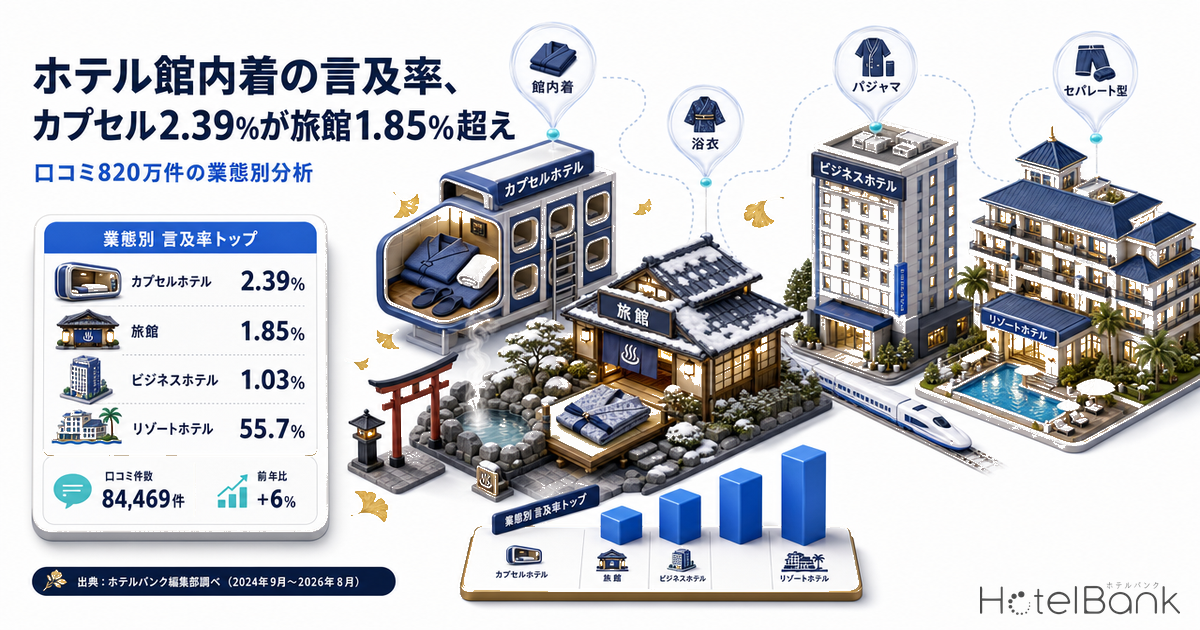
The review data is revealing in a slightly odd, very human way. In a dataset of 8,207,735 hotel reviews, capsule hotels mentioned katanas in 2.39% of reviews, while ryokan mentioned them in 1.85%. The same analysis found that clothing and yukata come up more frequently in ryokan reviews than in other accommodation types. None of this should be taken as literal proof that guests are measuring authenticity with a sword rack nearby. But it does suggest something useful: people use accommodation language to signal identity, expectation, and what feels distinctly Japanese. The choice is never just about the bed. It is about the texture of place, and about the story a stay lets you tell yourself afterward.
This is where Hotel vs. Ryokan: Was ist besser für deine Japan‑Reise? becomes a useful framing question rather than a slogan. The answer depends on whether you want the reassurance of the familiar or the ritual of the specific. One is not morally superior. One is simply more standardized, and the other more intentional.
Related choices worth considering
If you are building a trip around nights rather than just destinations, it helps to think in categories. A hotel works well when you want fast check-in, luggage storage, and easy access to stations, especially in dense urban areas. A ryokan makes more sense when you want the stay itself to be part of the destination, especially in hot spring towns, smaller resort areas, or places where evening meals and bath culture are central to the rhythm of the visit.
- Choose a hotel when you want convenience, consistency, and strong practical infrastructure.
- Choose a ryokan when you want tatami, futon, kaiseki, and a slower evening.
- Choose a ryokan if onsen access matters to you, but check tattoo policies first.
- Choose a hotel if you are arriving late, leaving early, or moving city to city.
- Choose either based on what kind of memory you want the stay to make.
If you are still weighing the cultural and practical trade-offs, it can help to think about the basic expectation of a ryokan guide: you are not only booking a room, you are booking a way of spending time. That is why terms like ryokan, tatami, futon, kaiseki, onsen, omotenashi, and yukata keep appearing around this topic. They are not decorative vocabulary. They are the machinery of the experience.
For readers who also want the hospitality angle, there is a useful comparison in the broader conversation around Capsule Hotels Mention Katanas More Than Ryokan, which points to how accommodation types get read as symbols as much as services. And if you are trying to decide between lodging styles more generally, the hotel-versus-ryokan question is tied to comfort, price, and atmosphere all at once. No single metric settles it.
Where to experience each style in Japan
To experience a hotel in Japan, look to major cities and transport hubs. Tokyo, Osaka, Kyoto, and Yokohama all have dense hotel inventories, from business properties to high-end international chains. That is where the standardized side of the market is easiest to feel: efficient lobbies, predictable rooms, and the plain relief of knowing the Wi-Fi will probably just work. To experience a ryokan, look toward traditional hot spring areas, countryside towns, and older district centers where the stay itself is meant to be part of the place. If the destination is built around bathing, seasonal food, and slower evenings, ryokan tend to make more sense there.
My practical advice is simple. If your trip is packed with trains, luggage, and early starts, use a hotel. If you want one night, or even two, that feel set apart from the rest of the itinerary, use a ryokan. Wear the lightest shoes possible, reduce the number of decisions, and let the stay do its own work. That is often enough.
Frequently Asked Questions
Is a hotel or ryokan cheaper in Japan?
Hotels are often cheaper and more standardized, with business hotels in major cities commonly around 8,000 to 15,000 JPY per night. A good ryokan with dinner and breakfast usually costs about 12,000 to 40,000 JPY per person.
What do you get at a ryokan that hotels usually do not offer?
Ryokan commonly offer tatami rooms, futon bedding set up by staff, kaiseki dinners, and often onsen access. The stay is designed around atmosphere as much as comfort.
Do ryokan always include hot springs?
No. Many ryokan offer onsen access, but not all do. When they do, baths are often separated by gender and sometimes by time slots, so it is worth checking the details before booking.
Are hotels in Japan a safer choice for first-time visitors?
Yes. Hotels are generally the safer, more comfortable choice when you want predictability, reliable Wi-Fi, larger beds, and 24-hour reception.
What Japanese terms should I know before booking a ryokan?
Useful terms include ryokan, tatami, futon, kaiseki, onsen, omotenashi, and yukata. They describe the core parts of the experience and the expectations around it.