What makes this story useful is the operator angle, not just the headline number. For anyone who loves ryokan culture, or is learning Japanese and wants the right vocabulary, this is a neat peek into how a traditional inn has to balance おもてなし (omotenashi, Japanese hospitality; attentive service), energy bills, and winter demand. Sounds good, right?
Ryokan winter heating costs, broken down room by room
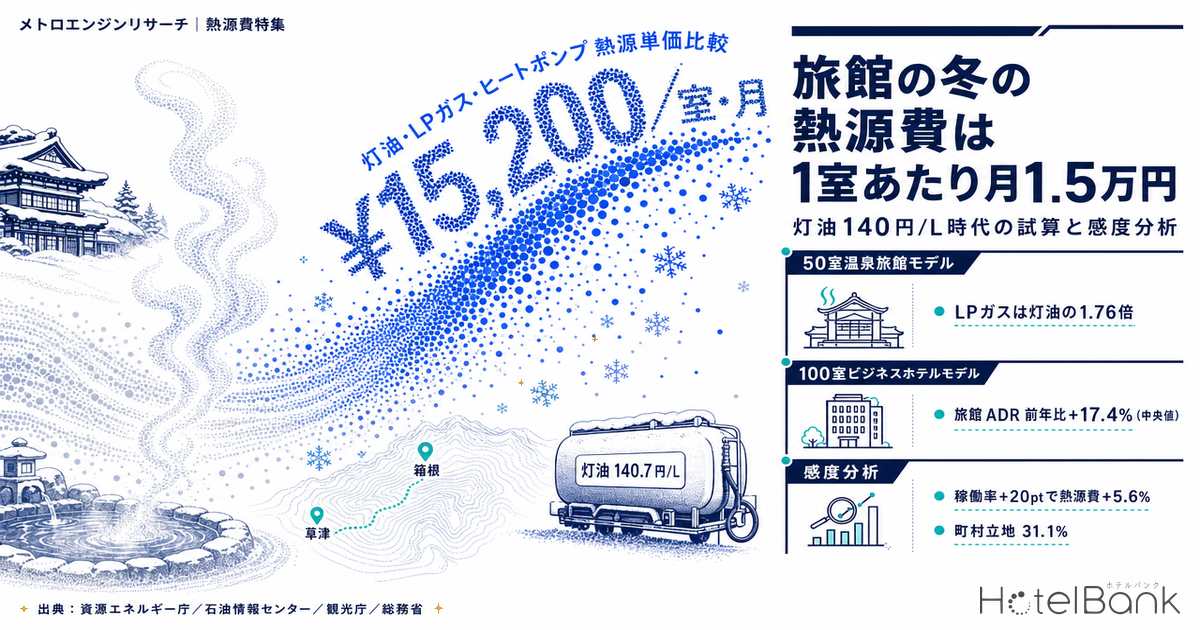
Ryokan winter heating costs aren't some vague “business expense” story, they can be calculated down to the room. According to Hotel Bank, a 50-room ryokan faces an average burden of 15,202 yen per room per month during the winter season, with the calculation covering November through March. The key fuel price used in the estimate is 140.7 yen per litre for heating oil. That’s a very specific setup, and it tells you how quickly a traditional inn’s operating costs can move when fuel prices shift. Wild, isn't it?
What many overlook is that ryokan aren't just “small hotels with 畳 (tatami, tatami mat).” Many still depend on oil-based heating systems, especially outside the biggest city centres, and that makes them sensitive to fuel price swings. In Japanese, heating is often discussed as 暖房 (danbo, heating), and when operators talk about winter pressure, they’re really talking about the cost of keeping guest rooms, baths, hallways, and dining spaces comfortable at the same time. My tip: if you’re learning Japanese, this is a great example of how business and everyday vocabulary overlap in real life. My verdict is that this is exactly the kind of niche number that tells you more than a general article ever could.
Why the 50-room model matters for operators
The first time I read a ryokan cost breakdown like this, what stood out was the scale. A 50-room property sits in an awkward but very common middle ground, large enough for fixed costs to bite, but not large enough to smooth them out easily. Unlike what we're used to with big chain hotels, a ryokan often has more service touchpoints, more traditionally heated spaces, and a stronger expectation of warmth in common areas, especially in winter.
Here’s the kicker: once you multiply the monthly per-room figure across a full property, the seasonal bill becomes a planning issue, not just a utility line item. For November to March, that 15,202 yen per room per month means operators are looking at a winter stretch where cash flow, occupancy, and heating efficiency all have to line up. For Japan fans, this also explains why some ryokan are so attentive to small comfort details, from 炬燵 (kotatsu, heated table with a blanket) in lounges to careful room prep before check-in. Simply brilliant.



On a related note, ryokan are part hospitality, part cultural asset. Guests come for the experience, not just the bed, so cutting heat too aggressively would hurt the very thing that makes the stay special. That tension is central to the business model, and it’s exactly why a cost calculation like this matters so much. Sounds good, right?
With and without subsidies: the real business question
To be fair, the most interesting part of this analysis is the scenario split, with and without support measures. The supplied report points to calculations under both subsidy and non-subsidy conditions, which is the right way to look at it because energy support can change the outcome fast. When a fuel subsidy is available, the effective burden on the ryokan drops, and that can be the difference between a manageable winter and a painfully tight one.
Quick detour: this is the kind of topic that often gets missed by casual Japan travellers. Guests might think about onsen, 浴衣 (yukata, light cotton robe; yukata), or the 会席料理 (kaiseki, traditional multi-course dinner) dinner, but the operator is watching the oil price just as carefully as the weather forecast. If heating oil sits at 140.7 yen per litre, then even a modest subsidy can matter a lot over several months. On the flip side, without support, the property has to absorb more of the cost directly, which can affect room pricing, staffing choices, or even how much of the building stays fully heated at once. My verdict is that this is where hospitality gets very real.
While we're at it, this also gives language learners a useful business-adjacent phrase set. Think of words like cost, support, burden, and calculation as practical Japanese-study bridges. A ryokan article like this is a reminder that Japanese isn’t only about anime or travel phrases, it also opens the door to reading actual industry reporting. Personally, I think that’s where progress starts to feel useful, not just cute. Not bad, right?
Frequently Asked Questions
How high are the winter heating costs for a 50-room ryokan?
According to Hotel Bank, the estimate is 15,202 yen per room per month during the winter period from November to March.
What fuel price is used in the calculation?
The calculation uses a heating oil price of 140.7 yen per litre.
Why do subsidies matter so much?
Because they can reduce the effective fuel burden over several months, which directly affects winter operating costs and pricing decisions.