Overview
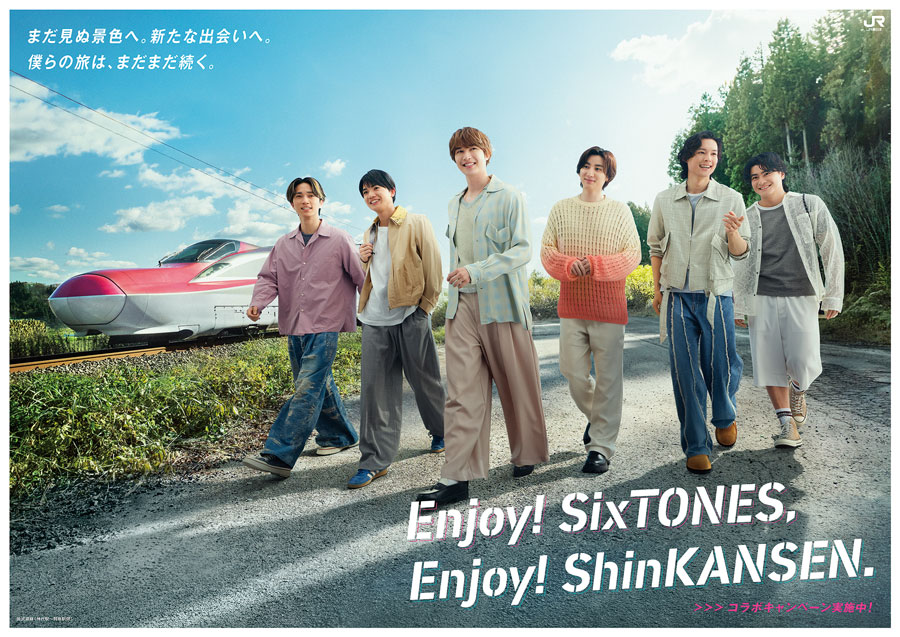
I first encountered the JR East SixTONES 新幹線 (shinkansen, bullet train; high-speed rail service) Campaign as part of a broader pattern I have come to notice in Japan: railway travel is rarely treated as mere transport. It is also a stage for seasonal imagery, music tie-ins, and the quiet persuasion of design. In this case, JR East has brought the pop group SixTONES back for a second phase under the Enjoy! Shinkansen banner, building on an earlier campaign that appears to have resonated strongly enough to continue.
SixTONES, who debuted in 2020, now serve as the face of the Shinkansen campaign. That choice says something about how contemporary Japanese marketing works when it is at its best. It does not simply borrow popularity; it tries to place a cultural current inside an existing ritual. The result is less a hard sell than a kind of companion piece to the journey itself.
For readers approaching this as JR East SixTONES Shinkansen Campaign news, the key point is straightforward: this is a recurring promotional collaboration, not a one-off stunt. For those looking for a JR East SixTONES Shinkansen Campaign guide, the useful question is how to understand the campaign in context, and how to follow it without treating it as isolated advertising. I think it helps to see it as a small watershed in JR East’s ongoing effort to connect rail travel with pop culture in a way that feels specific, not generic.
How the campaign fits JR East’s wider rail marketing
JR East has long understood that the Shinkansen is more than a train service. It is also a symbol of precision, movement, and the particular social choreography of travel in Japan. The Enjoy! Shinkansen branding places the emphasis on pleasure and anticipation, and SixTONES gives that feeling a recognizable human face. Rather than leaning on abstract claims, the campaign uses the group’s presence to make the act of boarding feel current and lightly ceremonial.
This is where the campaign becomes more interesting than a simple endorsement. JR East is linking railway travel with Japanese pop culture in a way that feels built for repeated use. A second phase suggests not only popularity, but a working formula: the earlier campaign created enough response to make continuation worthwhile. In a market where attention is often brief, that kind of return matters.
The campaign also belongs to a familiar Japanese media ecology in which 映像 (eizo, visual media; footage; moving images), meaning visual media and screens, helps shape how people encounter public space. Posters, videos, station displays, and campaign assets all contribute to the atmosphere around the journey. The train is still the train, but the frame around it has changed.
Why SixTONES works as the center of the collaboration
SixTONES debuted in 2020 and quickly became a strong pop presence. For a rail campaign, that matters because the group brings both recognition and a sense of movement. They are contemporary without feeling disposable, which is not a small distinction in Japanese branding. JR East is using SixTONES as the face of the Shinkansen campaign, and that role depends on more than fame. It depends on whether the group can carry a mood.
I have found that the most effective Japan collaborations often rely on a shared vocabulary of craft. In rail terms, that can mean timing, layout, and the disciplined use of image. In pop terms, it means a group whose identity is clear enough to translate across settings. SixTONES fits that need. Their presence gives the campaign a pulse, but not a noisy one.
There is also a practical logic here. Railway campaigns often have to speak to mixed audiences: regular commuters, travelers, fans, and people who may simply notice the visuals in passing. A group like SixTONES can bridge those audiences without requiring the campaign to over-explain itself. That is part of its strength.
What makes this kind of collaboration meaningful
At first glance, a Shinkansen promotion tied to a pop group may seem like a straightforward marketing move. Yet the Japanese setting gives it more texture. The train is a daily infrastructure, but also a site of formality and trust. A campaign like this asks whether pop culture can sit beside that infrastructure without flattening it. The answer, at least in this case, seems to be yes.
One reason is the familiarity of the surrounding rituals. A 予約 (yoyaku, reservation; booking), or reservation, is part of how many travelers encounter the Shinkansen. Posters, station signage, and campaign graphics become part of that process, folding entertainment into logistics. Another useful term here is おもてなし (omotenashi, wholehearted hospitality; attentive customer service), the kind of attentive hospitality often associated with Japanese service culture. The campaign does not replace that hospitality; it frames it, borrowing some of its warmth and order.
The story also reveals how Japanese promotional work can function as a kind of seasonal layer. A campaign begins, the public responds, and then the collaboration returns in a slightly different form. That recurrence matters. It suggests a dialogue rather than a single announcement, and it allows the audience to build memory around the experience.
Related titles and cultural touchpoints
For readers interested in the wider field around this campaign, there are several nearby touchpoints worth keeping in mind. JR East’s other Shinkansen promotions often show how railway branding can intersect with music, design, anime, or regional travel. More broadly, the Japanese pop industry frequently collaborates with transportation, retail, and tourism in ways that make the everyday feel curated for a moment.
If the appeal here is the presence of SixTONES, then it may also be useful to look at how newer idol and pop groups are positioned in public campaigns. Their role is often not simply to entertain, but to signal freshness, momentum, and accessibility. That can make them effective in settings that might otherwise feel purely functional.
For a reader using this page as JR East SixTONES Shinkansen Campaign japanisch lernen material, the campaign also offers a small vocabulary field. Shinkansen itself is a useful term, as are words like 親子 (oyako, parent and child; family pair) if one is discussing family travel contexts, though the stronger lesson here is less lexical than cultural. Public campaigns in Japan often teach through repetition: the same image, the same phrase, the same route, encountered again and again until it begins to feel natural.
How to follow the campaign and understand future phases
Because this is a recurring event, the best way to learn more is to watch how the campaign unfolds across JR East channels, station displays, and related promotional materials. The second phase matters precisely because it suggests there may be more to come, or at least more variations on the same theme. These campaigns are often cumulative. They build meaning through return.
When following a collaboration like this, I try to pay attention to three things: what image the company chooses, what audience it seems to address, and how long it expects the memory to last. In this case, the image is SixTONES, the audience is broad but attentive, and the memory is being encouraged to linger across more than one campaign cycle. That makes the project feel less like a splash and more like an ongoing arrangement.
If one wants a practical entry point, start with the latest campaign materials and then look back to the earlier phase that led here. The continuity tells the story. And so it became a plan.
Why the campaign matters beyond the platform
What I keep returning to is not only the popularity of SixTONES, but the way JR East has chosen to place that popularity in a public, shared environment. Rail travel in Japan remains deeply collective, even when each trip feels personal. Campaigns like this acknowledge that fact. They turn the station into a place where commerce, fandom, and transit briefly share the same air.
That may sound small, but small things carry weight in Japan, especially when they are repeated with care. A second campaign is not just a sequel. It is evidence that someone paid attention the first time, and decided the conversation was worth continuing.
For anyone seeking a clean JR East SixTONES Shinkansen Campaign guide, the simplest summary is this: it is an ongoing Enjoy! Shinkansen collaboration that uses SixTONES to make rail travel feel contemporary, memorable, and culturally connected. For anyone following JR East SixTONES Shinkansen Campaign news, the broader lesson is equally clear. In Japan, even a train campaign can become a story about taste, timing, and the patient work of recognition.