
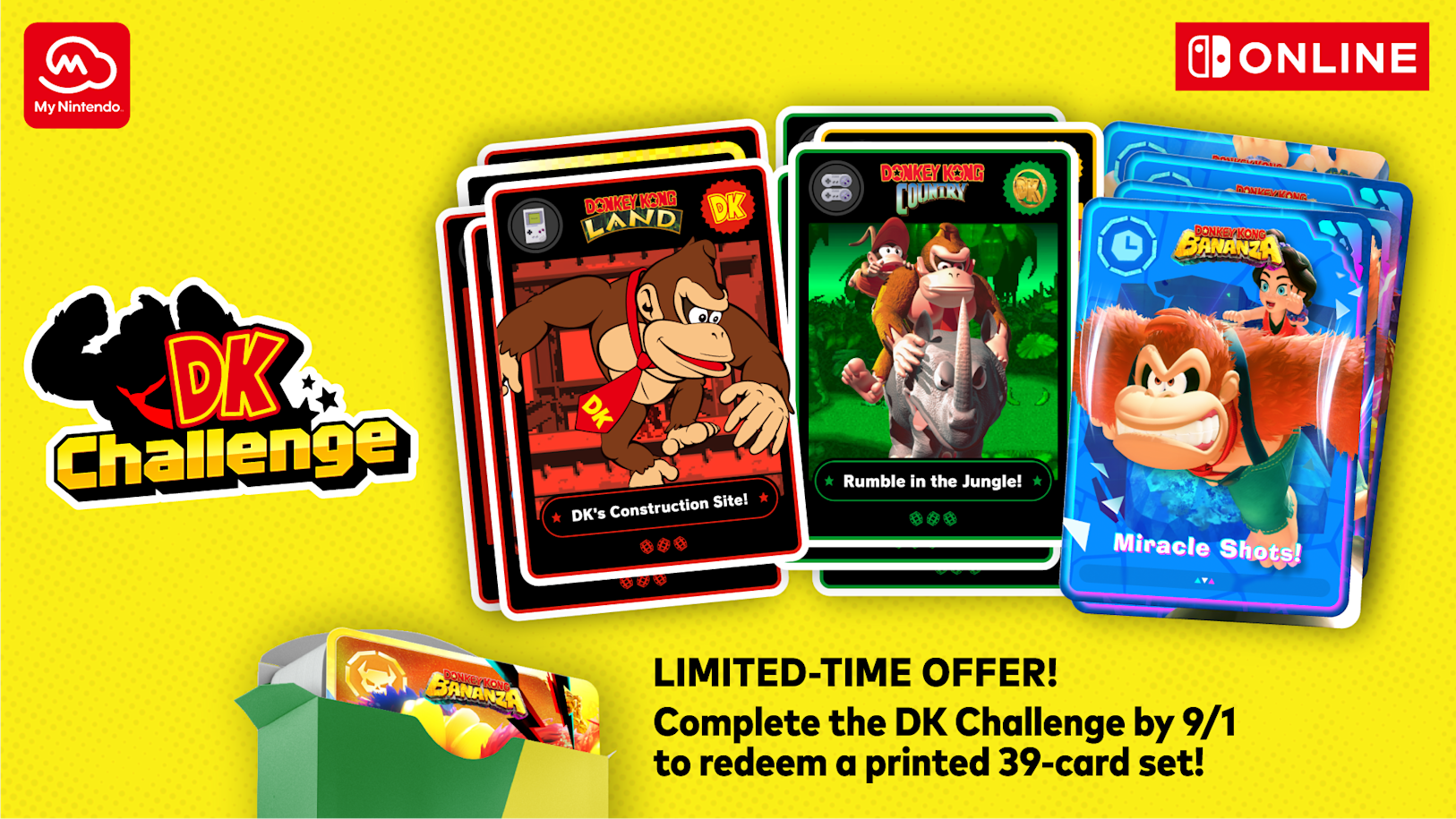
Here’s the thing: Nintendo didn’t have to make this collectible feel so specific. The cards tie into Donkey Kong Bananza and classic Donkey Kong history, which means the reward lands somewhere between promo item, fan service, and a mild nostalgia trap. Classic Nintendo, isn’t it?
![Dragon Ball Z: Kakarot [Master Edition]](https://s.pacn.ws/1/p/1eh/dragon-ball-z-kakarot-master-edition-908785.1.jpg?v=t8ja8t&width=400)


Nintendo turns the DK Challenge into something you can put on a shelf
Here’s the kicker: Nintendo is offering a physical reward for completing the DK Challenge, and it’s not a coupon, wallpaper, or one of those vague digital badges people forget about five minutes later. It’s a 39-card collectible set, plus a custom card case, for players who finish the full event before the deadline. That makes the reward feel oddly old-school in the best way. You do the work online, and Nintendo hands you something with actual presence.
The official Nintendo news post says eligible participants who complete the entire DK Challenge can get a collectible card set inspired by Donkey Kong Bananza and classic Donkey Kong adventures. My tip: that mix matters. Nintendo knows collectors love an item that sits right on the border between game merch and company history, because that’s where the long-tail appeal lives. Sounds weird, but it’s true.
And this is where it gets a little interesting. The challenge itself started as a digital event, with players unlocking digital challenge cards, so the physical reward feels like Nintendo taking a temporary online promotion and giving it a souvenir body. I’ve got a soft spot for that kind of thing. It reminds me of the little promotional cards you’d find tucked into game shops in Japan, the sort of object that looks disposable until you realise twenty years later that nobody threw it away.
Basically, Nintendo has taken a time-limited event and turned the finish line into a collectible. That’s good design for fans, and very good design for FOMO. Not subtle, but effective.
What the 39-card set means for collectors and players
Let me show you why this matters beyond the headline. A 39-card set isn’t tiny, and it isn’t the sort of thing you casually misplace in a desk drawer. The number itself gives the reward a real object logic, because it feels complete, organised, and designed to be kept together rather than broken up. The included custom card case pushes that idea even further. Nintendo isn’t just sending out loose cards, it’s framing them as a set with its own little home.
The third-party reporting from Nintendo Everything notes that only players who complete every mission in the DK Challenge before the event ends can receive the reward. That scarcity is doing a lot of work here. Free physical items from Nintendo usually create a little collector stampede, then vanish into resale listings and forum chatter. They spread like wildfire. They sell like hotcakes. They disappear into a handful of auction pages. That’s the pattern.
For Japanese learning fans, there’s also a neat vocabulary angle hiding in plain sight. 初回限定 (Shokai-gentei, limited initial release) means limited initial release, 収入 (shuunyuu, income; revenue) means revenue, and コレクター (korekusataa, collector) is the borrowed word you’ll hear around collectibles and hobby goods all the time. If you spend any time in Japanese game stores, the language around bonuses, bonuses-with-purchase, and limited runs comes up constantly. The words are simple. The psychology isn’t.
And yes, I do think the collectible angle is the real story here. The game challenge is the gate, but the card set is the thing people will show off, trade, or tuck into a binder and protect with unnecessary seriousness. I’ve seen grown adults baby a single event card like it was made of antique lacquer. Fair enough, honestly.
Why Nintendo keeps winning with physical extras
On the flip side, Nintendo is very good at understanding that a small physical reward can carry more emotional weight than a pile of digital checkmarks. A digital reward disappears into an account. A card set sits on a desk, gets photographed, gets displayed, gets rediscovered. That’s the difference between a reward and a memento.
For example, Japan’s pop-culture economy has always treated physical extras with unusual seriousness. Game centres hand out prizes, shops add purchase bonuses, and convenience store campaigns turn ordinary products into limited runs with tiny design changes. Nintendo isn’t inventing that habit, it’s just speaking fluent collector. Which means the DK Challenge reward feels very at home in the wider Japanese merch ecosystem, even if the event itself lives inside the digital Nintendo universe.
Oh, almost forgot: the timing also matters. According to the reports, the reward is tied to finishing the event before its end date, with some coverage saying the cutoff is September 1. Limited window, limited stock, limited patience. That combination always creates motion, and Nintendo knows it. The company has spent decades learning how to turn a game launch, a mission chain, or a special event into something people want to preserve rather than consume and forget.
My verdict: this is a small reward with outsized collector appeal. It’s also exactly the sort of thing that makes Nintendo feel less like a software publisher and more like a curator of objects. And I think that’s actually the story here, not the spec sheet but the way a simple card set can make a digital challenge feel worth keeping.
Wait, there’s more. If you want more Japan news on jpnerd.com, see the link below, and if you’re the sort of person who still enjoys a physical bonus tucked into a game campaign, you’re probably already halfway sold.


