For Japan fans and Japanese learners, this is a neat reminder that game tech, fan passion, and Japanese design all sit very close together. You can almost hear the word 提案 (teian, proposal; suggestion) in the background, because this is exactly the kind of bold fan-made proposal that keeps a classic alive.
![Dragon Ball Z: Kakarot [Master Edition]](https://s.pacn.ws/1/p/1eh/dragon-ball-z-kakarot-master-edition-908785.1.jpg?v=t8ja8t&width=400)

Guess what? The new BetterVR release for The Legend of Zelda: Breath of the Wild isn't just a quick camera trick. It is a full VR conversion for the Cemu emulator, with true stereo, six degrees of freedom, motion-controlled arms, and enough careful tuning to make Hyrule feel like a place you can actually stand inside.
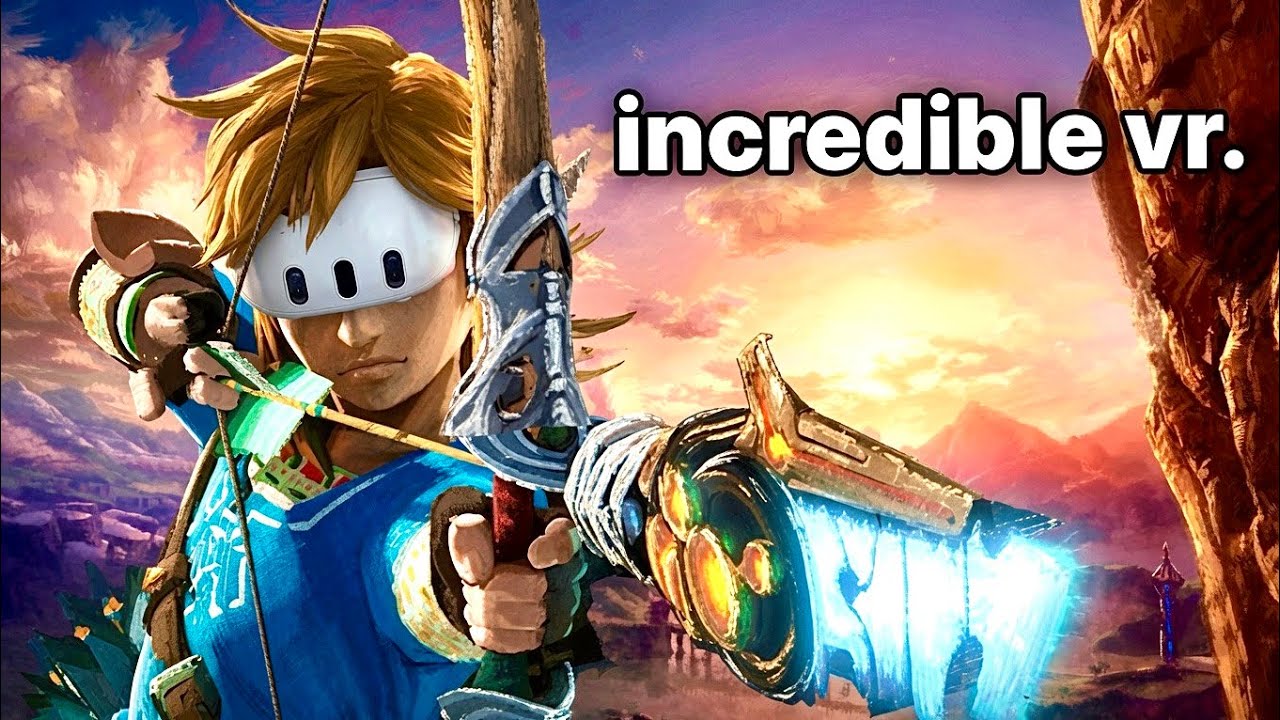
And that matters, because BotW wasn't built as a VR game. Nintendo shipped it in 2017 for Nintendo Switch and Wii U, with a design language built around distance, sightlines, and the freedom to climb almost anything. BetterVR takes that flat-screen structure and bends it into something else, without losing the feel of the original world. Wild, isn't it?
What makes this project stand out is not only the result, but the method. According to coverage from Wccftech, the mod took thousands of hours of reverse engineering. That number makes sense once you think about what had to be solved: rendering, head tracking, hand movement, camera stability, menu handling, and all the tiny pieces that stop a flat game from working in VR. No exaggeration: this is the kind of fan project that behaves more like a long-term software archaeology effort than a weekend mod.
For Japanese learners, there is even a language angle here. The word for reverse engineering is 逆襲 (gyakushu, counterattack; retaliatory strike) in some casual online contexts, but in technical Japanese you will also see リバースエンジニアリング (ribaasu enjiniaaringu, reverse engineering), adapted from English. And that fits the project perfectly, because BetterVR isn't a simple skin or reshade. It is a patient rebuild of how the game is perceived, frame by frame. My tip: if you like game-related Japanese vocabulary, this is a great moment to learn terms like VR, 精度 (seidou, precision; accuracy), and エンジン (enjin, engine), because they show up everywhere in Japanese tech talk.
On a related note: fans of Japanese game design will recognise the philosophy behind all this. Zelda games often feel elegant because their systems are tightly connected, from stamina and climbing to weather and enemy placement. BetterVR had to respect that structure. If the camera drifted, the sense of scale would break. If Link's hands looked wrong, immersion would collapse. If menus became unreadable, the whole project would feel clumsy. So the mod is really a test of whether a Japanese-designed game engine can survive being reinterpreted for a completely different medium. And it does, impressively so.
BetterVR and the BotW VR conversion challenge
To be fair: a lot of fan VR projects start with ambition and end with discomfort. BetterVR is different because it focuses on making the game readable, playable, and surprisingly natural inside a headset. The mod renders the world in stereo, so each eye gets its own image, and that gives Hyrule real depth. Mountains no longer look like distant wallpaper, and shrines gain an almost tactile presence. If you've ever visited a Japanese temple and noticed how the steps, lanterns, and stone paths change as you move, you already understand the kind of spatial feeling VR is trying to capture.
Why BotW is such a tough VR target
Here's the catch: BotW is full of systems that assume a normal display. The camera can pull back for climbing, combat, or gliding. The world streams huge distances. Link's body is often implied rather than fully represented. That means the mod has to translate not only graphics, but interaction logic. BetterVR gives Link arms that follow the player, which sounds simple until you realise how many animations, collision rules, and perspective problems sit underneath that one feature.
And it gets better: the project has kept evolving through many releases, with VR.org noting that it is still being refined years later, not frozen at some rough first version. That tells you something about the creator's mindset. This isn't a one-off showcase. It's ongoing craftsmanship, and that's very Japanese in spirit, even if the code is global.
Thousands of hours of reverse engineering Zelda's engine
Plot twist: the heart of this project isn't VR hardware at all. It's the Zelda engine. BetterVR had to learn how BotW's technical core thinks, then persuade it to behave in a new way. That means figuring out rendering pipelines, animation timing, player input, and the assumptions the game makes about where the camera should sit. If one variable is off, motion sickness appears fast, and the magic is gone.
The reverse engineering work is especially impressive because BotW isn't a small title. It is one of Nintendo's most technically admired open-world games, built with a level of systemic polish that players still study years after release. The modder, known as Crementif, has effectively spent years decoding that logic so it can survive inside a headset. Let's be honest: most people will never do anything this stubborn for a free mod. That stubbornness is exactly why the result is so cool.
There is also something very Japanese about the patience here. In Japan, people often talk about 職人 (shokunin, craftsman; artisan) spirit, the craftsman's mindset, where repetition and precision matter more than flashy claims. BetterVR feels like that. It isn't trying to replace Nintendo's original vision, only to extend it with near-obsessive care. Personally, I love that kind of work, because it shows respect rather than rebellion.
Zelda engine, VR design, and what fans should watch next
Here's the kicker: BetterVR is not only a Zelda story. It is a broader reminder that old engines can still surprise us when someone understands them deeply enough. The same technical curiosity that lets a learner pick apart a Japanese sentence, 漢字 (kanji, kanji; Chinese characters) by kanji, is at work here. First you notice the surface, then the structure, then the hidden rules. Hyrule in VR is a bit like that.
And there is more on the horizon. Coverage from Wccftech says Mario Kart 8 is also coming to the BetterVR project. If that happens, the implications are huge, because racing games in VR live or die on camera work and speed perception. The idea alone shows how far this mod has already travelled from a simple experiment to a platform-level project. Convinced yet?
For Japan fans, this is also a lovely example of how Japanese games travel beyond Japan and keep evolving in fan hands. A Nintendo game made in Kyoto in 2017 is now being rebuilt by a community that spans continents, languages, and hardware setups. That mix of precision, patience, and pure enthusiasm is exactly why the Zelda series still has such a strong pull. Classic Japan, isn't it?
Frequently Asked Questions
What is BetterVR?
BetterVR is a fan-made VR mod for The Legend of Zelda: Breath of the Wild on the Cemu emulator.
Why is this mod such a big deal?
It turns a game not designed for VR into a full stereo, six-degree-of-freedom experience with motion-style arm tracking.
Is the project finished?
No. It has been developed over years and is still being refined with new releases.